
No products in the cart.
Why Does a Stepper Motor “Whistle”? Driver Frequency Settings and Solutions

Contents
- Stepper Motor Whistling Sound: Driver Frequency Settings and Solutions – Introduction and Technical Analysis Stepper motors, indispensable components in industrial automation, are favored in numerous applications for their ability to provide precise positioning and speed control. Used across a wide spectrum, from robotic systems and CNC machines to 3D printers and textile machinery, these motors are generally known for their reliable and robust construction. However, field engineers and operators frequently encounter a sometimes bothersome issue: the “whistling” sound the motor emits during operation. This sound is not merely a source of noise pollution; it can also carry important clues about the system’s overall performance, energy efficiency, and even longevity. This technical article and field guide will delve into the source of this audible noise from stepper motors, specifically explaining its relationship with driver frequency settings, and offering practical solutions for industrial automation professionals. Our objective is to elucidate the physical and electrical principles behind this complex phenomenon, helping to design quieter, more efficient, and more reliable automation systems. We will approach the subject from a broad perspective, covering everything from stepper motor operating principles to driver PWM switching techniques, mechanical resonances, and microstepping strategies, enabling you to understand the root causes of field problems and implement lasting solutions. Stepper Motor Whistling Sound: Operating Principle and Technical Data
- Field Considerations for Stepper Motor Whistling: Driver Frequency Settings and Solutions
- Common Issues and Solutions for Stepper Motor Whistling
- Conclusion and Expert Advice on Stepper Motor Whistling
- FAQ
Stepper Motor Whistling Sound: Driver Frequency Settings and Solutions – Introduction and Technical Analysis
Stepper motors, indispensable components in industrial automation, are favored in numerous applications for their ability to provide precise positioning and speed control. Used across a wide spectrum, from robotic systems and CNC machines to 3D printers and textile machinery, these motors are generally known for their reliable and robust construction. However, field engineers and operators frequently encounter a sometimes bothersome issue: the “whistling” sound the motor emits during operation. This sound is not merely a source of noise pollution; it can also carry important clues about the system’s overall performance, energy efficiency, and even longevity. This technical article and field guide will delve into the source of this audible noise from stepper motors, specifically explaining its relationship with driver frequency settings, and offering practical solutions for industrial automation professionals. Our objective is to elucidate the physical and electrical principles behind this complex phenomenon, helping to design quieter, more efficient, and more reliable automation systems. We will approach the subject from a broad perspective, covering everything from stepper motor operating principles to driver PWM switching techniques, mechanical resonances, and microstepping strategies, enabling you to understand the root causes of field problems and implement lasting solutions.
Stepper Motor Whistling Sound: Operating Principle and Technical Data
As their name suggests, stepper motors are brushless DC motors that rotate in discrete steps in response to electrical pulses. Inside these motors, there are stator windings and a magnetic rotor. The driver applies current sequentially to the stator windings, creating magnetic fields that pull the rotor to a specific angular position. Each electrical pulse causes the motor to advance by a certain “step.” The size of this step depends on the motor’s physical structure, typically 1.8 degrees or 0.9 degrees. However, for more precise control in modern applications, microstepping technology is widely used. Microstepping divides each full step into smaller substeps, allowing the motor to rotate more smoothly and offer higher positioning accuracy. This is achieved by the driver adjusting the current in the stator windings in a waveform similar to a sine wave. While this process helps reduce mechanical vibrations of the motor, it does not completely eliminate sound generation.
Another significant factor is resonance. Stepper motor systems have both electrical and mechanical resonance points. Mechanical resonance is the tendency of the motor or its connected load to naturally vibrate at certain frequencies. If the motor’s step frequency or the driver’s PWM frequency coincides with one of these natural resonance frequencies, the vibration amplitude increases significantly, leading to an intensification of the sound. Electrical resonance relates to the interaction between the inductance of the motor windings and the capacitance of the driver. Advanced algorithms and anti-resonance features in drivers are designed to prevent this situation, but they may not always be sufficient. Particularly at low speeds or within specific speed ranges, the motor entering resonance can cause excessive noise and vibration, in addition to step losses and torque drops. Therefore, optimizing driver frequency settings, microstepping ratios, and mechanical mounting is critically important for both reducing noise and enhancing system performance.
| Parameter | Value/Description |
|---|---|
| PWM Switching Frequency | The pulse width modulation frequency used by the driver for current control. Typically in the 16 kHz – 60 kHz range; if it falls within the human audible range, it creates a whistling sound. |
| Microstep Resolution | How many substeps the motor divides one full step into. For example, 1/16, 1/32, 1/256 microsteps. Higher resolution ensures smoother and quieter operation. |
| Motor Phase Current | The maximum current applied to each motor phase. Directly affects torque and is set by the driver. Excessive current heats the motor, insufficient current leads to torque loss. |
| Motor Inductance (L) | The resistance of motor windings to current change. High inductance can cause torque drop at high speeds. Important for driver selection. |
| Resonance Frequency | The natural vibration frequency of the motor or system. Operating at these frequencies can cause excessive noise and vibration. Anti-resonance algorithms aim to reduce this. |
| Noise Level (dB) | The intensity of the sound produced by the motor during operation. Must be kept within acceptable limits in industrial environments. Can be reduced through optimization. |
| Driver Supply Voltage | The DC voltage supplying the driver. Higher voltages allow the motor to respond faster and provide more torque at high speeds. |

Field Considerations for Stepper Motor Whistling: Driver Frequency Settings and Solutions
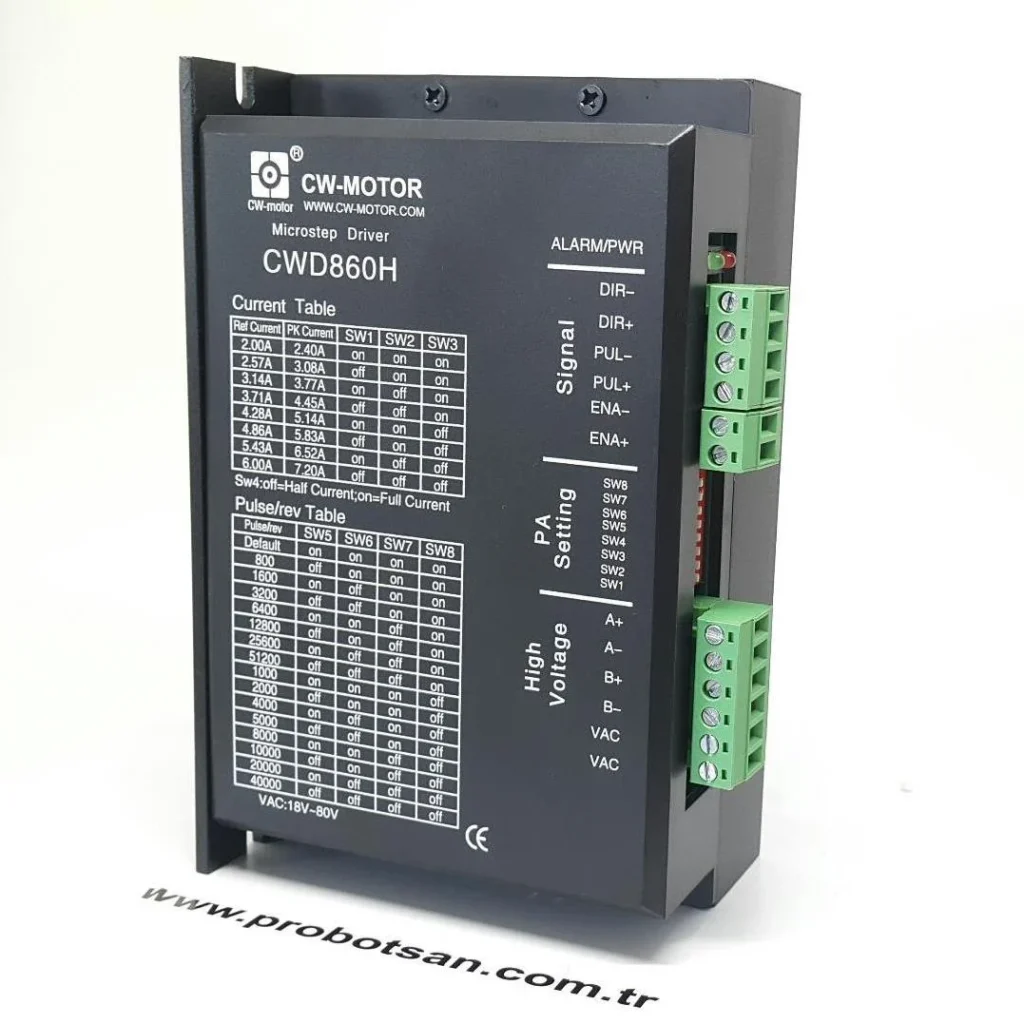
- Driver Selection and Compatibility: In stepper motor systems, the compatibility between the motor and the driver is critically important. The driver must be suitable for the motor’s rated current and inductance. For high-performance applications, advanced DSP-based drivers or closed-loop drivers should be preferred. These drivers typically offer higher PWM switching frequencies (e.g., above 40 kHz) or automatic resonance damping algorithms, significantly reducing noise. The microstepping resolution provided by the driver also directly affects the motor’s smoothness and quietness.
- PWM Frequency Settings: Many modern stepper motor drivers allow the user to adjust the PWM switching frequency. If your driver offers this feature, moving the frequency outside the human audible range (generally above 20 kHz) is one of the most effective ways to eliminate the whistling sound. This setting is usually made through the driver’s software interface or via DIP switches. While lowering the frequency too much can negatively affect motor performance and torque, adjustments are typically made to increase it. However, higher frequencies can lead to more heat generation in the driver, so thermal management must be considered.
- Microstepping Optimization: Microstepping not only increases the motor’s step accuracy but also ensures smoother motor operation, thereby producing less mechanical vibration and noise. Higher microstepping ratios (e.g., 1/16, 1/32, 1/256) generally result in quieter operation. However, very high microstepping ratios, especially in low-speed applications, can lead to torque loss or “blurry” motor movement. It is important to find the optimal microstepping ratio by considering the balance between the precision and torque requirements of your application. Trial-and-error and testing processes are beneficial at this point.
- Mechanical Mounting and Vibration Damping: The mechanical structure to which the motor is attached can also influence the intensity of the sound. Loose mounts, weak chassis, or materials prone to resonance can amplify vibrations produced by the motor. Mounting the motor on a solid, vibration-damping surface, using anti-vibration motor mounts or rubber isolators, can significantly reduce noise. Additionally, correct selection and alignment of couplings and other mechanical connection elements contribute to the overall quietness of the system.
- Motor Load and Resonance Zones: The load conditions under which the motor operates can change the resonance points. It is possible for the motor to enter resonance and produce excessive sound at certain speeds or under load. For such situations, anti-resonance algorithms or digital damping features offered by drivers can be used. These features dynamically adjust the current waveform at specific resonance frequencies of the motor to reduce vibration and sound. If necessary, adjusting the system’s speed profile to avoid resonance zones can also be a solution.
- Cable Quality and Length: The quality and length of stepper motor cables can also affect electrical noise and EMI (Electromagnetic Interference). Long and unshielded cables can act like antennas, radiating the driver’s high-frequency switching signals, causing interference in other surrounding electronic devices and leading to unwanted electrical resonances in the motor itself. Using shielded cables where possible and keeping cable length to a minimum helps reduce electrical noise and, consequently, the sound produced by the motor.
Common Issues and Solutions for Stepper Motor Whistling
When working with stepper motors in the field, the “whistling” sound or other noise problems usually stem from a few fundamental causes. These issues and their practical solutions are detailed below:
Problem 1: High-Frequency Continuous Whistling Sound (Independent of Operating Speed)
Cause: This type of whistling sound typically occurs when the PWM switching frequency of the stepper motor driver falls within the human audible range (approximately 2 kHz – 20 kHz). The driver continuously switches at this frequency to control the current in the motor windings, leading to rapid changes in the motor’s magnetic field, and consequently, micro-vibrations in the laminations and other metal parts. These vibrations are then emitted as an audible sound.
Solution: The most direct solution is to adjust the driver’s PWM switching frequency to move it outside this range. In most modern drivers, this setting can be made via a software interface or physical DIP switches. Increasing the frequency above 20 kHz (e.g., 40 kHz, 60 kHz, or higher) will make the sound completely inaudible. However, higher switching frequencies can lead to more power loss and heat generation in the driver, so the driver’s thermal capacity and cooling measures must be considered. If your driver does not offer this adjustment or it is insufficient, using new-generation drivers with higher switching frequencies or those optimized for “silent operation” can provide a permanent solution.
Problem 2: Excessive Noise and Vibration at Low Speeds or within a Specific Speed Range
Cause: The motor operating excessively noisy and vibrantly at low speeds or within a specific speed range is typically related to mechanical or electrical resonance. At these speeds, the motor’s step frequency or the driver’s excitation frequency coincides with one of the system’s natural resonance frequencies. This situation increases vibration amplitude, reduces motor torque, and can lead to step losses.
Solution: Several approaches are available to solve this problem. Firstly, increasing the microstepping ratio can ensure smoother motor operation, thereby reducing resonance effects. For example, moving from full step to 1/8 or 1/16 microstep usually provides a significant improvement. Secondly, it is important to enable or optimize anti-resonance algorithms found in many advanced drivers. These algorithms dynamically adjust the current waveform at frequencies where the motor enters resonance, damping the vibration. Thirdly, if possible, adjusting the system’s speed profile to avoid resonance zones (i.e., preventing the motor from operating at these critical speeds for extended periods) can be a temporary or permanent solution. Finally, reinforcing the motor’s mechanical mounting, using vibration-damping isolators or spacers, is also effective in reducing noise caused by resonance.
Problem 3: Humming/Grinding Sound Under Motor Load or During Acceleration/Deceleration
Cause: Humming or grinding sounds produced by the motor under load or when its motion dynamics change (acceleration/deceleration) are generally associated with insufficient torque, step losses, or the motor being overstressed. This occurs when the motor’s magnetic field tends to lose synchronization with the rotor.
Solution: First, it is necessary to check the driver’s motor current settings. Ensure that an adequate current level, appropriate for the motor’s rated current, is set. Insufficient current leads to torque loss. Secondly, evaluate whether the motor meets the application’s torque requirements. If necessary, selecting a higher torque motor or using a geared system can solve the problem. Thirdly, setting smoother acceleration and deceleration ramps can reduce sudden load changes on the motor, preventing such sounds. Using a closed-loop driver with the motor can minimize such problems by detecting and correcting step losses and providing more precise torque control.
Problem 4: Electrical Interference (EMI) and Noise from Cabling
Cause: The high-frequency switching operations of stepper motor drivers can emit electromagnetic interference (EMI) into their surroundings. These interferences can propagate through motor cables, leading to unwanted noise in the motor itself or in other nearby electronic devices. Poor quality, long, or unshielded cables exacerbate this effect.
Solution: For such problems, using shielded motor cables and properly grounding the shield at the driver side is critical. Keeping cable length as short as possible and routing power cables separately from signal cables also reduces interference. Enclosing the driver in a metal enclosure or using EMI filters to improve electromagnetic compatibility are also effective solutions. Furthermore, ensuring that the driver and motor are properly grounded is a fundamental step in reducing electrical noise.
Conclusion and Expert Advice on Stepper Motor Whistling
The “whistling” sound from stepper motors is a common issue in industrial automation applications, but it can be largely managed with the right approaches. This sound is primarily caused by factors such as the PWM switching frequency of stepper motor drivers falling within the human audible range, interaction with the resonance frequencies of the motor and mechanical system, and inadequate microstepping. As an expert field engineer, my advice is to approach this problem with a holistic strategy, rather than a single solution. The first step is to conduct a detailed analysis of the existing system: the motor’s technical specifications, the driver’s capabilities, the condition of the mechanical mounting, and the dynamic requirements of the application must be meticulously examined. If it is possible to shift the PWM frequency above 20 kHz via driver settings, this is often the fastest and most effective solution. However, not every driver offers this flexibility, or high frequencies might cause excessive heating in the driver. In such cases, optimizing microstepping ratios can reduce noise by ensuring smoother motor operation.
At a more advanced level, identifying the system’s resonance points and enabling or optimizing the driver’s anti-resonance algorithms plays a critical role in eliminating humming and vibrations, especially those occurring at low speeds. The robustness of the mechanical mounting and the use of vibration-damping elements should also not be overlooked, as micro-vibrations produced by the motor can easily be amplified by an improper mounting. For long-term and high-performance applications, investing in advanced DSP-based or closed-loop drivers not only reduces noise but also provides higher torque, better positioning accuracy, and overall system stability. It should be remembered that every automation system is unique, and the best solution is often achieved through a combination of different approaches. Therefore, allocating sufficient time for testing and verification processes, combined with field experience, will guarantee the most efficient and quiet operating conditions. In the future of industrial automation, silent and efficient systems will not only enhance environmental comfort but also offer significant advantages in terms of energy efficiency and longevity.
FAQ
Why does my stepper motor make a whistling sound?
The primary cause of a stepper motor whistling is typically the Pulse Width Modulation (PWM) switching frequency of its driver falling within the human audible range (2 kHz – 20 kHz). This rapid switching causes micro-vibrations in the motor's magnetic field and mechanical components, which are perceived as a whistling or humming sound.
What are the main solutions to eliminate stepper motor noise?
To reduce the whistling sound, you can adjust the driver's PWM switching frequency to above 20 kHz, optimize microstepping ratios for smoother operation, enable anti-resonance algorithms in advanced drivers, improve mechanical mounting with vibration-damping elements, and ensure proper cable shielding and grounding.
How do driver frequency settings impact stepper motor noise?
PWM frequency is the rate at which the driver switches current to the motor windings. If this frequency is within the audible range, it causes the motor to vibrate and produce sound. Adjusting it above 20 kHz (e.g., 40 kHz or 60 kHz) moves the noise out of human hearing, making the motor operate more quietly.
How does microstepping help in reducing noise from stepper motors?
Microstepping divides each full motor step into smaller substeps, resulting in smoother motor movement. This reduction in abrupt motion minimizes mechanical vibrations and resonance effects, leading to significantly quieter operation, especially at lower speeds.
What is resonance in stepper motor systems and how does it contribute to noise?
Resonance occurs when the motor's step frequency or the driver's excitation frequency matches the natural vibration frequency of the motor or its mechanical system. This amplifies vibrations, leading to increased noise, reduced torque, and potential step losses. Advanced drivers often have anti-resonance algorithms to counteract this.