


































































































TB6600, DM542, and Leadshine Stepper Driver Differences: An Industrial Automation Field Guide
📑 Table of contents (Click to open)
- TB6600, DM542, and Leadshine Stepper Driver Differences: An Industrial Automation Field Guide
- Introduction and Technical Analysis
- Operating Principle and Technical Data
- TB6600 Stepper Driver
- DM542 Stepper Driver (and Similar Digital Drivers)
- Leadshine Stepper Drivers: Advanced Industrial Solutions
- Comparative Analysis: TB6600 vs. DM542 vs. Leadshine
- Choosing the Right Stepper Driver for Your Industrial Application
- For Entry-Level and Hobbyist Applications: TB6600
- For Mid-Range Industrial and Professional Prototyping: DM542 (and Similar Digital Drivers)
- For High-Performance Industrial and Demanding Applications: Leadshine
- Key Considerations for Selection
- Conclusion
- FAQ
TB6600, DM542, and Leadshine Stepper Driver Differences: An Industrial Automation Field Guide
Introduction and Technical Analysis
At the heart of industrial automation and motion control systems, stepper motor drivers play a critical role in ensuring precise and repeatable movements of machinery. Used across a wide spectrum, from production lines to robotic systems, CNC router machines to precise positioning platforms, stepper motor drivers are the electronic brains that directly influence the motor’s torque, speed, and positioning accuracy. While many different brands and models of stepper drivers are available on the market, TB6600, DM542, and Leadshine brands, in particular, exhibit significant differences in terms of performance, cost, and application range. This technical article and field guide aim to assist industrial automation professionals in selecting the right driver by providing a detailed analysis of these three popular stepper driver types. By offering a comprehensive perspective, from the fundamental operating principles and technical specifications of each driver to their ideal application areas and their advantages and disadvantages in the field, the goal is to help engineers, technicians, and system integrators choose the most suitable, reliable, and efficient stepper driver solution for their projects. The correct driver selection not only impacts the initial investment cost but also directly affects the system’s overall performance, energy efficiency, maintenance costs, and long-term operational reliability. This guide aims to be a comprehensive information source to support your decision-making processes.
Operating Principle and Technical Data
Stepper motor drivers are electronic devices that ensure a stepper motor rotates at specific angles by sending sequential current pulses to the motor windings via microprocessors or specialized integrated circuits (ASICs). The frequency of these pulses determines the motor’s speed; the pulse sequence determines the motor’s direction; and the number of pulses determines the distance the motor travels. Drivers typically operate on the principle of current control (constant current drive), attempting to keep the current flowing through the motor windings constant, which allows the motor to produce more consistent torque across all speed ranges. The unique architecture and control algorithms of each driver type make them suitable for different application scenarios and directly affect their performance.
TB6600 Stepper Driver
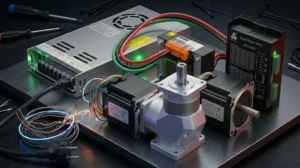
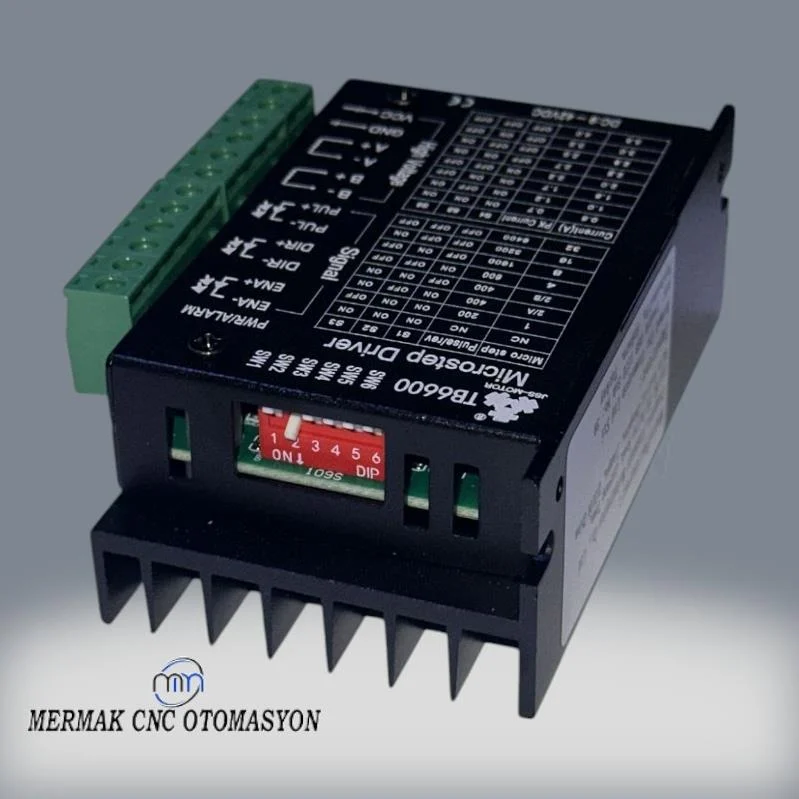
The TB6600 is a cost-effective stepper motor driver, typically based on Toshiba’s TB6600HG integrated circuit, often preferred for hobby-level and light industrial applications. It is commonly found in 3D printers, small-scale CNC machines, laser engraving machines, and various DIY (Do-It-Yourself) projects. Its operating principle relies on controlling the current by sending PWM (Pulse Width Modulation) signals to the motor windings. This driver can operate within a supply voltage range of 9V to 42V DC and typically offers a current output of 3.5A (RMS) to 4A (peak). Its micro-stepping capabilities generally range from 1/1 (full step) to 1/16, which can be sufficient for basic precision requirements. Its biggest advantages are its low cost and simple setup. Current and micro-stepping settings can be easily adjusted with user-friendly DIP switches. However, it has some limitations for long-term, high-performance operation in industrial environments. Issues such as torque loss at high speeds, increased motor noise, and overheating in cases of inadequate cooling can occur. Internal protection mechanisms (overcurrent, overtemperature) are generally at a more basic level and may require a more advanced solution for intensive industrial use.
DM542 Stepper Driver (and Similar Digital Drivers)
The DM542, rather than being a specific brand, represents a popular series of digital stepper motor drivers produced by many manufacturers such as JMC and Wantai, designed for industrial applications. Unlike the TB6600, these drivers utilize a more advanced DSP (Digital Signal Processor)-based control algorithm. This allows for significantly improved performance, especially in terms of smoothness, reduced motor vibration, and higher torque output at elevated speeds. DM542-type drivers typically operate with a wider voltage range, often from 20V to 50V DC, and can handle higher current outputs, commonly up to 4.2A (RMS) or 5.6A (peak), making them suitable for driving larger NEMA 17, 23, and 34 stepper motors. Their micro-stepping capabilities are also more extensive, often reaching up to 1/256, which provides much finer resolution and smoother motion, crucial for precision CNC router machines and industrial automation tasks. These drivers often include more robust protection features, such as overvoltage, undervoltage, overcurrent, and short-circuit protection, enhancing their reliability in demanding industrial environments. The DSP technology allows for advanced features like anti-resonance, which optimizes motor performance and reduces noise and vibration across various speed ranges. While slightly more expensive than the TB6600, the DM542 offers a superior balance of performance, reliability, and cost-effectiveness for a broad range of industrial applications, including professional-grade CNC milling machines, laser cutters, and pick-and-place robots. Configuration is typically done via DIP switches for basic settings, but some advanced models may offer PC-based software for more detailed parameter tuning.
Leadshine Stepper Drivers: Advanced Industrial Solutions
Leadshine is a globally recognized brand, renowned for its high-performance and highly reliable stepper and servo drive systems. Leadshine stepper drivers represent the pinnacle of industrial-grade motion control, offering a wide array of models (e.g., DM series, EM series, AM series) tailored for various industrial applications, from entry-level industrial CNC machines to high-precision manufacturing systems. Their drivers are characterized by sophisticated DSP control algorithms, often proprietary, which provide exceptional smoothness, minimal vibration, and maximum torque output across the entire speed range. Leadshine drivers typically support a broad voltage input, including both DC (e.g., 24-80VDC) and AC (e.g., 20-80VAC) options, and can deliver significantly higher current outputs, often up to 8A or even more, enabling them to drive very large NEMA 34, 42, and even NEMA 52 stepper motors. Micro-stepping resolutions can be extremely high, reaching up to 1/512 or 1/1000, ensuring ultra-smooth motion and very fine positioning accuracy, which is critical for applications requiring superior surface finish and intricate detailing. A key advantage of Leadshine drivers is their advanced feature set, which often includes:
- Anti-Resonance: Automatically filters out mechanical resonance, improving motor smoothness and torque.
- Self-Test and Auto-Configuration: Simplifies setup by automatically identifying optimal motor parameters.
- Multi-Stepping: Allows for low-resolution pulse input to be converted into high-resolution micro-steps, ensuring smooth motion without requiring high-frequency pulse generators.
- Input/Output Isolation: Provides robust electrical isolation for enhanced noise immunity and system protection.
- Advanced Protection Features: Comprehensive protection against overvoltage, overcurrent, undervoltage, short-circuit, and motor phase error.
- PC-based Tuning Software: Many Leadshine models come with dedicated software for detailed parameter configuration, diagnostics, and real-time monitoring, offering unparalleled control and optimization capabilities.
Leadshine drivers are the preferred choice for demanding industrial applications such as large-format industrial CNC router machines, plasma cutters, laser engravers, automated assembly lines, and robotics where precision, reliability, and high performance are non-negotiable. While they come at a higher price point than TB6600 or DM542 drivers, the investment is justified by their superior performance, durability, and advanced features that contribute to increased productivity, reduced downtime, and higher quality output in industrial settings.
Comparative Analysis: TB6600 vs. DM542 vs. Leadshine
To provide a clear understanding, let’s compare these three types of stepper drivers across several key industrial parameters:
| Feature | TB6600 | DM542 (and Similar) | Leadshine |
|---|---|---|---|
| Control Technology | Basic PWM, Analog | DSP-based Digital Control | Advanced DSP-based Digital Control (often proprietary algorithms) |
| Voltage Range | 9V-42V DC | 20V-50V DC (typical) | 24-80V DC / 20-80V AC (model dependent) |
| Current Output (Peak) | Up to 4A | Up to 5.6A | Up to 8A+ (model dependent) |
| Micro-stepping Resolution | 1/1 to 1/16 | 1/1 to 1/256 | 1/1 to 1/512 or 1/1000 |
| Smoothness & Vibration | Moderate, noticeable vibration at certain speeds | Good, reduced vibration due to DSP | Excellent, very smooth motion, minimal vibration |
| High-Speed Performance | Limited torque at higher speeds | Good torque retention at higher speeds | Excellent torque retention and high-speed stability |
| Protection Features | Basic (overcurrent, overtemp) | Robust (overvoltage, overcurrent, short-circuit) | Comprehensive (all above + motor phase error, I/O isolation) |
| Configuration | DIP switches | DIP switches (some models with PC software) | DIP switches & extensive PC-based tuning software |
| Typical Applications | Hobby CNC, 3D printers, small DIY projects | Mid-range CNC machines, laser cutters, industrial prototypes | Professional industrial CNC router machines, plasma, laser, robotics, automated manufacturing |
| Cost | Lowest | Medium | Highest (justified by performance and features) |
Choosing the Right Stepper Driver for Your Industrial Application
Selecting the appropriate stepper driver is crucial for the success and efficiency of any industrial automation project. The choice depends heavily on the specific requirements of your application, balancing performance, precision, reliability, and budget. Here’s a guide to help you make an informed decision:
For Entry-Level and Hobbyist Applications: TB6600
If your project involves small-scale motion control, such as a desktop 3D printer, a mini CNC router machine for prototyping, or educational robotics, the TB6600 offers a cost-effective solution. Its simplicity and low price point make it ideal for learning and experimentation. However, be mindful of its limitations regarding high-speed torque, potential for noise, and basic protection features. It is not recommended for continuous industrial operation or applications requiring high precision and reliability.
For Mid-Range Industrial and Professional Prototyping: DM542 (and Similar Digital Drivers)
For applications that demand more than what a hobbyist driver can offer but do not require the absolute top-tier performance of premium brands, the DM542 series is an excellent choice. These drivers are well-suited for:
- Mid-sized CNC router machines for woodworking or light metalworking.
- Industrial laser engraving and cutting machines.
- Automated dispensing systems.
- Pick-and-place machines with moderate speed and accuracy requirements.
- Upgrading existing systems from older, less efficient analog drivers.
The DSP-based control provides a significant improvement in smoothness, torque, and reliability compared to the TB6600, making them a solid workhorse for many professional industrial applications where budget is a consideration but performance cannot be compromised significantly.
For High-Performance Industrial and Demanding Applications: Leadshine
When your industrial application demands the highest levels of precision, speed, reliability, and advanced control features, Leadshine stepper drivers are the go-to solution. They are indispensable for:
- Large-scale industrial CNC router machines for heavy-duty milling, routing, and cutting of various materials.
- High-speed plasma and laser cutting systems where cut quality and throughput are paramount.
- Complex multi-axis motion control systems in robotics and automated manufacturing lines.
- Applications requiring extremely smooth motion, minimal vibration, and precise positioning, such as optical inspection systems or semiconductor manufacturing.
- Environments where robust protection against electrical noise and faults is critical.
The investment in Leadshine drivers pays off through enhanced machine performance, reduced maintenance, longer operational life, and superior product quality. Their advanced tuning capabilities allow for fine-grained optimization, ensuring your motion control system operates at its peak efficiency.
Key Considerations for Selection
When making your final decision, consider these critical factors:
- Motor Size and Current Rating: Ensure the driver’s current output matches or exceeds the rated current of your stepper motor.
- Voltage Requirements: The driver’s input voltage range must be compatible with your power supply and the motor’s voltage requirements. Higher voltage often translates to better high-speed performance.
- Micro-stepping Needs: For applications requiring very smooth motion and high resolution, opt for drivers with higher micro-stepping capabilities.
- Environmental Conditions: Consider the operating environment. Industrial-grade drivers like DM542 and Leadshine offer better protection against dust, moisture, and electrical noise.
- Budget: While cost is a factor, prioritize the long-term reliability and performance benefits over initial savings, especially for industrial applications.
- Ease of Configuration: For simpler projects, DIP switch configuration might suffice. For complex systems, PC-based tuning software offers greater flexibility and diagnostic capabilities.
- Technical Support and Availability: Leadshine, as a major brand, often provides extensive documentation and support. Consider the availability of spare parts and technical assistance for your chosen driver.
Conclusion
The choice between TB6600, DM542, and Leadshine stepper drivers boils down to a careful evaluation of your specific industrial application’s demands. The TB6600 serves as an entry-level option for hobbyists and light tasks. The DM542 series provides a robust, cost-effective solution for a wide range of mid-tier industrial applications, offering a significant performance upgrade. Leadshine drivers stand out as the premium choice for high-performance, high-precision industrial automation, delivering unparalleled reliability and advanced features. By understanding the technical nuances and application suitability of each, industrial B2B buyers can make an informed decision that optimizes their motion control systems for efficiency, precision, and longevity.
For expert advice on selecting the ideal stepper driver for your industrial CNC router machine or automation project, or to request a quote for high-quality motion control components, please contact Mermak CNC. Our team is ready to assist you in finding the perfect solution tailored to your specific needs. Request a quote on WhatsApp today!
FAQ
What are the main differences between TB6600, DM542, and Leadshine stepper drivers?
The TB6600 is a basic, cost-effective stepper driver suitable for hobby projects and light-duty applications like small 3D printers or DIY CNC machines. It offers basic micro-stepping (up to 1/16) and operates on lower voltage/current. The DM542 (and similar digital drivers) are industrial-grade, DSP-based drivers offering better smoothness, higher torque at speed, and more robust protection, ideal for mid-range CNC router machines. Leadshine drivers are premium industrial solutions with advanced DSP algorithms, extensive micro-stepping (up to 1/1000), superior high-speed performance, and comprehensive protection, designed for high-precision, heavy-duty industrial automation and large CNC systems.
Which stepper driver is best for an industrial CNC router machine?
For industrial CNC router machines, the DM542 series is generally a good starting point for mid-range applications due to its balance of performance, reliability, and cost. For high-performance industrial CNC machines, especially those requiring high precision, speed, and continuous operation, Leadshine drivers are highly recommended. The TB6600 is typically not suitable for industrial CNC applications due to its limited power, precision, and durability.
What factors should I consider when choosing a stepper driver for my industrial automation project?
Key factors include the current and voltage requirements of your stepper motor, the desired micro-stepping resolution for smoothness and precision, the required torque at various speeds, the operating environment (e.g., noise, dust), and your budget. Also, consider the level of protection features and the availability of advanced tuning options (like PC software) for optimization.
Are Leadshine stepper drivers considered industrial grade and reliable for heavy-duty use?
Yes, Leadshine drivers are widely regarded as a top-tier choice for industrial applications. They offer advanced features like anti-resonance, multi-stepping, and comprehensive protection, coupled with robust build quality and extensive tuning capabilities. This makes them ideal for demanding environments where precision, reliability, and high throughput are critical, such as in large-scale manufacturing and complex robotics.
Can I use a TB6600 stepper driver for a professional industrial application to save costs?
While the TB6600 is very affordable, its limitations in current output, voltage range, micro-stepping resolution, and protection features make it unsuitable for most industrial applications. It may lead to insufficient torque, poor precision, increased motor noise, and potential overheating under continuous industrial loads, resulting in downtime and reduced productivity.