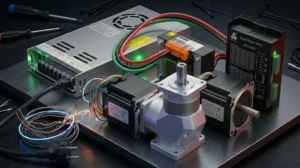




































































Should a Stepper Motor Driver Be Connected Close or Far to the Motor?
📑 Table of contents (Click to open)
- The Importance of Stepper Motor Driver Placement
- Signal Integrity and Noise Management: Advantages of Close Connection
- Impact of Short Cable Runs
- Electromagnetic Compatibility (EMC) and Noise Reduction
- Power Loss and Voltage Drop: Challenges of Remote Connection
- Cable Resistance and Heating
- Voltage Fluctuations and Motor Torque Loss
- Thermal Management and Environmental Conditions
- Driver Cooling and Lifespan
- Motor’s Operating Environment
- Cost and Installation Complexity
- Cable Costs and Cross-Section Selection
- Ease of Installation and Maintenance Access
- FAQ
Practical notes for CNC router, automation and industrial motion systems.
Stepper motors are fundamental components in industrial automation systems, essential for applications requiring precise positioning and motion control. A critical factor directly influencing their performance is the physical placement of the stepper motor driver. The decision of whether to connect the driver close to or far from the motor has wide-ranging implications, affecting everything from overall system efficiency and reliability to cost and ease of maintenance. This article will detail the strategies for stepper motor driver placement, their technical advantages and disadvantages, impacts on field applications, and key factors to consider when making the optimal decision.
The Importance of Stepper Motor Driver Placement
The position of a stepper motor driver is more than a simple preference regarding cable length; it’s a strategic engineering decision that profoundly impacts the holistic performance of an electromechanical system. This placement directly determines the quality of signals the motor receives, power loss, susceptibility to electromagnetic interference (EMI), and consequently, the motor’s precision, torque, and speed. Incorrect placement can lead to unexpected system errors, performance degradation, and even a shortened equipment lifespan.
When making this decision, various parameters must be evaluated together, including specific application requirements, environmental factors, cost constraints, and ease of maintenance. For instance, the optimal driver position for a high-precision CNC router machine might differ significantly from that for a long-distance conveyor system. In both scenarios, the best solution should maximize overall system efficiency and reliability.
Signal Integrity and Noise Management: Advantages of Close Connection
Positioning the stepper motor driver as close as possible to the motor offers critical advantages, particularly concerning signal integrity and noise management. Shorter cable runs ensure that control signals and power supply reach the motor with minimal degradation, allowing the motor to operate with greater precision and stability.
Short cable lengths minimize reflections and signal distortions caused by impedance mismatches in the transmission of both control signals (step/direction signals) and motor phase currents (A, B phases). Long cables can extend signal rise and fall times due to inductive and capacitive effects, potentially causing the motor to operate at lower speeds or with reduced torque. This can negatively impact the motor’s positioning accuracy, especially in micro-stepping applications with high-frequency step signals.

Impact of Short Cable Runs
Short cable runs significantly reduce electrical resistance, inductance, and capacitance. This ensures that step and direction signals sent from the driver to the motor experience less attenuation and distortion. Clean and strong signals reaching the motor enable it to accurately receive each step and maintain its precise positioning capability. Especially in high-speed or micro-stepping applications, signal integrity forms the foundation of motor performance.
Furthermore, short cables allow motor phase currents to be transmitted with lower voltage drop. This means the motor is supplied with a higher effective voltage at its terminals, enabling it to produce its nominal torque more efficiently. Voltage drop caused by long cables can lead to significant performance loss, particularly in stepper motors drawing high current.

Electromagnetic Compatibility (EMC) and Noise Reduction
Close connection plays a key role in enhancing the system’s electromagnetic compatibility (EMC) performance. The switched current waveforms of stepper motors are significant sources of electromagnetic noise. This noise can propagate through long cables to other sensitive electronic devices, causing interference and malfunctions in the system. Short cable lengths greatly reduce the potential for this noise to spread via antenna effect.
When short and well-shielded cables are used, both radiated and conducted emissions can be more easily controlled. This is vital for preventing critical components like PLCs, sensors, or communication lines in industrial environments from being affected. Close positioning can also potentially reduce the costs of additional filtering and shielding.
Power Loss and Voltage Drop: Challenges of Remote Connection
Positioning the stepper motor driver far from the motor introduces significant power loss and voltage drop issues. This not only reduces the system’s energy efficiency but can also prevent the motor from achieving its expected performance.
Long distances increase the resistance and inductance of cables, causing a portion of the electrical energy transmitted from the driver to the motor to dissipate as heat. This heat loss represents wasted energy and can lead to cables overheating, posing a safety risk. Additionally, drops in the motor’s operating voltage can prevent the motor from fully developing its nominal torque and speed, resulting in inadequate performance for the application.

Cable Resistance and Heating
Every electrical cable has a specific resistance depending on its length and cross-sectional area. As the distance between the driver and motor increases, so does this resistance. According to Ohm’s law (V=IR), a voltage drop (V) occurs across the cable when a certain current (I) passes through it. This voltage drop causes the motor to be supplied with a lower voltage at its terminals. Furthermore, the power dissipated across the cable resistance (P=I²R) is released as heat. This can lead to excessive cable heating, which raises serious safety concerns such as insulation degradation and fire risk.
Especially in high-current stepper motors and over long distances, this heat loss can become substantial. Engineers are often forced to use thicker (lower resistance) cables to minimize these losses, which negatively impacts cost and cable flexibility. High temperatures also shorten cable life and reduce overall system reliability.

Voltage Fluctuations and Motor Torque Loss
Resistance and inductance in cables can cause voltage fluctuations during sudden current draws (load changes or accelerations) when the motor is operating. The high inductance of long cables offers greater resistance to current changes, making it difficult for the driver to control the motor current at the desired level and speed. This can lead to delays or inadequacies in the motor’s torque production.
Low voltage at the motor terminal prevents the motor from generating a sufficiently strong magnetic field, thus failing to produce its full nominal torque. This torque loss can cause the motor to skip steps or stall, especially in applications operating under high loads or requiring dynamic response. This translates to production downtime and costly failures. Additionally, voltage drop can limit the maximum speed the motor can achieve.
Thermal Management and Environmental Conditions
The decision regarding stepper motor driver placement is not limited to electrical performance; thermal management and environmental factors are also crucial. Ambient temperature, humidity, dust, and vibration directly impact the equipment’s lifespan and reliability.
Proper thermal management prevents both the driver and motor from overheating, preserving their performance and lifespan. Environmental conditions necessitate selecting an appropriate enclosure and cooling system to protect the driver’s sensitive electronic components. Ignoring these factors can lead to unexpected failures and premature equipment aging.

Driver Cooling and Lifespan
Stepper motor drivers, containing switched power electronics circuits, generate significant heat during operation. Ineffective heat dissipation can lead to overheating of internal electronic components (MOSFETs, capacitors, etc.), shortening the driver’s lifespan. Every 10°C increase in temperature can approximately halve the lifespan of semiconductor components. Therefore, positioning the driver in a suitable environment with adequate cooling is vital.
Integrating the driver near the motor, within the machine body, can often provide a better thermal environment, as the machine body can act as a larger heat sink. However, if the motor’s operating environment already has high temperatures or the driver’s own cooling capacity is insufficient, placing the driver inside a cooler, controlled cabinet might be more sensible. In such cases, active cooling (fans, air conditioners) or passive cooling (large surface area heat sinks) measures should be implemented within the cabinet.
Motor’s Operating Environment
The motor’s operating environment also plays a significant role in determining the driver’s position. If the motor operates in a dusty, humid, vibrating, or extremely hot/cold environment, it might be more appropriate to place the driver in a more protected area away from these harsh conditions. For example, in a food processing plant where motors are exposed to high humidity and frequent washing, drivers are preferably located in a separate, sealed cabinet to prevent them from being affected.
In such situations, even if the cable distance between the driver and motor increases, protecting the driver from environmental factors can be more advantageous in terms of overall system reliability and maintenance costs. However, when making this decision, the performance losses associated with long cables and additional protective measures (industrial-grade cables, shielding) must be carefully evaluated.
Cost and Installation Complexity
The decision regarding stepper motor driver placement is not only about technical performance but also significantly impacts the total project cost and the complexity of the installation process. Many factors, from cable costs and assembly labor to maintenance access and future modification potential, influence this decision.
Engineering and procurement teams must balance initial investment costs with long-term operating and maintenance expenses. Sometimes, a higher initial cable cost can be amortized over the long term through fewer errors, higher efficiency, and lower maintenance expenditures. Therefore, conducting a comprehensive cost-benefit analysis is crucial.
Cable Costs and Cross-Section Selection
Cable costs increase non-linearly with the distance between the driver and motor. Longer distances mean more cable footage, and the need to use thicker cross-section cables to compensate for voltage drop and power loss. Thicker cables not only increase the cost per meter but can also reduce the cable’s bending radius and flexibility, making installation more difficult.
The cost of specialized shielded, multi-core, oil-resistant, and abrasion-resistant cables used in industrial environments can be quite high. The selection of these cables should be based not only on the motor’s current rating but also on environmental conditions and signal integrity requirements. Over long distances, cable costs can represent a significant portion of the project’s total budget.
Ease of Installation and Maintenance Access
The driver’s position directly affects system installation and future maintenance processes. Placing the driver close to the motor can reduce cabling time and complexity, but this might expose the driver to adverse environmental conditions such as heat, vibration, or contamination on the machine body. If frequent access to the driver is required (for parameter adjustment, fault diagnosis), an accessible location should be preferred. Conversely, placing the driver in a central control cabinet, while potentially increasing cable length, can offer a more controlled environment and easier access for maintenance personnel, especially in complex industrial CNC router setups with multiple axes.
FAQ
What are the main advantages of connecting a stepper motor driver close to the motor?
Connecting the stepper motor driver close to the motor generally improves signal integrity, reduces electromagnetic interference (EMI), and minimizes power loss due to shorter cable runs. This leads to more precise and stable motor operation, especially in high-speed or micro-stepping applications.
What are the disadvantages of connecting a stepper motor driver far from the motor?
Connecting the driver far from the motor can lead to significant power loss and voltage drop in the cables, reducing the motor's effective torque and speed. It also increases susceptibility to EMI and can cause signal degradation, potentially leading to inaccurate positioning or skipped steps.
What factors should be considered when deciding on the optimal placement for a stepper motor driver?
Consider the operating environment (temperature, humidity, dust, vibration), the need for maintenance access, and the overall project budget. If the motor operates in harsh conditions, a remote driver in a protected enclosure might be better, despite longer cable runs. For high-precision industrial CNC applications, close proximity is often preferred.
How do long cables affect stepper motor performance and system efficiency?
Longer cables increase resistance and inductance, leading to greater voltage drop and power dissipation as heat. This can result in lower effective voltage at the motor, reducing its torque and speed. It also increases cable costs and can make installation more complex.
Why is thermal management important for stepper motor drivers?
Proper thermal management is crucial because stepper motor drivers generate heat. Overheating can shorten the lifespan of electronic components. Placing the driver in a cool, well-ventilated area or within an enclosure with active cooling (fans) helps maintain optimal operating temperatures and extends equipment life.