
No products in the cart.
Differences Between Quality Stepper Motor Drivers and Cheap Drivers

Contents
- Introduction and Technical Analysis In motion control applications, which are at the heart of industrial automation systems, stepper motors and the stepper motor drivers that power them play a critical role. Stepper motors are preferred in many applications requiring precise positioning due to their open-loop control capabilities. However, the motor’s performance, lifespan, and the system’s overall reliability are directly proportional to the quality of the driver used. Within the wide range of products on the market, there are significant technical and operational differences between industrial-grade drivers, which can be described as “quality,” and budget-friendly drivers, referred to as “cheap.” This article will delve into these differences for industrial automation professionals, providing technical insights blended with field experience, and serving as a guiding resource for selecting the right driver. The aim is to highlight the potential risks and costs that focusing solely on initial cost can create in the long run. While cost optimization is always important in industrial applications, the consequences of compromising on quality in critical systems can often be much more severe than anticipated. In this context, a detailed comparison will be made, covering everything from the basic operating principles of drivers to their advanced features and field performance. Operating Principle and Technical Data
- Considerations in the Field
- Common Problems and Solutions
- Expert Advice
- Request a Quote on WhatsApp
- FAQ
Introduction and Technical Analysis
In motion control applications, which are at the heart of industrial automation systems, stepper motors and the stepper motor drivers that power them play a critical role. Stepper motors are preferred in many applications requiring precise positioning due to their open-loop control capabilities. However, the motor’s performance, lifespan, and the system’s overall reliability are directly proportional to the quality of the driver used. Within the wide range of products on the market, there are significant technical and operational differences between industrial-grade drivers, which can be described as “quality,” and budget-friendly drivers, referred to as “cheap.” This article will delve into these differences for industrial automation professionals, providing technical insights blended with field experience, and serving as a guiding resource for selecting the right driver. The aim is to highlight the potential risks and costs that focusing solely on initial cost can create in the long run. While cost optimization is always important in industrial applications, the consequences of compromising on quality in critical systems can often be much more severe than anticipated. In this context, a detailed comparison will be made, covering everything from the basic operating principles of drivers to their advanced features and field performance.
Operating Principle and Technical Data
Stepper motors are brushless DC motors that convert digital signals into mechanical rotational movements at specific angles. Each digital pulse causes the motor to rotate by a specific “step” angle. The precision and smoothness of these steps largely depend on the capabilities of the stepper motor driver. The primary function of the driver is to receive pulse and direction signals from the controller (PLC, microcontroller, etc.) and apply current to the motor windings with the correct phase and amplitude. This current control directly affects the motor’s torque, speed, precision, and vibration level.
Quality Stepper Motor Drivers typically feature the following advanced characteristics:
- Advanced Microstepping: Quality drivers offer high-resolution microstepping capabilities that can divide the motor’s nominal step angle into much smaller increments (e.g., 1/256 or 1/512 microsteps). This ensures smoother motor rotation, operation with lower vibration and noise levels, and much more precise positioning. It is indispensable for industrial robotics, CNC router machines, and precision positioning systems.
- Sinusoidal Current Control Algorithms: While basic drivers often use square wave current control, quality drivers apply sinusoidal current waveforms to the motor windings, optimizing motor torque, reducing resonance effects, and ensuring more efficient motor operation. This minimizes torque ripple, especially at low speeds.
- Anti-Resonance: Stepper motors can enter resonance at certain speeds, leading to torque loss, high vibration, and noise. Quality drivers detect these resonance frequencies with internal algorithms and automatically dampen them, ensuring stable operation.
- Dynamic Current Adjustment: These drivers incorporate intelligent algorithms that can automatically adjust the current based on the motor’s load condition and speed. This prevents unnecessary motor heating, increases energy efficiency, and extends the driver’s lifespan.
- Comprehensive Protection Functions: Critical protection mechanisms such as overcurrent, overvoltage, undervoltage, overtemperature, motor open circuit/short circuit, and phase error are standard. These protections safeguard both the driver and the motor from malfunctions, enhancing system reliability.
- Feedback and Closed-Loop Capability: They can continuously monitor the motor’s actual position with encoder feedback. This allows for servo-like performance by automatically correcting or preventing lost steps. Ideal for applications requiring high torque, speed, and positional accuracy.
- Industrial Communication Interfaces: They provide seamless integration with PLCs and other controllers via standard industrial protocols such as EtherCAT, Profinet, CANopen, and Modbus TCP/RTU. This offers centralized control and diagnostic capabilities in complex automation systems.
- High Efficiency and Low Heat Generation: Thanks to advanced power electronics components and optimized switching algorithms, they ensure less energy loss and lower heat generation. This reduces the need for external cooling and prevents thermal stress on other equipment in the control cabinet.
- User-Friendly Software and Auto-Tuning: They offer easy setup, parameter adjustment, and diagnostic capabilities through intuitive software. Some models feature auto-tuning functions that can automatically detect motor characteristics and set optimal parameters.
On the other hand, Cheap Stepper Motor Drivers generally lack most of the features mentioned above:
- Limited Microstepping: They typically offer lower microstep resolutions (e.g., 1/8, 1/16). This leads to noticeable vibrations, noise, and lower positioning accuracy in motor movements.
- Simple Current Control: They often use less sophisticated, square-wave-like current control methods. This causes the motor to heat up more, experience torque ripple, and operate inefficiently.
- Inadequate or Missing Protection: While basic protections like overcurrent or overtemperature may be present, they are often incomplete or insufficient. This can easily lead to driver or motor failure in cases of incorrect connection or overload.
- No Closed-Loop Support: They generally cannot operate with encoder feedback, which increases the risk of lost steps and reduces reliability in critical applications.
- Limited Communication: Mostly, they only offer a pulse/direction interface. Industrial network integration is not possible, complicating system integration and limiting remote diagnostic capabilities.
- Higher Heat and Noise: Due to their lower efficiency, they generate more heat and typically operate more noisily. This can create additional cooling requirements and degrade the quality of the working environment.
- Short Lifespan and Reliability Issues: Low-quality electronic components and inadequate design shorten the lifespan of these drivers and can lead to unexpected failures.
| Parameter | Quality Industrial Driver | Cheap Driver |
|---|---|---|
| Microstep Resolution | 1/32 to 1/256 or higher (e.g., 51200 steps/revolution) | 1/2 to 1/16 (e.g., 3200 steps/revolution) |
| Current Control Type | Sinusoidal, Dynamic Current Adjustment, Anti-Resonance | Square wave or simple PWM, static current adjustment |
| Protection Features | Overcurrent, Overvoltage, Undervoltage, Overtemperature, Motor Open/Short Circuit, Phase Error | Usually only basic overcurrent/overtemperature |
| Communication Protocols | EtherCAT, Profinet, CANopen, Modbus RTU/TCP, Pulse/Direction | Usually only Pulse/Direction |
| Feedback Support | Closed-Loop control with encoder feedback | None, only Open-Loop |
| Maximum Supply Voltage | 24VDC – 220VAC (varies by application, e.g., 80VDC, 110VAC) | Typically 12VDC – 48VDC (limited range) |
| Noise and Vibration Level | Very low, smooth motion | High, noticeable vibration |
| Average Price Range | 150 USD – 1000+ USD (depending on features) | 20 USD – 100 USD |
| Lifespan and Reliability | High, long-lasting, compliant with industrial standards | Low, short-lived, high risk of failure |

Considerations in the Field
- Application Needs Analysis: Before selecting a driver, the application’s requirements must be thoroughly determined. Factors such as motion precision, desired speed and torque, duty cycle, environmental conditions, and budget should be considered. In critical applications requiring high precision, high speed, or continuous operation, quality drivers should not be compromised.
- Motor Compatibility and Power Supply: Ensure that the driver is compatible with the nominal current, voltage, and inductance values of the stepper motor to be used. Furthermore, the power supply feeding the driver must have sufficient current capacity and the correct voltage level, which is critically important. An inadequate power supply negatively impacts the performance of both the driver and the motor.
- Environmental Conditions and Cooling: Industrial environments can often be dusty, humid, and subject to high temperatures. The driver’s IP protection class and operating temperature range must be suitable for these conditions. Cheap drivers often have inadequate cooling designs; in such cases, additional fans or cooling solutions should be considered. Quality drivers generally operate more efficiently and generate less heat, which simplifies thermal management.
- Cabling Quality and Shielding: High-quality, appropriately sized, and shielded cables should be used for motor and control signals. Especially over long cable distances or in environments with high electrical noise, shielded cables protect signal integrity and prevent interference-induced errors. The grounding scheme must be correctly implemented, and all components properly grounded.
- Vibration and Resonance Control: Vibration and resonance in stepper motor systems can lead to torque loss, noise, and mechanical wear. The anti-resonance algorithms of quality drivers largely solve these problems. Since cheap drivers lack this feature, it may be necessary to use speed profiles that avoid the mechanical system’s resonance frequencies or employ external dampeners.
- Spare Parts and Service Support: Quality driver manufacturers typically offer long-term product support, spare parts availability, and technical service. For cheap products, these supports may be limited or non-existent, leading to prolonged system downtime or complete replacement costs in case of failure.
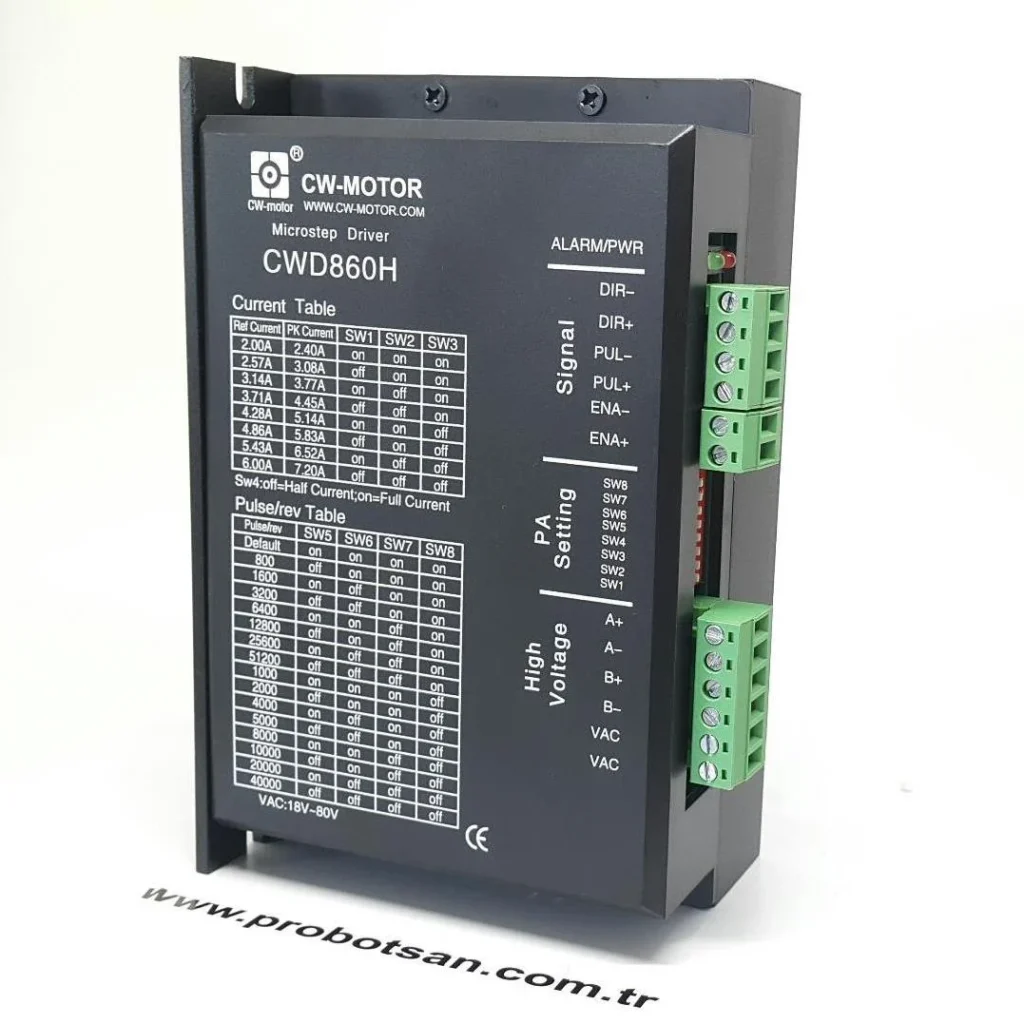
Common Problems and Solutions
Common problems encountered with stepper motor drivers in industrial automation and their solutions can vary depending on the driver’s quality:
- Lost Steps:
- Problem: The motor fails to reach the desired position or stalls under load. This usually occurs due to insufficient torque, excessive speed, incorrect acceleration/deceleration profiles, or resonance. In cheap drivers, low current control quality and lack of anti-resonance increase this risk.
- Solution: Compare the motor’s torque capacity with the load required by the application. If necessary, choose a higher torque motor or increase the motor’s high-speed torque by using a higher supply voltage. Optimize the driver’s current settings according to the motor’s nominal current. Smooth out acceleration/deceleration ramps. For quality drivers, enable the anti-resonance feature; for cheap drivers, determine speed profiles that avoid resonance zones or use mechanical damping elements. If a closed-loop driver is used, check encoder connections and feedback parameters.
- Overheating:
- Problem: The driver or motor heats up abnormally, leading to performance degradation or shutdown due to thermal protection. This can be caused by high current settings, inadequate cooling, driver inefficiency, or continuous operation under heavy load.
- Solution: Reduce the driver’s current setting to match the motor’s nominal current, but keep it at a level that meets torque requirements. Ensure adequate ventilation for the driver and motor; if necessary, use an additional fan or heat sink. For quality drivers, enable dynamic current adjustment or idle current reduction features. Ensure the ambient temperature is within the driver’s operating range.
- High Vibration and Noise:
- Problem: The motor vibrates excessively and produces loud noise during operation. This can result from low microstepping resolution, resonance, loose mechanical connections, or incorrect mounting. In cheap drivers, simple current control exacerbates this situation.
- Solution: Increase the microstep setting to smooth out motor movement. Use the anti-resonance feature in quality drivers. Check the motor’s mechanical connections and ensure they are tight. Verify that the coupling between the motor and load is correctly aligned. Use vibration isolators if necessary.
- Sudden Failures and Short Lifespan:
- Problem: The driver fails unexpectedly or stops working after a short period of use. This is typically caused by low-quality components, inadequate protection circuits, thermal stress, or electrical fluctuations. It is frequently observed in cheap drivers.
- Solution: Opt for quality drivers that comply with industrial standards. Ensure the power supply is stable and protected from sudden voltage surges. Verify that the input voltage is within the driver’s specified range. Avoid operating under excessive load. Provide proper fuse and circuit breaker protection.
- Communication Problems:
- Problem: Errors or interruptions in data transmission between the controller and the driver. This can be caused by electromagnetic interference (EMI), incorrect wiring, missing termination, or incompatible communication parameters.
- Solution: Use shielded communication cables and properly ground the shield. Ensure the communication line is sufficiently far from other power cables. In industrial networks (e.g., CANopen, EtherCAT), check that termination resistors are correctly connected and the network topology is appropriate. Ensure that the communication parameters (baud rate, address, etc.) of the driver and controller match.
Expert Advice
In the world of industrial automation, selecting a stepper motor driver is a strategic decision that involves much more than just the initial purchase cost. The differences between “quality” and “cheap” drivers are not limited to numbers in technical specification tables; they directly impact the system’s overall performance, reliability, maintenance costs, and even production efficiency. While a cheap driver may offer an attractive price tag initially, the problems it can cause in the long run, such as lost steps, overheating, frequent failures, and production downtime, can significantly increase the total cost of ownership (TCO). In industrial environments, where even minutes matter on production lines, unexpected downtime due to a malfunction can lead to tens of thousands of dollars in losses. Therefore, in critical applications and systems requiring high precision, speed, and reliability, it is vital not to compromise on quality, industrial-grade stepper motor drivers. Features such as advanced microstepping, sinusoidal current control, comprehensive protection functions, closed-loop capability, and industrial communication protocols not only provide better performance but also extend the system’s lifespan, reduce maintenance needs, and increase energy efficiency. As expert advice, when choosing a driver, thoroughly analyze the application’s requirements and focus not only on the initial cost but also on the warranty, technical support, spare parts availability, and overall reliability provided by the product. Remember, a correct investment in industrial automation pays for itself many times over in the long run and enhances your company’s competitiveness. Request a quote on WhatsApp today to discuss your specific industrial CNC router needs.
Request a Quote on WhatsApp
For detailed information on Mermak CNC’s industrial-grade stepper motor drivers and to get a customized quote for your specific application, please do not hesitate to contact us. Our expert team is ready to assist you in selecting the most suitable and reliable solutions for your industrial automation needs. Request a quote on WhatsApp today!
FAQ
What are the main technical differences between quality and cheap stepper motor drivers?
Quality stepper motor drivers offer advanced microstepping, sinusoidal current control, anti-resonance, dynamic current adjustment, comprehensive protection, and often closed-loop capabilities. Cheap drivers typically lack these features, leading to lower precision, higher noise, less reliability, and a shorter lifespan.
How does the cost difference between quality and cheap drivers impact long-term operational expenses?
While cheap drivers have a lower initial cost, they often lead to higher total cost of ownership (TCO) due to frequent failures, production downtime, increased maintenance, and lower efficiency. Quality drivers, despite a higher upfront investment, provide long-term reliability, better performance, and reduced operational costs.
What are common problems encountered with stepper motor drivers, and how can they be resolved?
Lost steps, overheating, high vibration and noise, and sudden failures are common issues. Solutions include optimizing current settings, ensuring adequate cooling, increasing microstep resolution, using anti-resonance features, and selecting industrial-grade drivers with robust protection and support.
What factors should industrial B2B buyers consider when selecting a stepper motor driver?
Consider the application's precision, speed, and torque requirements, environmental conditions, and the need for closed-loop control or industrial communication. Always prioritize drivers with comprehensive protection, good technical support, and spare parts availability for critical industrial applications.
Do quality stepper motor drivers offer better energy efficiency?
Yes, quality drivers with features like dynamic current adjustment and efficient power electronics minimize energy loss and heat generation, leading to better energy efficiency compared to cheap drivers that often operate less efficiently and produce more heat.