








































































Does Poor Machine Leveling Affect Cutting Quality? | Mermac CNC

📑 Table of contents (Click to open)
An unstable machine foundation significantly degrades cutting quality. Learn how vibrations, misalignment, and precision loss occur when your industrial CNC router or cutting machine isn’t perfectly leveled. Essential setup and maintenance advice for optimal performance.
Practical notes for CNC router, automation and industrial motion systems.
The Critical Impact of Machine Leveling on Cutting Quality
In industrial automation and manufacturing, the precise installation of machinery is paramount. For high-precision equipment like cutting machines, ensuring the unit is perfectly and stably seated on its foundation is not just a recommendation—it’s a critical requirement. When a machine is not properly leveled, it can lead to a cascade of issues that directly degrade production quality. This instability prevents vibrations generated during operation from being properly dissipated into the ground, causing the machine’s frame and moving components to experience micro-level imbalances. Consequently, the cutting head or tool deviates from its intended path, resulting in rough edges, dimensional inaccuracies, and a general decline in performance. For machines like laser cutters, plasma cutters, CNC routers, or waterjet cutters, which demand accuracy down to the micron, even slight deviations can be detrimental. An uneven foundation also leads to uneven distribution of static and dynamic loads, potentially causing stress and deformation in the machine chassis, shortening its mechanical lifespan and increasing maintenance costs.
Operational Principles and Technical Implications
The core principle behind most cutting machines involves a high-speed cutting element (laser beam, plasma arc, milling bit, water jet) precisely guided along a programmed path. This precision relies heavily on the machine’s overall rigidity and stability. When a machine is not firmly seated on its foundation, this stability is compromised. Key technical issues that arise include:
- Vibration Transfer and Resonance: All machinery generates some vibration during operation. Proper installation ensures these vibrations are either absorbed or transferred effectively to the ground. An uneven seating creates air gaps or inconsistent contact points, preventing proper damping. This can lead to resonance within the machine structure, amplifying vibrations and causing unwanted oscillations in the cutting head, directly impacting the cut surface.
- Loss of Alignment and Parallelism: Modern cutting machines require precise axial movement and parallelism, often within fractions of a millimeter. A tilted machine base disrupts the alignment of its axes (X, Y, Z). For instance, if a CNC router table is not perfectly parallel to the cutting tool, it will result in inconsistent cutting depths or angled cuts across the material. In laser and plasma machines, this can cause the focal point to shift, leading to an irregular kerf width.
- Stress on Bearing and Guide Systems: Uneven loading on the machine frame due to poor leveling induces uneven stresses on sensitive components like linear guides, ball screws, and bearings. This increases friction, accelerates wear, and reduces the precision of motion, leading to jerky movements, tool chatter, and a degraded cut quality.
- Increased Sensitivity to Thermal Deformations: A well-leveled and secured machine can better manage thermal expansion and contraction. An unstable foundation can exacerbate these effects, leading to more unpredictable thermal deformations as temperature fluctuates, further compromising accuracy.
Addressing foundation and leveling issues during installation is a fundamental step towards achieving optimal cutting quality and ensuring the longevity of industrial cutting equipment.
| Parameter | Value/Description |
|---|---|
| Foundation Flatness Tolerance | Typically ±0.5 mm to ±0.1 mm per meter. Tighter tolerances (e.g., ±0.05 mm) for high-precision machines. |
| Vibration Amplitude Limit | Maximum acceptable vibration amplitude that does not affect cutting quality. Generally below 10-20 microns (µm). Lower limits (e.g., 5 µm for milling, 1 µm for laser) may be required. |
| Alignment Precision | Parallelism and perpendicularity tolerance between machine axes. Typically ±0.02 mm to ±0.005 mm per meter. |
| Cutting Repeatability | Consistency of the machine in performing the same cut. Can deviate from ±0.01 mm to ±0.1 mm due to foundation issues. |
| Machine Weight Distribution | Even distribution of the machine’s weight across its support points. Achieved only with a level foundation. |
| Anti-Vibration Materials | Rubber, neoprene, air springs. Key properties include vibration damping coefficient and compression resistance. |
| Foundation Load Capacity | Sufficient capacity to support the machine’s static and dynamic loads (e.g., 500 kg/m² – 2000 kg/m²). |
Key Considerations for Installation and Operation
- Foundation Preparation and Concrete Quality: The installation surface must be constructed from high-strength concrete (minimum C25-C30 class) of adequate thickness to support the machine’s static and dynamic loads. The foundation should be free of cracks and possess sufficient load-bearing capacity. For heavy machinery, a dedicated concrete base or plinth may be necessary. Foundation flatness should be verified using laser leveling equipment or precision spirit levels, and corrected with leveling compounds or epoxy floor coatings if required.
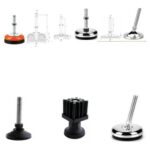
- Machine Installation and Precision Leveling: During installation, precise leveling must be performed at the points specified by the manufacturer, typically using adjustable leveling feet or mounting holes. This process requires optical leveling devices, laser measures, or digital spirit levels. The leveling feet should be adjusted to distribute the machine’s weight evenly and ensure full contact with the foundation. Shim plates (shims) of appropriate thickness should be used to fill any gaps. Proper leveling ensures all machine axes and the table are correctly oriented relative to the reference planes.
- Vibration Isolation and Damping: Install appropriate anti-vibration mounts, air springs, or elastomeric pads between the machine and the foundation. These components minimize the transmission of machine-generated vibrations to the ground and also reduce the impact of external vibrations on the machine. The selection of isolation materials depends on the machine’s weight, operating frequencies, and environmental conditions. Effective isolation extends component life and enhances cutting precision.
- Periodic Checks and Maintenance: Regular checks of leveling and fastener tightness are crucial after installation. Over time, foundations can settle, leveling feet can loosen, or vibrations might cause the machine to shift. These periodic inspections allow for early detection of deviations, enabling corrective action before cutting quality is significantly affected. Monitor the foundation for any signs of deformation and consider the impact of nearby heavy equipment operations.
- Management of Environmental Factors: Fluctuations in ambient temperature and humidity can cause micro-level expansions and contractions in the foundation and machine materials. A stable foundation is more resilient to these effects. Additionally, external vibration sources like nearby forklift traffic, presses, or other machinery can impact the CNC router. Consider additional isolation measures or physical barriers to mitigate these environmental vibrations.
Ensuring your industrial CNC router machine or other cutting equipment is installed on a perfectly level and stable foundation is a non-negotiable step for achieving superior cut quality, maximizing efficiency, and prolonging the life of your investment. For expert consultation and solutions, request a quote on WhatsApp today.
Related product categories: Genel · CNC Router · Turuncu Makine Ayağı
