
No products in the cart.
Is Noisy Stepper Motor Operation Caused by the Driver or the Motor?

Contents
- Introduction and Technical Analysis In industrial automation systems, particularly in applications requiring precise positioning and motion control, stepper motors are indispensable components. However, undesirable noises during stepper motor operation can both degrade the system’s overall performance and lead to serious failures in the long run. These sounds can range from a faint hum to an annoying buzz or vibration. For field technicians and engineers, accurately diagnosing the source of such noises—determining whether the sound originates from the driver or the motor—is the first and most critical step in finding an effective solution. This article delves into the problems of noisy operation encountered in stepper motor systems, offering a comprehensive guide for experts in the industrial automation sector on the origins and solutions to these issues. Our aim is to simplify complex diagnostic processes and provide practical, actionable solutions for problems encountered in the field. While stepper motors inherently have the potential to produce vibration and noise, if these sounds exceed acceptable levels, they can have adverse effects on the lifespan, precision, and even other surrounding equipment within the system. Therefore, understanding and eliminating the causes of noisy operation is vital not only for the health of the motor or driver but also for the efficiency and reliability of the entire automation line. Operating Principle and Technical Data
- Field Considerations
- Common Problems and Solutions
- Expert Advice
- FAQ
Introduction and Technical Analysis
In industrial automation systems, particularly in applications requiring precise positioning and motion control, stepper motors are indispensable components. However, undesirable noises during stepper motor operation can both degrade the system’s overall performance and lead to serious failures in the long run. These sounds can range from a faint hum to an annoying buzz or vibration. For field technicians and engineers, accurately diagnosing the source of such noises—determining whether the sound originates from the driver or the motor—is the first and most critical step in finding an effective solution. This article delves into the problems of noisy operation encountered in stepper motor systems, offering a comprehensive guide for experts in the industrial automation sector on the origins and solutions to these issues. Our aim is to simplify complex diagnostic processes and provide practical, actionable solutions for problems encountered in the field. While stepper motors inherently have the potential to produce vibration and noise, if these sounds exceed acceptable levels, they can have adverse effects on the lifespan, precision, and even other surrounding equipment within the system. Therefore, understanding and eliminating the causes of noisy operation is vital not only for the health of the motor or driver but also for the efficiency and reliability of the entire automation line.
Operating Principle and Technical Data
Stepper motors are brushless DC motors that convert electrical energy into precise mechanical rotational motion. Magnetic fields, which cause the rotor to rotate at specific angles (step angle), are created by sequentially energizing the motor’s coils (phases). A stepper motor driver sends the correct current pulsations to these coils, enabling the motor to move in the desired direction and at the desired speed. One of the most important features of drivers is their ability to precisely control the motor current. Especially microstepping technology divides a full step into smaller substeps, ensuring smoother, vibration-free, and quieter motor operation. This increases positioning accuracy and minimizes resonance effects. Driver current control is typically PWM (Pulse Width Modulation) based, which requires continuous current adjustment through rapid switching in the motor coils. This switching frequency can be a primary cause of high-frequency noises originating from the driver. The motor itself, in addition to the torque and motion generated by the magnetic fields on the rotor, is also prone to vibrations and noises originating from its mechanical structure (bearings, shaft, mounting). When the motor’s natural resonance frequencies coincide with the excitation frequencies provided by the driver, significant noise and vibration problems can arise. Therefore, proper system design and compatible component selection play a critical role in preventing noisy operation issues. Parameters such as the motor’s inductance, resistance, and holding torque, along with the driver’s maximum current capacity, supply voltage, and microstep resolution, directly affect the system’s overall performance and noise level. In industrial applications, the compatibility between the motor and driver is of vital importance for system efficiency and longevity. Incorrect matching can lead to motor overheating, step loss, and distinctly noisy operation.
| Parameter | Value/Description |
|---|---|
| Motor Step Angle | Typically 1.8° or 0.9° (200 or 400 steps/revolution) |
| Motor Phase Current | Commonly 0.5A – 6A, adjusted by the driver. |
| Motor Phase Inductance | 1mH – 10mH (critical for driver selection) |
| Driver Max. Output Current | Should be suitable for or higher than the motor’s phase current. |
| Driver Supply Voltage | Commonly 12VDC – 80VDC, critical for motor speed and torque. |
| Driver Microstep Resolution | 1/2, 1/4, 1/8, 1/16, 1/32, 1/64, 1/128, 1/256 (provides smoother operation) |
| Driver Switching Frequency | Typically 20kHz – 50kHz (affects audible noise level) |

Field Considerations
- Mechanical Connections and Mounting Quality: The flatness of the surface to which the motor is mounted, the tightness of the mounting screws, and the correct alignment of the couplings are among the most common mechanical causes of vibration and noise. A loose mount or a misaligned shaft can cause the motor to resonate and produce significant noise during operation. Incorrect selection or damaged couplings can also lead to irregularities in transmitted torque and mechanical noises. Periodically checking and, if necessary, correcting all these connection points can prevent many problems from the outset.
- Bearing Condition and Wear: The bearings inside stepper motors ensure smooth rotation of the rotor. Over time or under excessive load, bearings can wear out, become unlubricated, or get damaged. Worn bearings indicate a fault by producing squealing, rattling, or humming sounds during motor operation. Manually checking the motor’s bearings (for play) or feeling for roughness when rotating the motor shaft can help in early diagnosis of bearing issues.
- Cabling and Electrical Noise: The length, cross-section, and shielding of cables between the motor and driver have a significant impact on electrical interference and noise. Long and insufficiently thick cables can cause voltage drops and current fluctuations, leading to irregular motor operation and noise. Additionally, unshielded cables can be affected by environmental electromagnetic noise or emit electromagnetic noise themselves, affecting other systems. Loose or corroded cable connections also increase contact resistance, leading to similar problems.
- Power Supply Quality and Capacity: The voltage stability and current capacity of the power supply provided to the driver are critical for the stepper motor system’s performance. An inadequate or fluctuating power supply can prevent the driver from accurately controlling the motor current. This can lead to torque loss, step skipping, and irregular, noisy motor operation. Especially during sudden load changes, if the power supply cannot provide sufficient current, the system may become unstable.
- Resonance Frequencies and Vibration Damping: Stepper motors have natural resonance points at certain speeds or frequencies. When operating at these points, motor vibration and noise can significantly increase. In addition to the motor’s own resonance, the mechanical system it is connected to (e.g., a long lead screw or a moving table) can also have resonance frequencies. To reduce these resonances, microstepping resolution is often increased, vibration-damping couplings or dampers are used, or the drivers’ internal anti-resonance algorithms are activated. It is important to determine the system’s natural frequencies and optimize speed profiles to avoid these frequencies.
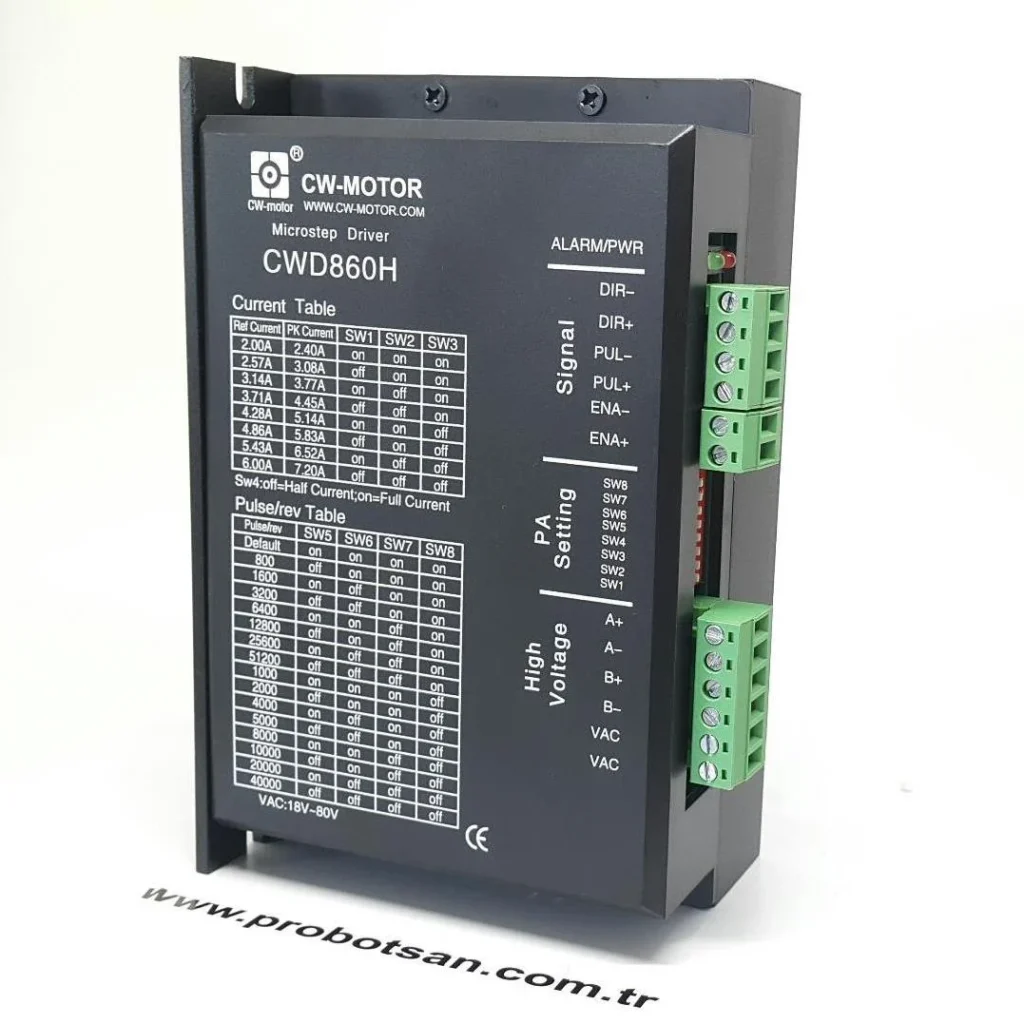
- Driver Current Settings and Microstepping: Accurately setting the driver’s output current to the motor’s nominal current is essential. High current leads to motor overheating and unnecessary torque production, while low current causes torque loss and step skipping. Both situations can contribute to noisy motor operation. The microstepping setting also directly affects the motor’s smoothness and quietness. Higher microstepping values (e.g., 1/16 or 1/32) generally provide quieter operation but require more processing power from the driver and a higher pulse frequency.
- Environmental Conditions and Cooling: The ambient temperature, humidity, and dust levels of the operating environment affect the lifespan and performance of both the motor and the driver. High ambient temperatures lead to overheating of the motor and driver, increasing the risk of failure. Inadequate cooling, especially when the motor operates at its nominal current, can cause winding temperatures to reach critical levels. Overheated motors can lose their magnetic properties and start operating noisily. Dust and dirt can damage bearings or driver components.
Common Problems and Solutions
Diagnosing noisy operation problems in stepper motor systems can often be challenging due to the complex interaction between the driver and the motor. However, knowing common problem scenarios and their potential solutions can expedite the troubleshooting process.
Driver-Related Noises:
- High-Frequency Hum or Buzz: These sounds typically originate from the driver’s PWM switching frequency. The driver sends high-frequency pulses to control the current in the motor coils, and if the frequency of these pulses is within the human audible range (typically below 20 kHz), it can be perceived as a hum.
- Solution: Many modern drivers have features to change the switching frequency or offer “silent modes” (such as stealthchop, spreadcycle). Checking these settings to raise the switching frequency above the human hearing threshold or enabling modes that provide smoother current waveforms can resolve the issue. Additionally, increasing microstep resolution can make the motor current smoother, reducing such noises.
- Low-Frequency Vibration or Noise (Especially at Low Speeds): This situation usually results from insufficient current control by the driver or the motor entering resonance at low speeds. Distortions in the current waveform or inadequate smoothing can cause the motor to move in a “jerky” manner.
- Solution: It is critical to accurately set the driver’s current settings according to the motor’s nominal current. Increasing the microstepping setting ensures smoother motor movement, reducing low-speed vibrations. Enabling anti-resonance or vibration damping algorithms found in some drivers can also be beneficial. If necessary, consider installing a vibration damper on the motor shaft to absorb mechanical resonances.
- Noise Accompanied by Step Loss: In situations where the motor cannot handle the load or acceleration/deceleration ramps are too steep, the driver cannot properly supply the motor, and the motor loses steps. This typically results in “clattering” or “cracking” sounds.
- Solution: Check the driver’s current setting and ensure it matches the motor’s nominal current. If necessary, slightly increase the current (but be careful not to overheat the motor). Review motion profile settings to make acceleration and deceleration ramps smoother. Check if the load exceeds the motor’s capacity; if so, consider using a more powerful motor or a gearbox that provides higher torque.
Motor-Related Noises:
- Mechanical Squealing, Rattling, or Humming: These types of sounds typically originate from the motor’s bearings or mechanical mounting. Worn, dirty, or unlubricated bearings hinder the motor’s rotational movement and produce friction noises.
- Solution: Manually rotate the motor shaft to check for play or roughness in the bearings. Replacing worn or damaged bearings usually solves this problem. Check the motor’s mounting screws and tighten any loose ones. Ensure that the coupling between the motor and the mechanical system it is connected to is properly aligned and not damaged. A flexible coupling can compensate for small alignment errors, reducing mechanical stress and noise.
- Resonance Vibrations: The coincidence of the motor’s natural resonance frequencies with the excitation frequencies leads to significant vibrations and noises in the motor body. This is usually more pronounced in specific speed ranges.
- Solution: Increasing microstep resolution can make the motor move in smaller steps and more smoothly, reducing resonances. Enable the driver’s anti-resonance features. Installing a vibration damper on the motor shaft can absorb resonance energy, reducing noise and vibration. Optimizing motion profiles (acceleration, constant speed, deceleration) to quickly pass through resonance zones is also a method.
- Overheating and Associated Noise: Motor overheating can result from both high current settings from the driver and inadequate cooling. In overheated motors, magnetic properties can change, leading to irregular operation and noise.
- Solution: Check the driver’s current settings and ensure they do not exceed the motor’s nominal current. Review ambient temperature and motor cooling conditions. If necessary, improve cooling by adding a cooling fan to the motor or enhancing airflow in the environment. Analyze whether the motor is continuously operating significantly above its nominal current; this may indicate incorrect sizing of the motor or system.
System-Related Noises:
- Load Resonance: The mechanical system driven by the motor (lead screw, belt-pulley system, table, etc.) may have its own natural resonance frequencies. When these frequencies coincide with the motor’s excitation frequencies, significant vibrations and noises occur throughout the entire system.
- Solution: Review the design of the mechanical system; using more rigid materials, increasing support points, or changing mass distribution can alter resonance frequencies. Using vibration damping elements (rubber mounts, elastomer couplings) can be beneficial. If necessary, adjust the motor’s speed profiles to avoid the system’s resonance frequencies.
- External Electromagnetic Interference: Nearby strong electromagnetic fields (power supplies, inverters, high-current cables) can affect the motor or driver’s control signals, leading to irregular operation and noise.
- Solution: Separate control and power cables. Use shielded cables for sensitive control cables and properly ground the shielding. Identify sources of interference and move them away from the motor and driver or implement shielding measures.
Expert Advice
Noisy operation problems encountered in stepper motor systems are often not due to a single cause but rather a result of complex interactions between the motor, driver, and mechanical system. Therefore, adopting a systematic and holistic approach is essential for successful troubleshooting and resolution. Field experience often plays a critical role in catching details that might be overlooked at first glance. As expert advice, any noisy operation issue should first begin with the simplest and most visible mechanical checks: tightness of mounting screws, condition of couplings, play in bearings, etc. Subsequently, electrical connections, cable quality, and power supply voltage/current should be checked. These steps can often resolve many superficial problems. If the problem persists, driver settings (current, microstepping, anti-resonance features) and motor technical specifications (inductance, resistance) should be examined in detail. Analyzing motor current waveforms and driver output signals using an oscilloscope is an invaluable tool for detecting driver-related electrical noise or current control irregularities. Similarly, a vibration analyzer can identify the source of mechanically induced problems by determining the resonance frequencies of the motor and its connected mechanical system. Manufacturer datasheets and application notes provide valuable information about the optimal operating conditions and recommended settings for the motor and driver. It should be remembered that sometimes the problem may stem from a system design incompatibility or incorrect sizing. In such cases, instead of just replacing components, the entire system may need to be re-evaluated and optimized. Regular maintenance, early diagnosis, and proactive problem-solving approaches are vital to ensure the continuous and efficient operation of industrial automation systems. With expert observation and the use of correct tools, stepper motor systems can be made to operate quietly, precisely, and reliably, thereby maximizing production efficiency and system lifespan. Request a quote on WhatsApp today for Mermak CNC solutions.
FAQ
What are the primary causes of a noisy stepper motor?
Noisy stepper motor operation can stem from either the stepper motor itself or its driver, or often a combination of both. Common causes include mechanical issues like worn bearings or loose mounting, electrical problems such as incorrect driver current settings or poor power supply, and resonance issues within the motor or the mechanical system it drives.
How can I determine if the noise is coming from the stepper motor or the driver?
To diagnose the source, start by checking mechanical connections for tightness and bearing condition for wear. Then, verify electrical connections, cable quality, and power supply stability. If these are sound, examine driver settings like current, microstepping, and anti-resonance features. An oscilloscope can help analyze current waveforms, while a vibration analyzer can pinpoint mechanical resonances.
What are the common solutions for reducing stepper motor noise?
Solutions include tightening mechanical mounts, replacing worn bearings, using appropriate shielded cabling, ensuring a stable power supply, and optimizing driver settings. For driver-related noise, adjust PWM switching frequency or enable silent modes. For motor resonance, increase microstepping, use vibration dampers, or adjust motion profiles to avoid critical frequencies.
Does microstepping affect stepper motor noise levels?
Yes, microstepping significantly reduces noise and vibration by dividing each full step into smaller increments, leading to smoother motor movement. Higher microstep resolutions (e.g., 1/16, 1/32) generally result in quieter operation, especially at lower speeds.
Can an overheating stepper motor cause noise?
Overheating can cause a stepper motor to operate noisily as its magnetic properties may change, leading to irregular movement. Ensure the driver's current settings are appropriate for the motor and that there is adequate cooling, possibly by adding a fan or improving ambient airflow.