





































































Nema 23 vs. Nema 34 Stepper Motors: Power Differences Explained
📑 Table of contents (Click to open)
Nema 23 vs. Nema 34 Stepper Motors: A Field Guide to Power Differences
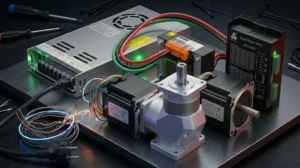
At the heart of industrial automation, motion control systems are paramount for modern manufacturing’s efficiency and precision. Stepper motors, a key component in these systems, are favored for their ability to provide precise positioning and speed control across a wide range of applications. Selecting the correct stepper motor is a critical step for project success and long-term performance. Specifically, Nema 23 and Nema 34 stepper motors often present a choice dilemma for industrial automation engineers and system integrators. This detailed field guide and technical article delves into the fundamental power differences between these two motor types, their technical specifications, application scenarios, and practical considerations for making the optimal choice.
Operating Principles and Technical Data
Stepper motors are brushless DC motors that convert electrical energy into mechanical motion. Their ability to move in discrete steps makes them ideal for high-precision positioning applications. The core principle involves energizing stator windings in a specific sequence, creating magnetic fields that attract and repel the rotor’s magnetic poles, causing it to rotate by a precise ‘step’ angle. Repeating these steps in a controlled manner achieves the desired speed and position.
The Nema standard (National Electrical Manufacturers Association) defines mounting dimensions and flange types for stepper motors. The numbers in Nema 23 and Nema 34 refer to the approximate size of the motor’s face in inches. A Nema 23 motor has a flange size of approximately 2.3 x 2.3 inches (57 x 57 mm), while a Nema 34 motor is approximately 3.4 x 3.4 inches (86 x 86 mm). This physical size difference directly impacts the motors’ internal construction and, consequently, their power capabilities.
Torque is the primary determinant of power difference. Nema 34 motors feature a significantly larger frame, a wider rotor diameter, and typically a longer magnetic path compared to Nema 23 motors. These structural differences enable Nema 34 motors to generate larger magnetic fields, resulting in higher holding torque and dynamic torque. Holding torque is the motor’s ability to maintain its position against an external force when energized but stationary. Dynamic torque indicates the motor’s capacity to move a load at a specific speed. Nema 23 motors typically offer holding torques ranging from 0.5 N.m to 3 N.m (approx. 70-425 oz-in), whereas Nema 34 motors can achieve values from 4 N.m up to 18 N.m (approx. 560-2500 oz-in) or more. This means a Nema 34 can move much heavier loads or accelerate the same load with greater force.
This increase in torque capacity brings other technical differences:
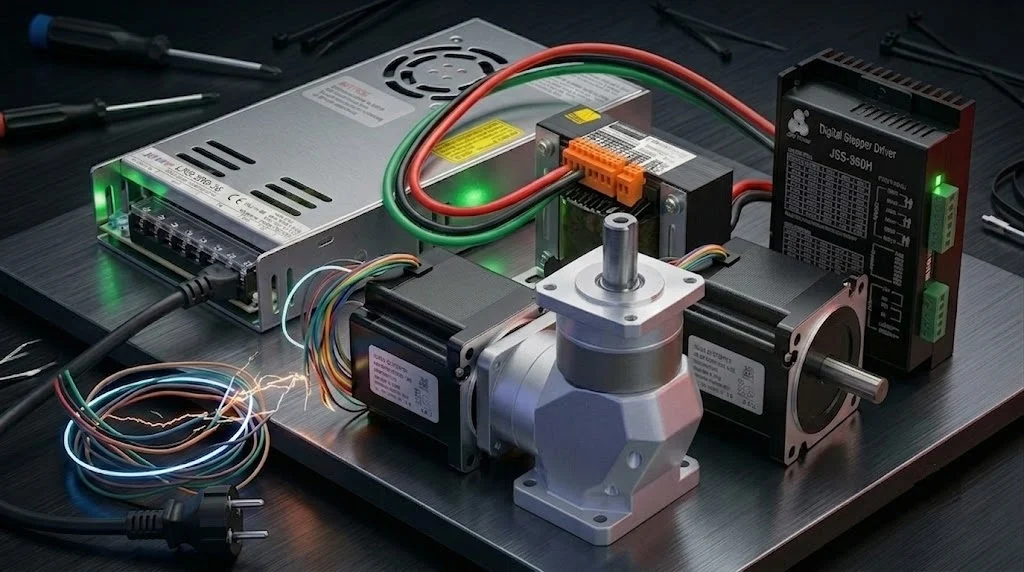
- Current and Voltage Requirements: Higher torque output necessitates larger coil windings and stronger magnetic fields in Nema 34 motors, typically requiring higher phase currents (e.g., 4-8A or more for Nema 34 vs. 2-5A for Nema 23) and sometimes higher supply voltages. This directly influences the selection of motor drivers and power supplies.
- Rotor Inertia: The larger rotors of Nema 34 motors inherently possess higher rotor inertia. High inertia can increase acceleration and deceleration times, potentially limiting performance in applications requiring rapid start-stop cycles. This makes driver tuning and motion profile optimization more critical.
- Physical Size and Weight: The larger frame means Nema 34 motors occupy more space and are heavier, which must be considered in machine design, installation footprint, and overall system weight.
- Thermal Management: Higher currents and torques generate more heat in Nema 34 motors. Effective thermal management is crucial for motor longevity and performance. Additional cooling solutions (heat sinks, fans) may be necessary.
- Speed Performance: Generally, stepper motor torque decreases at higher speeds. Nema 34 motors, with their higher starting torque, can maintain acceptable torque levels at higher speeds compared to Nema 23. However, their high inertia can be a disadvantage in very high-speed start-stop applications.
- Cost: Larger and more powerful Nema 34 motors are typically more expensive than their Nema 23 counterparts. Higher current requirements also mean Nema 34 drivers and power supplies can be more costly.
These fundamental technical differences dictate where each motor type excels. Nema 23 motors are cost-effective solutions for medium-sized CNC machines, 3D printers, pick-and-place robots, laboratory automation equipment, and lighter load-carrying systems. Nema 34 motors are indispensable for heavy-duty industrial CNC routers and mills, large gantry systems, industrial manipulators, heavy material conveyors, and indexing tables requiring high torque.
| Parameter | Nema 23 Stepper Motor | Nema 34 Stepper Motor |
|---|---|---|
| Frame Size (Flange) | Approx. 57×57 mm (2.25×2.25 in) | Approx. 86×86 mm (3.38×3.38 in) |
| Holding Torque Range | 0.5 N.m – 3 N.m (70-425 oz-in) | 4 N.m – 18 N.m (560-2500 oz-in) and above |
| Max. Phase Current | 2A – 5A (Varies by manufacturer) | 4A – 8A (Varies by manufacturer) |
| Rotor Inertia | Lower (e.g., 0.1-0.5 kg·cm²) | Higher (e.g., 1-5 kg·cm²) |
| Mechanical Size & Weight | More compact and lighter | Larger and heavier |
| Typical Applications | Small/medium CNC, 3D printers, pick-and-place, lab equipment | Heavy-duty CNC, large gantries, industrial robotics, heavy load transport |
| Cost Factor (Motor & Driver) | More economical | Higher cost |
| Thermal Management Needs | Generally less critical, passive cooling may suffice | More critical, active cooling (fan/heat sink) may be required |
| Speed Performance | Torque drop at high speeds more pronounced, low inertia advantage | Maintains more torque at higher speeds, high inertia disadvantage |
| Driver Voltage | Typically 24-48V DC | Typically 24-80V DC (higher voltage preferred for high torque) |

Field Considerations
- Detailed Torque Requirement Analysis: Before selecting a motor for an automation project, a thorough analysis of the required torque is essential. This includes static holding torque needed to keep the load in place and dynamic torque required for acceleration, deceleration, and continuous motion. Over-specifying can lead to unnecessary costs, while under-specifying results in poor performance or system failure.
- Motion Profile and Speed Requirements: Consider the typical operating speeds and acceleration/deceleration rates. If rapid movements and quick stops are frequent, a motor with lower inertia (often Nema 23, or a Nema 34 with specific low-inertia windings) might be more suitable, even if its peak torque is lower. For applications involving sustained high loads or slow, powerful movements, the higher torque of a Nema 34 is usually necessary.
- System Integration: Ensure the chosen motor is compatible with your existing or planned motion control system. This includes the stepper driver’s current and voltage ratings, the power supply’s capacity, and the physical mounting space available on your CNC router or automation equipment. The choice of motor can also influence the selection of other components like linear guide rails, ball screws, and vacuum tables, which must be sized appropriately for the forces involved.
- Environmental Factors: Assess the operating environment. High ambient temperatures may necessitate active cooling for Nema 34 motors. Dust, moisture, or corrosive elements might require motors with appropriate IP ratings or enclosures.
- Budget Constraints: Balance performance requirements with budget. While Nema 34 motors offer superior power, Nema 23 motors can be perfectly adequate and more cost-effective for less demanding tasks. Remember to factor in the cost of the compatible driver and power supply.
In conclusion, the choice between Nema 23 and Nema 34 stepper motors hinges on a clear understanding of the application’s specific demands. Nema 23 motors provide a robust and economical solution for a wide array of automation tasks where moderate torque is sufficient. For applications demanding higher force, heavier loads, and greater precision under challenging conditions, the increased power and torque of Nema 34 motors are often essential. By carefully evaluating torque, speed, inertia, and system integration factors, you can confidently select the stepper motor that will ensure optimal performance and reliability for your industrial CNC router or automated system.
Ready to optimize your machine’s performance? Request a quote on WhatsApp for tailored stepper motor solutions and expert consultation.