



































































NEMA 17, NEMA 23, and NEMA 34 Stepper Motor Differences and Selection for Industrial Applications
📑 Table of contents (Click to open)
- NEMA 17, NEMA 23, and NEMA 34 Stepper Motor Differences and Selection: Introduction and Technical Analysis
- NEMA 17, NEMA 23, and NEMA 34 Stepper Motor Differences and Selection: Operating Principle and Technical Data
- NEMA 17 Stepper Motors
- NEMA 23 Stepper Motors
- NEMA 34 Stepper Motors
- NEMA 17, NEMA 23, and NEMA 34 Stepper Motor Differences and Selection: Field Considerations
- NEMA 17, NEMA 23, and NEMA 34 Stepper Motor Differences and Selection: Common Problems and Solutions
- NEMA 17, NEMA 23, and NEMA 34 Stepper Motor Differences and Selection: Conclusion and Expert Advice
- FAQ
NEMA 17, NEMA 23, and NEMA 34 Stepper Motor Differences and Selection: Introduction and Technical Analysis
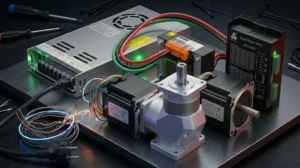
Movement control systems, at the heart of industrial automation, are continuously evolving to meet the precision, speed, and reliability demands of modern manufacturing processes. Stepper motors, as fundamental actuators in these systems, are widely preferred across a broad range of applications due to their open-loop control advantages, simple structure, and cost-effectiveness. However, the performance of these motors and their compatibility with the system depend heavily on correct selection. This detailed field guide and technical article focuses on one of the most fundamental questions faced by industry experts and engineers: What are the differences between NEMA 17, NEMA 23, and NEMA 34 stepper motors, and how do you choose the most suitable one for your project? These motors are industrial classifications determined by National Electrical Manufacturers Association (NEMA) standards, corresponding to flange sizes. This standardization facilitates compatibility among manufacturers and provides engineers with a quick understanding of the motor’s physical dimensions. Selecting the right motor not only meets the system’s mechanical and electrical requirements but also directly impacts energy efficiency, cost, and the system’s overall lifespan. Therefore, a deep understanding of each NEMA size’s unique characteristics, advantages, disadvantages, and typical application areas is indispensable for a successful automation project. In this guide, we will delve into the technical details of these three popular stepper motor sizes, sharing critical engineering parameters and field experiences to consider during the selection process.
NEMA 17, NEMA 23, and NEMA 34 Stepper Motor Differences and Selection: Operating Principle and Technical Data
Stepper motors are brushless DC motors that convert electrical energy into precise angular movements. They operate on the principle of sequentially energizing coil windings, causing the rotor to move in specific, discrete steps. Each electrical pulse (step) causes the motor to rotate by a specific angle. This “step angle” determines the motor’s precision and typically has values like 1.8° or 0.9°. Smaller step angles mean higher resolution and smoother motion. Microstepping technology, used with modern drivers, divides these step angles into much smaller increments (e.g., 1/16, 1/32, 1/256 steps), reducing vibration, lowering noise, and increasing motion fluidity. However, as the microstep count increases, a slight decrease in the motor’s generated torque may be observed. A stepper motor’s performance is typically characterized by parameters such as holding torque, dynamic torque, current, inductance, and inertia.
NEMA Classification: NEMA specifies the motor’s flange size in inches. For example, NEMA 17 indicates that the motor’s front face is approximately 1.7 inches x 1.7 inches (about 42×42 mm). This sizing provides a general idea of the motor’s potential torque capacity, as larger motors generally have more coil volume and thus higher torque.
NEMA 17 Stepper Motors
NEMA 17 motors, with 42 mm x 42 mm flange dimensions, are among the smallest and most commonly used stepper motors. They typically offer a holding torque between 0.2 Nm and 0.8 Nm. Their low inertia and compact size make them ideal for light-load applications requiring fast response and precise positioning. They usually operate at current values between 1.5A and 2.5A. Typical application areas include 3D printers (extruder and axis movements), small CNC machines (engraving, PCB milling), camera sliders, laboratory automation equipment, automatic doors, and small robotic arms. Advantages include low cost, easy integration, and low power consumption, while disadvantages are limited torque capacity and the risk of losing steps with heavier loads.
NEMA 23 Stepper Motors
NEMA 23 motors, with 57 mm x 57 mm flange dimensions, offer an excellent balance for medium-scale applications. They typically have a holding torque capacity between 1 Nm and 3 Nm and can draw currents between 2A and 4A. They provide higher torque and better inertia matching compared to NEMA 17, making them suitable for moving heavier loads. Application areas are quite broad; they are frequently used in fields such as medium-scale industrial CNC router machines, pick-and-place robots, automated assembly lines, textile machinery, laser cutters, and industrial printers. NEMA 23 is often the most popular choice in terms of cost-performance ratio. It offers sufficient torque without requiring a very large mounting area. However, being larger and heavier than NEMA 17, they can pose limitations in some compact designs.
NEMA 34 Stepper Motors
NEMA 34 motors, with 86 mm x 86 mm flange dimensions, represent the largest and most powerful class of stepper motors. They can offer holding torques from 4 Nm to 12 Nm, and even higher in special designs, operating at current values of 4A to 6A or more. These motors are designed for industrial and heavy-duty applications due to their high torque and heavy load-carrying capacities. Their high inertia enables precise control of large loads. Typical application areas include large industrial CNC machines (plasma cutters, metalworking machines), heavy-load gantry systems, industrial presses, automated storage and retrieval systems (AS/RS), robotic manipulators, and large conveyor systems. While NEMA 34 motors offer high torque and robustness, they come with disadvantages such as higher cost, larger size, and greater power consumption. Additionally, more powerful and often more expensive drivers are required to operate these motors.
| Parameter | NEMA 17 | NEMA 23 | NEMA 34 |
|---|---|---|---|
| Flange Size (mm) | 42 x 42 | 57 x 57 | 86 x 86 |
| Typical Holding Torque (Nm) | 0.2 – 0.8 | 1.0 – 3.0 | 4.0 – 12.0+ |
| Typical Current (A/Phase) | 1.5 – 2.5 | 2.0 – 4.0 | 4.0 – 6.0+ |
| Typical Weight (kg) | 0.2 – 0.5 | 0.7 – 1.5 | 2.0 – 5.0+ |
| Application Areas | 3D printers, small CNC, camera sliders | Medium CNC, pick-and-place, laser cutters | Large CNC, gantry systems, heavy-duty robots |
| Advantages | Compact, low cost, low power | Good torque/cost ratio, medium loads | High torque, heavy load capacity |
| Disadvantages | Limited torque, risk of step loss | Larger and heavier than NEMA 17 | High cost, large size, high power consumption |
NEMA 17, NEMA 23, and NEMA 34 Stepper Motor Differences and Selection: Field Considerations
- Load Analysis and Torque Requirement: The most critical step in selecting a stepper motor is an accurate and detailed analysis of the load the motor will move. This analysis should include not only factors like static friction and gravity but also the load’s inertia and the dynamic torque requirements during acceleration and deceleration. Generally, it is recommended to select a motor with a peak torque that provides a safety margin of 50-70% above the required maximum torque. It should be remembered that torque can decrease at high speeds, so the motor’s torque-speed curve must be carefully examined.
- Driver Selection and Compatibility: Choosing the right driver is vital to maximize stepper motor performance. The driver must match the motor’s nominal current, be able to supply sufficient voltage (typically 5-20 times the motor’s nominal voltage) to achieve maximum motor torque, and its microstepping capabilities are crucial for motion precision and smoothness. Additionally, safety features such as overcurrent, overtemperature, and short-circuit protections should be considered. Modern drivers offer improved performance with resonance damping and current control algorithms.
- Mechanical Connection and Environmental Factors: Correctly connecting the motor to the mechanical system is critical for performance and lifespan. The choice of intermediate connection elements such as couplings, belt-pulley systems, or gearboxes affects torque transmission, precision, and vibration. Backlash, flexibility, and alignment errors can severely degrade system performance. Furthermore, environmental conditions such as temperature, humidity, dust, vibration, and potential electromagnetic interference (EMI) in the motor’s operating environment should be decisive in selecting the motor’s IP rating and materials.
- Thermal Management and Heat Dissipation: Stepper motors tend to heat up, especially with high currents or during long operating cycles. Excessive heat shortens the life of motor windings and can permanently damage their magnetic properties. Adequate airflow, heatsinks, or forced air cooling may be required to ensure the motor operates within its nominal temperature limits. Thermal management should be given more attention, especially for larger motors like NEMA 23 and NEMA 34.
- Cabling, Noise, and EMC: Stepper motor cabling must ensure accurate and interference-free transmission of current from the driver to the motor. Voltage drops and signal degradation can occur over long cable distances. Additionally, the motor’s high-frequency switching currents can generate electromagnetic interference (EMI) in nearby sensitive electronics. Therefore, using shielded cables, keeping cables separate from power and signal lines, and proper grounding are important for EMC compliance.
- Use of Feedback (Encoder): While open-loop stepper motors are often sufficient, encoder-equipped stepper motors or closed-loop stepper systems (servo-step) may be preferred in situations requiring high reliability, position verification, or the elimination of potential step loss risks. An encoder continuously reports the motor’s instantaneous position back to the controller, allowing the system to correct itself in case of any step loss, thus offering higher precision and reliability.
NEMA 17, NEMA 23, and NEMA 34 Stepper Motor Differences and Selection: Common Problems and Solutions
Some common problems encountered in stepper motor-based systems and their solutions, based on field experience, are detailed below:
1. Step Loss or Positioning Error:
- Scenario: The motor moves less than the commanded distance or does not move at all, causing the system to lose its position.
- Causes:
- Insufficient Torque: The motor cannot generate enough torque to move the load (load is too heavy, motor size is too small, speed is too high).
- Excessive Speed: Operating the motor at speeds higher than allowed by its torque-speed curve.
- Resonance: Operating at a speed that coincides with the natural frequencies of the motor or mechanical system, leading to severe vibrations and torque loss.
- Insufficient Current: The driver cannot supply sufficient current to the motor, or the current limit is set incorrectly.
- Mechanical Friction/Binding: High friction, binding, or misaligned mechanical parts in the system.
- Incorrect Acceleration/Deceleration Ramps: Acceleration and deceleration times are too short, preventing the motor from overcoming inertia.
- Solutions:
- Motor torque can be increased (selecting a larger NEMA motor, a higher current/voltage driver).
- Acceleration/deceleration ramps can be extended.
- Microstep settings can be optimized (generally, higher microstepping helps reduce resonance).
- Driver current limits and voltage settings are checked.
- Friction or binding points in the mechanical system are identified and eliminated.
- If necessary, switch to encoder-equipped closed-loop stepper systems.
- Speed profile is adjusted to avoid resonance regions, or drivers with resonance damping features are used.
2. Overheating:
- Scenario: The motor becomes too hot to touch, leading to performance degradation or permanent damage.
- Causes:
- Excessive Current: Too high current sent from the driver to the motor.
- High Duty Cycle: The motor is continuously operated under high load.
- Insufficient Cooling: High ambient temperature or insufficient airflow.
- Exceeding Motor’s Nominal Values: The motor is continuously operated close to its maximum torque capacity.
- Solutions:
- Driver current limits are correctly set according to the motor’s nominal current.
- If necessary, a motor operating at lower currents is selected, or a larger NEMA motor is used.
- A heatsink is installed on the motor, or forced air cooling (fan) is used.
- Ambient temperature is reduced, or airflow around the motor is improved.
- Idle current reduction feature is used.
3. Vibration and Noise:
- Scenario: The motor vibrates excessively or makes loud noises during operation.
- Causes:
- Resonance: Entering resonance at certain speeds or step frequencies.
- Microstep Settings: Incorrect or insufficient microstep settings.
- Mechanical Connection: Loose mounting, misalignment, or weak couplings.
- Driver Quality: Low-quality or old drivers can cause current fluctuations.
- Solutions:
- Microstep settings are increased to provide smoother motion.
- Drivers with resonance damping features are used.
- Connections between the motor and mechanical system are checked and tightened, and alignment is corrected.
- If necessary, higher quality, quieter drivers are preferred.
- Vibration-absorbing materials can be added to the motor’s mounting surface.
4. Motor Not Rotating or Rotating in the Wrong Direction:
- Scenario: The motor does not respond to commands or moves in the opposite direction than expected.
- Causes:
- Wiring Error: Incorrect connection of motor phases to the driver.
- Power Supply Issues: Power supply providing insufficient voltage or current.
- Control Signals: Step/direction signals not reaching the driver or being incorrect.
- Driver Malfunction: The driver is faulty.
- Solutions:
- Motor wiring (phase sequence) is checked and corrected.
- Voltage and current values of the power supply are measured to confirm sufficiency.
- Control signals (step, dir, enable) are checked with an oscilloscope.
- Whether the driver is faulty is determined by testing with another motor.
- For direction reversal issues, simply swapping two phase wires is usually sufficient.
NEMA 17, NEMA 23, and NEMA 34 Stepper Motor Differences and Selection: Conclusion and Expert Advice
Making the correct choice among NEMA 17, NEMA 23, and NEMA 34 stepper motors in industrial automation projects is a vital decision for project success, cost-effectiveness, and longevity. The fundamental differences among these motors are directly related not only to their physical dimensions but also to the torque they produce, the loads they can carry, their speed capabilities, and thus their application areas. NEMA 17 offers an ideal solution for light-load applications where precision and compactness are paramount; NEMA 23 is preferred in many medium-scale applications, providing an optimal balance between torque, size, and cost. For heavy loads, high torque requirements, and large-scale industrial systems, NEMA 34 is indispensable with its power and durability.
As an expert, I always recommend analyzing the system’s requirements in great detail when starting the motor selection process. This should cover not only the static and dynamic torque needs of the mechanical load but also the desired speed, positioning accuracy, environmental conditions, budget constraints, and future potential upgrade requirements. Remember that the motor should not be evaluated alone but as a whole with the driver, power supply, and mechanical transmission system. A motor’s performance is directly dependent on the quality and settings of its connected driver. Furthermore, special attention should be paid to details that might be overlooked, such as potential resonance points, thermal management, and electromagnetic compatibility. Remember, choosing the right motor is not just selecting a component; it is a critical engineering decision that determines the quality, efficiency, and lifespan of the entire automation system. In light of the information presented in this guide, you can select the most suitable stepper motor for your projects and ensure your systems operate at peak performance.
FAQ
What are the main differences between NEMA 17, NEMA 23, and NEMA 34 stepper motors?
NEMA 17 motors are compact (42x42mm flange), offering 0.2-0.8 Nm torque for light loads like 3D printers. NEMA 23 motors are medium-sized (57x57mm flange), providing 1-3 Nm torque for applications such as medium CNC router machines. NEMA 34 motors are large and powerful (86x86mm flange), delivering 4-12+ Nm torque for heavy industrial machinery and gantry systems.
How do I choose the right NEMA stepper motor for my industrial application?
Consider the required torque for your load (static and dynamic), desired speed and precision, available space, budget, and environmental conditions. Always factor in a safety margin for torque. Review the motor's torque-speed curve and ensure compatibility with your chosen driver and power supply.
What are common problems with stepper motors and how can they be resolved?
Common issues include step loss (due to insufficient torque, excessive speed, or resonance), overheating (from high current or poor cooling), and vibration/noise (from resonance or improper microstepping). Solutions involve optimizing driver settings, improving mechanical connections, enhancing thermal management, and selecting the appropriate motor size.
What does the NEMA rating (e.g., NEMA 17, 23, 34) signify for stepper motors?
The NEMA classification (e.g., NEMA 17, NEMA 23) refers to the motor's flange size in inches. For example, NEMA 17 means approximately 1.7 x 1.7 inches. This standard helps ensure compatibility and provides a general indication of the motor's potential torque capacity, with larger NEMA numbers typically indicating higher torque.
How important is the stepper motor driver in relation to motor performance?
Yes, selecting the right stepper motor driver is crucial. The driver must match the motor's nominal current and provide sufficient voltage. Advanced drivers offer microstepping for smoother motion, resonance damping, and protection features, all of which significantly impact the motor's performance and longevity.