
No products in the cart.
How and Why Step Motor Driver Quality Affects Performance in Industrial CNC Systems

Contents
- Introduction and Technical Analysis Step motors are indispensable components in industrial automation systems, widely preferred for applications requiring precise positioning and speed control. However, a critical component that fully unleashes the potential of a step motor and directly impacts the overall system performance is the step motor driver. The quality of the driver profoundly affects not only the motor’s torque and speed capabilities but also the system’s precision, vibration level, energy efficiency, noise profile, and even its longevity. This technical article and field guide will meticulously examine for industrial automation professionals how and why step motor driver quality has such a decisive impact on system performance. While selecting a low-quality driver might initially appear as a cost advantage, it can result in a much higher “total cost of ownership” (TCO) due to potential malfunctions, production losses, and maintenance costs during operational processes. Therefore, choosing the right driver is a fundamental step for the success of an automation project. Operating Principle and Technical Specifications
- Field Considerations for Industrial CNC Router Systems
- Common Issues and Solutions for Step Motor Drivers
- Expert Advice
- Request a Quote on WhatsApp
- FAQ
Introduction and Technical Analysis
Step motors are indispensable components in industrial automation systems, widely preferred for applications requiring precise positioning and speed control. However, a critical component that fully unleashes the potential of a step motor and directly impacts the overall system performance is the step motor driver. The quality of the driver profoundly affects not only the motor’s torque and speed capabilities but also the system’s precision, vibration level, energy efficiency, noise profile, and even its longevity. This technical article and field guide will meticulously examine for industrial automation professionals how and why step motor driver quality has such a decisive impact on system performance. While selecting a low-quality driver might initially appear as a cost advantage, it can result in a much higher “total cost of ownership” (TCO) due to potential malfunctions, production losses, and maintenance costs during operational processes. Therefore, choosing the right driver is a fundamental step for the success of an automation project.
Operating Principle and Technical Specifications
Step motor drivers are power electronics circuits that receive digital pulse (step) and direction signals from the control system and apply appropriate current pulses to the motor windings. These current pulses rotate the motor’s rotor by specific angles, ensuring precise positioning. The fundamental technical characteristics and operating principles that determine driver quality are as follows:
1. Current Control and Resolution: The torque of step motors is directly proportional to the amount of current flowing through their windings. High-quality drivers control the current in the motor windings with exceptional precision and stability. Advanced drivers typically operate on the “constant current drive” principle and regulate this current via a “chopper” circuit. The higher the chopper frequency and the more accurate the current regulation, the smoother the motor operates, the less it heats up, and the better it can maintain its nominal torque over a wider speed range. In low-quality drivers, current fluctuations and regulation errors lead to motor vibration, torque loss, and excessive heating.
2. Microstepping Technology: Traditional step motors typically rotate in steps of 1.8 degrees (200 steps/revolution) or 0.9 degrees (400 steps/revolution). Microstepping technology increases the motor’s motion resolution by dividing each full step into smaller increments, providing much smoother and vibration-free motion, especially at low speeds. A driver’s microstepping capability (e.g., 1/16, 1/128, or 1/256 microsteps) depends on the precision of the sine and cosine waveform currents applied to the motor windings. High-quality drivers accurately generate these sinusoidal current profiles, minimizing angular positioning errors and reducing the risk of resonance. Poor microstepping control causes the motor to move “irregularly” or “jerkingly,” leading to positioning errors and increased noise.
3. Resonance Damping and Vibration Reduction: Step motor systems tend to enter mechanical resonance at certain speeds or frequencies. This can lead to severe motor vibration, noise, step loss, and even mechanical damage. High-quality drivers incorporate internal “anti-resonance” algorithms or “vibration damping” features. These algorithms reduce the effect of resonance frequencies by dynamically adjusting the motor current or using special modulation techniques. These features are critically important, especially in high-precision automation applications such as CNC router machines, robotic arms, and medical devices.
4. Protection Features: Industrial environments can be exposed to electrical fluctuations, overloads, and high temperatures. Quality drivers have comprehensive safety features to protect both the motor and their own circuitry:
- Overcurrent Protection: Cuts off the circuit when abnormally high current is detected in the motor windings or driver output.
- Overvoltage Protection: Protects the driver when the supply voltage exceeds a certain limit.
- Undervoltage Protection: Prevents unstable operation when the supply voltage drops too low.
- Overtemperature Protection: Shuts down the output when the driver’s internal temperature reaches a critical level.
- Short-Circuit Protection: Prevents damage in case of a short circuit at the output terminals.
These protection mechanisms enhance system reliability and prevent costly repairs in the event of malfunctions.
5. Feedback and Closed-Loop Capabilities: Some advanced step motor drivers allow for closed-loop control with encoder feedback. These “closed-loop step” or “hybrid step-servo” drivers continuously monitor the motor’s actual position and make automatic corrections in case of step loss, offering precision and reliability close to that of servo systems. Such drivers are preferred in applications with high dynamic loads or those requiring very precise positioning.
6. Communication Interfaces and Configuration: Modern industrial automation systems require fast and reliable communication with central controllers. Quality drivers typically support standard digital inputs/outputs (Step/Dir, Enable) as well as industrial communication protocols like RS-485, CANopen, EtherCAT, and PROFINET. This allows for remote configuration of driver parameters, status monitoring, and advanced diagnostic capabilities.
7. Power Supply and Thermal Management: The driver’s supply voltage range and internal filtering capacity determine the system’s resistance to fluctuations in the electrical grid. High-quality drivers generally have a wider voltage range and better ripple suppression capability. Furthermore, the driver’s efficiency and thermal design (large heatsink surfaces, efficient power electronics components) ensure long-term, high-performance operation. Inadequate thermal management shortens the driver’s lifespan and degrades its performance.
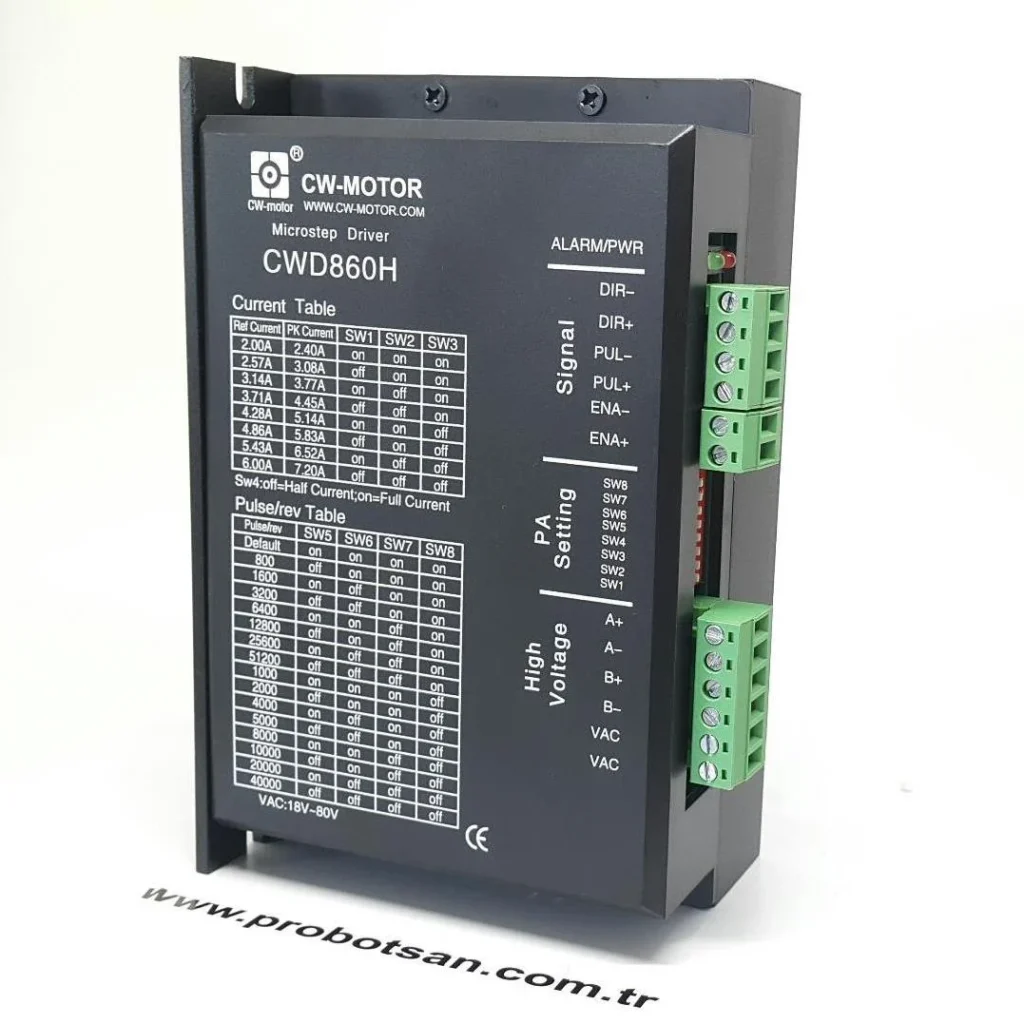
| Parameter | Value/Description |
|---|---|
| Current Control Type | Constant Current Chopper (PWM) |
| Microstep Resolution | Adjustable from 1/1 to 1/256 |
| Maximum Output Current | 5.6A Peak (4.0A RMS) |
| Supply Voltage Range | 18-80 VDC |
| Resonance Damping | Active Anti-Resonance Algorithm |
| Protection Features | Overcurrent, Overvoltage, Undervoltage, Overtemperature, Short Circuit |
| Communication Interface | Step/Dir, Enable, RS-485 (Modbus RTU) |
| Operating Temperature Range | -20°C to +65°C |
| Feedback Capability | Optional Encoder Input (Closed-Loop Mode) |
Field Considerations for Industrial CNC Router Systems
- Motor-Driver Matching: The driver’s maximum output current and supply voltage range must be compatible with the nominal current and voltage values of the step motor used. The motor’s inductance and impedance are also factors affecting driver performance. Incorrect matching can lead to insufficient motor torque, overheating, or step loss. Strict adherence to manufacturer datasheets is crucial, and if possible, preferring motor and driver sets from the same brand is recommended.
- Cabling Quality and EMC: Step motor cables carry high current pulses and thus have the potential to emit electromagnetic noise (EMC). Running control signal cables (Step, Dir, Enable) separately from motor power cables, and preferably shielded, is vital to maintain signal integrity and prevent interference with the control system. Attention must be paid to the grounding scheme and cable length limits.
- Thermal Management and Mounting: Drivers generate significant heat, especially when operating at high currents. The driver’s mounting surface should be a metal panel capable of dissipating heat, and sufficient airflow must be provided around it. Forced cooling (fan) may be necessary in enclosed panels. The ambient temperature must remain within the driver’s specified operating temperature range; excessive temperature shortens the driver’s lifespan and can cause protection mechanisms to activate, shutting down the system.
- Power Supply Selection and Capacity: Providing adequate and stable power to the driver is extremely important. The power supply’s output voltage must be within the driver’s operating range, and its current capacity must meet the maximum current requirements of the driver and motor. Leaving a margin to handle current peaks that may occur during sudden accelerations and decelerations is important for system stability. Low-quality or insufficient power supplies negatively affect driver performance due to voltage drops and fluctuations.
- Parameter Settings and Optimization: The optimal microstep resolution, current limits, acceleration/deceleration ramps, and resonance damping settings may vary for each application. Correctly setting these parameters via the driver’s software interface or DIP switches ensures the motor operates most efficiently and smoothly. Trial-and-error and systematic testing help find the optimal settings.

Common Issues and Solutions for Step Motor Drivers
1. Motor Vibration or Excessive Noise:
- Causes:
- Low current control quality of the driver.
- Insufficient microstep resolution or poor microstepping algorithms.
- System operating at a resonance frequency.
- Mechanical backlash or connection issues.
- Improper motor matching.
- Solutions:
- Switch to a higher-quality driver offering sinusoidal current control.
- Increase microstep resolution (e.g., from 1/8 to 1/32 or 1/64).
- Enable the driver’s anti-resonance feature or adjust the speed profile to avoid resonance regions.
- Check and tighten mechanical connections.
- Ensure the motor and driver impedance, inductance, and current values are compatible.
2. Step Loss or Positioning Error:
- Causes:
- Insufficient motor torque (high load, low current setting).
- Excessive acceleration or deceleration ramps.
- Mechanical binding or excessive friction.
- Incorrect setting of driver current limits.
- Unstable current control in a low-quality driver.
- Interference in control signals (EMC issues).
- Solutions:
- Increase the driver’s output current to match the motor’s nominal values (ensure the motor does not overheat).
- Extend acceleration and deceleration times to manage inertia.
- Check the mechanical system, reduce friction, or consider a more powerful motor/driver combination.
- Use shielded control cables and separate them from motor power cables.
- Upgrade to a closed-loop (encoder-equipped) step driver if necessary.
3. Motor or Driver Overheating:
- Causes:
- Motor current set too high.
- Insufficient cooling (for driver or motor).
- Improper motor or driver matching (e.g., driving a high-inductance motor with a low-voltage driver).
- Driver operating at low efficiency.
- High ambient temperature.
- Solutions:
- Reduce motor current, but ensure it meets torque requirements.
- Provide additional cooling (fan, larger heatsink) for the driver and motor.
- Check the driver’s efficiency and thermal design.
- Review the suitability of the motor and driver combination.
- Utilize the idle current reduction feature.
4. Irregular Movement or Jerking at Low Speeds:
- Causes:
- Insufficient microstep resolution.
- Poor quality of the driver’s microstep current waveforms (non-sinusoidal).
- Resonance effects.
- Solutions:
- Increase the microstep setting (e.g., from 1/16 to 1/128).
- Use a high-quality driver with advanced microstepping algorithms.
- Check the anti-resonance feature.
Expert Advice
The quality of a step motor driver undeniably has a decisive impact on the performance, reliability, and lifespan of industrial automation systems. While choosing a cheap or low-quality driver might offer a short-term cost advantage, in the long run, it can lead to countless problems such as system vibration, noise, step loss, positioning errors, overheating, and frequent malfunctions. These issues result in production losses, increased maintenance costs, decreased product quality, and even safety risks, creating costs that far exceed the initial savings. As an expert, my advice is to pay as much attention to driver selection as to motor selection in step motor applications. Considering the precision, speed, torque, and operating environment conditions required by your project, a driver with the most suitable technical specifications from a reliable brand should be preferred. Critical parameters such as microstepping quality, current control precision, resonance damping capabilities, and protection features should be examined in detail. If necessary, evaluating more advanced solutions like closed-loop step drivers can enhance the overall stability and reliability of the system. Remember, in industrial automation, the “cheapest” solution often turns into the “most expensive” one. Investing in the right driver guarantees your system will operate smoothly, efficiently, and with high performance for many years. Field experience shows that a quality driver maximizes the motor’s potential while significantly increasing the system’s overall efficiency and durability.
Request a Quote on WhatsApp
For expert advice on selecting the ideal step motor driver for your industrial CNC router machine or other automation needs, and to receive a tailored quote, please contact Mermak CNC directly on WhatsApp. Our team is ready to assist you with high-quality components and solutions.
FAQ
What is the primary function of a step motor driver in an industrial setting?
Step motor drivers convert digital pulse and direction signals from a control system into current pulses for the motor windings. This precise current control allows the motor's rotor to turn by specific angles, enabling accurate positioning and speed control in industrial applications like CNC router machines.
How does a high-quality step motor driver improve the performance of an industrial CNC router?
High-quality drivers offer superior current control, advanced microstepping for smoother motion, effective resonance damping to prevent vibration and step loss, and robust protection features against overcurrent, overvoltage, and overheating. These features ensure higher precision, reliability, and a longer lifespan for the entire system.
What technical specifications should industrial buyers prioritize when selecting a step motor driver?
Key factors include current control accuracy, microstepping resolution (e.g., 1/128 or 1/256), active anti-resonance algorithms, comprehensive protection features (overcurrent, overvoltage, overtemperature), and communication interfaces like RS-485 or EtherCAT for advanced diagnostics and control.
What are the common problems associated with low-quality step motor drivers, and how can they be resolved?
Common issues include motor vibration, step loss, positioning errors, and overheating. These are often caused by low-quality current control, insufficient microstepping, resonance, improper motor-driver matching, or inadequate thermal management. Solutions involve upgrading to a better driver, optimizing settings, ensuring proper cooling, and using shielded cabling.
Beyond the driver itself, what other field considerations are important for optimal step motor system performance?
Proper motor-driver matching, high-quality shielded cabling for EMC, effective thermal management for both motor and driver, a stable and adequately sized power supply, and meticulous parameter optimization are crucial for maximizing performance and longevity in industrial applications.