







































































Understanding the Differences: Helical vs. Straight Racks in CNC Machinery

📑 Table of contents (Click to open)
Practical notes for CNC router, automation and industrial motion systems.
Helical vs. Straight Racks: Understanding the Core Differences in Motion Control
In the realm of industrial automation and motion control, the precise conversion of rotary motion to linear motion is fundamental. Rack and pinion systems, particularly for long-stroke applications, offer a compelling balance of cost-effectiveness and speed compared to ball screws or linear motors. However, the choice between a straight rack and a helical rack is paramount, significantly influencing system performance, longevity, and maintenance requirements. Understanding their distinct characteristics is key to optimizing any CNC router machine or industrial CNC router setup.
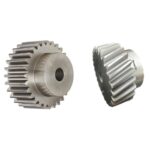
Straight racks feature teeth that are parallel to the rack’s longitudinal axis. Helical racks, conversely, have teeth that are angled relative to this axis, creating a spiral or helical form. This fundamental geometric difference dictates their operational behavior, load-bearing capabilities, noise levels, and suitability for various industrial applications.
Operational Principles and Technical Specifications
Rack and pinion systems are integral to many automated systems. The selection of the appropriate rack type directly impacts the efficiency and reliability of the entire motion control system, from the spindle motor’s power transmission to the precision of the linear guide rail movement.
Straight Rack (Düz Kremayer)
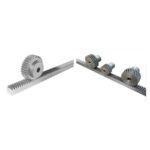
The straight rack is the most common and simplest type of gear rack. Its teeth are cut straight and parallel to the rack’s length. When meshed with a pinion, the pinion’s teeth engage the rack’s teeth across their full width simultaneously.
- Simple Design and Manufacturing: The straight tooth geometry simplifies production, often resulting in lower manufacturing costs.
- High Rigidity: Full tooth engagement can provide good rigidity under specific load conditions.
- No Axial Thrust: Straight teeth do not generate axial forces on the pinion or its bearings, simplifying bearing selection and system design.
- Lower Load Capacity: Load is concentrated on a few teeth at any given moment. This can lead to faster wear or damage under high torque or shock loads.
- Noisier Operation: The abrupt engagement and disengagement of teeth create a “clacking” sound and vibration, especially at higher speeds.
- Suitable for Lower Speed, Moderate Precision: Often used in applications where noise is not a primary concern and high precision is not critical, such as simple automation, gate openers, or general-purpose material handling.

Helical Rack (Helis Kremayer)
Helical racks feature teeth that are angled relative to the rack’s axis. When meshed with a helical pinion, this angled design allows for gradual, smooth tooth engagement and disengagement.
- Higher Load Capacity: Multiple teeth are in contact simultaneously, distributing the load over a wider area. This significantly increases load-carrying capacity and extends service life.
- Quieter and Smoother Operation: The gradual engagement eliminates the “clacking” effect, resulting in much quieter operation and reduced vibration. This is crucial for high-speed and precision applications.
- Enhanced Precision and Smoothness: Continuous, smooth tooth contact provides superior motion transfer and higher positioning accuracy, essential for demanding tasks on CNC machines and robotic systems.
- Generates Axial Thrust: The angled teeth create an axial force that must be managed by the pinion’s bearing system. This requires careful selection of thrust-capable bearings, such as angular contact or tapered roller bearings.
- More Complex Manufacturing and Higher Cost: The angled tooth profile requires more sophisticated manufacturing processes and tooling, leading to a higher unit cost compared to straight racks.
- Ideal for High Speed and Precision: Preferred for high-performance CNC machinery, robotics, laser cutters, and other applications demanding high speed, accuracy, and minimal noise.
| Parameter | Straight Rack | Helical Rack |
|---|---|---|
| Tooth Geometry | Parallel to rack axis, straight | Angled to rack axis (helix angle) |
| Load Capacity | Moderate (Load concentrated) | High (Load distributed) |
| Noise & Vibration | Higher (especially at speed) | Lower (gradual engagement) |
| Axial Thrust | None | Present (requires bearing support) |
| Manufacturing Complexity | Simpler | More complex |
| Cost | Generally lower | Generally higher |
| Precision & Smoothness | Moderate | High |
| Typical Applications | Basic automation, general machinery | CNC machines, robotics, high-speed systems |

Key Considerations for Implementation
- Mounting Precision and Alignment: For helical racks, precise alignment between the pinion and rack is critical to ensure proper tooth engagement and maximize system life. Misalignment leads to accelerated wear and increased noise. While straight racks are more tolerant, precision mounting is always recommended for optimal performance.
- Axial Load Management (Helical Racks): The axial thrust generated by helical racks must be adequately supported by the pinion’s bearing system. Failure to do so can lead to bearing failure and system malfunction.
- Backlash Control: Minimizing backlash (the clearance between pinion and rack teeth) is crucial for precision applications. While helical racks generally offer better backlash control, especially with preloaded systems, proper adjustment is necessary for both types.
- Lubrication: Consistent and appropriate lubrication is vital for both rack types to reduce friction, wear, and heat buildup, thereby extending their operational life.
Conclusion
The choice between a helical and a straight rack depends heavily on the specific requirements of your industrial application. For high-speed, high-precision, and quiet operations, such as those found in advanced CNC router machines and robotic systems, helical racks are the superior choice, despite their higher cost and the need for careful bearing selection. For less demanding applications where cost is a primary driver and noise is less of a concern, straight racks can provide a reliable and economical solution.
By understanding these fundamental differences, engineers and machine builders can make informed decisions to optimize the performance, accuracy, and durability of their linear motion systems. For expert advice on selecting the right rack and pinion system for your industrial CNC needs, contact our specialists.
Ready to enhance your machine’s performance? Request a quote on WhatsApp today!
Related product categories: Helis Kremayer · Düz Kremayer · Genel
