






































































Helical vs. Spur Rack: Understanding the Differences for Industrial Applications

📑 Table of contents (Click to open)
Helical racks offer quieter, higher load capacity, and more precise movement due to their angled teeth, while spur racks are simpler, cheaper, but generate more backlash, noise, and vibration. Understanding these differences is crucial for selecting the right linear motion system for your industrial application.
Practical notes for CNC router, automation and industrial motion systems.
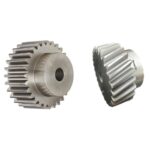
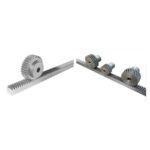
In industrial automation, achieving precise linear motion is fundamental. The rack and pinion system is a cornerstone of this technology, converting rotary motion into linear motion. Within this system, the choice between a helical rack and a spur rack significantly impacts performance, efficiency, and overall system behavior. The core distinction lies in the geometry of their teeth. Spur racks feature teeth that are straight and parallel to the rack’s axis, while helical racks have teeth cut at an angle (helix angle).
How They Work: Tooth Geometry and Contact
The fundamental difference in how these racks operate stems directly from their tooth design and the resulting contact pattern with the pinion gear. This difference dictates their performance characteristics in demanding industrial environments.
Spur Rack (Straight Rack)
Spur racks have teeth that run straight along the length of the rack, perpendicular to the direction of motion. When a spur pinion engages with a spur rack, a single tooth on the pinion makes full contact with a single tooth on the rack simultaneously. This contact is instantaneous: a tooth pair comes into full engagement and then disengages completely. This abrupt engagement and disengagement can lead to:
- Impact Loads: Sudden force transfer during engagement.
- Noise and Vibration: The abrupt contact generates audible noise and mechanical vibrations, especially at higher speeds.
- Backlash: A certain amount of play or clearance (backlash) is inherent between the mating teeth. This can lead to positioning inaccuracies, particularly when reversing direction.
Despite these drawbacks, spur racks are simpler to manufacture, making them a more cost-effective solution. They are typically used in applications where high precision is not the primary concern, such as simpler automation lines, gate mechanisms, or manual positioning systems.
Helical Rack (Helical Rack)
Helical racks feature teeth that are cut at an angle relative to the rack’s axis. This angled design creates a gradual engagement and disengagement process between the pinion and rack teeth. As one tooth pair begins to disengage, the next tooth pair is already coming into contact and taking over the load. This continuous, rolling contact offers several advantages:
- Smooth and Quiet Operation: The gradual engagement significantly reduces noise and vibration, leading to a much smoother operational feel.
- Higher Load Capacity: The load is distributed across multiple teeth simultaneously, reducing stress on individual teeth and allowing for higher torque and force transmission.
- Increased Precision and Reduced Backlash: The continuous contact minimizes backlash, enabling much higher positional accuracy, which is critical for applications like CNC machining.
- Reduced Wear: Load distribution and smoother contact lead to less wear on both the rack and pinion, extending their service life.
The main considerations for helical racks are their more complex manufacturing process, which increases cost, and the generation of an axial thrust force due to the helix angle. This axial force must be managed by the pinion’s bearing system to prevent premature wear or system instability.
Technical Specifications and Considerations
Both helical and spur racks share common technical parameters such as module (tooth size), pressure angle (tooth profile angle), material (typically alloy steel), hardness (achieved through heat treatment), and precision class (defined by DIN or ISO standards). However, helical racks introduce the helix angle as a critical parameter, directly influencing noise levels, load capacity, and the magnitude of axial thrust forces.
For high-precision applications, hardening and grinding (ground racks) are common processes for both types. These processes enhance surface hardness, reduce friction and wear, and improve the accuracy of the tooth profile, further minimizing backlash.
| Parameter | Spur Rack (Straight Rack) | Helical Rack (Helical Rack) |
|---|---|---|
| Tooth Geometry | Straight teeth, parallel to the rack’s axis. | Teeth angled at a specific helix angle relative to the axis. |
| Tooth Contact | Instantaneous; full contact and separation occur simultaneously on one tooth pair. | Gradual and continuous; load is shared across multiple teeth. |
| Backlash | Generally higher. | Minimized, enabling high precision. |
| Noise & Vibration | Higher levels. | Significantly lower, smoother operation. |
| Load Capacity | Suitable for moderate loads. | Ideal for high and very high loads. |
| Precision & Speed | Low to moderate precision and speed. | Very high precision, high to very high speeds. |
| Axial Thrust Force | Negligible. | Generated on pinion and bearings; requires management. |
| Cost & Manufacturing | Lower cost, simpler production. | Higher cost, more complex production. |
| Typical Applications | Simple automation, gate mechanisms, manual positioning. | CNC machines, robotics, heavy-duty gantry systems, laser cutters. |
Key Considerations for Implementation
- Mounting Precision and Alignment: For helical racks, precise alignment between the pinion and rack is critical. Misalignment accelerates wear and increases noise. The bearing system for the pinion must be designed to handle the axial thrust forces generated by helical teeth. While alignment is important for spur racks, it is not as critically sensitive as with helical types.
- Lubrication and Maintenance: Both rack types require regular and appropriate lubrication to reduce friction, prevent wear, and protect against corrosion. Helical racks, due to their continuous contact, may benefit from more consistent lubrication. Automatic lubrication systems are highly recommended for continuous operation or hard-to-reach systems. The type of lubricant (grease or oil) and its frequency should follow manufacturer recommendations and operational conditions.
- Environmental Factors: The operating environment (dust, moisture, temperature) significantly impacts the choice of rack and its lifespan. Stainless steel or specially coated racks may be necessary for corrosive environments. High temperatures can degrade lubricant performance, while low temperatures can increase lubricant viscosity, leading to higher friction. Dust can act as an abrasive, causing rapid wear; protective bellows or seals should be considered in such conditions.
- Backlash Adjustment: In high-precision applications, especially with spur racks, adjustable pinion systems or split pinion designs are used to minimize backlash. This ensures the accuracy required for tasks like precise cutting or assembly on CNC machinery.
Choosing between a helical and spur rack depends on a careful evaluation of application requirements, including speed, load, precision needs, noise tolerance, and budget. For demanding industrial applications like high-performance CNC routers, servo-driven systems, and automated manufacturing lines, the superior precision, smoother operation, and higher load capacity of helical racks often make them the preferred choice, despite their higher initial cost.
Ready to optimize your linear motion system? Request a quote on WhatsApp today to discuss your specific needs with our experts.
Related product categories: General · Electronics · Combination Packages