No products in the cart.
Why Ethernet Control Cards Offer Superior Stability in Industrial Automation
Contents
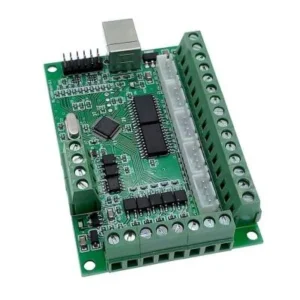
Ethernet control cards are revolutionizing industrial automation with their superior stability. Offering high bandwidth, deterministic protocols, and robust noise immunity, they ensure reliable data communication for critical applications. This article explores the technical advantages that make Ethernet control cards the preferred choice for modern CNC router machines and automated systems.
Mermak CNC Technical Guide
Practical notes for CNC router, automation and industrial motion systems.
Understanding the Stability of Ethernet Control Cards in Industrial Automation
In the realm of industrial automation, the speed, reliability, and stability of data communication are paramount for production efficiency and system integrity. Ethernet-based control cards are rapidly replacing traditional serial communication methods (like RS-232, RS-485), becoming the backbone of modern automated systems. An Ethernet control card acts as the hardware interface, enabling industrial devices such as PLCs (Programmable Logic Controllers), DCS (Distributed Control Systems), or RTUs (Remote Terminal Units) to communicate over a network with sensors, actuators, motors, and other control units. These cards not only facilitate data transfer but also support real-time operations, enhancing the precision and repeatability of automation processes. Stability, in this context, refers to the ability to deliver predictable and uninterrupted performance without data loss, excessive latency, or jitter. The superior stability of Ethernet control cards stems from a combination of advanced physical layer designs, intelligent data link layer management, deterministic protocol integration, and strict adherence to electromagnetic compatibility (EMC) standards.
Principles of Operation and Technical Specifications
The stability of Ethernet control cards is achieved through several engineering principles and technical features, specifically designed to withstand the demanding conditions of industrial environments:
- Robust Physical Layer: Industrial Ethernet employs more durable physical layer components than standard office Ethernet. Specialized industrial connectors (M12, IP67-rated RJ45) offer high protection against vibration, moisture, dust, and chemicals. Cables are typically shielded (STP/FTP) twisted pair, increasing resistance to electromagnetic interference (EMI). Fiber optic cables provide absolute electrical isolation, especially for long distances and high-noise environments, offering the highest level of stability.
- Deterministic Protocols: Traditional Ethernet’s CSMA/CD (Carrier Sense Multiple Access with Collision Detection) is not sufficiently deterministic for automation. Industrial Ethernet control cards support real-time protocols like Profinet, EtherCAT, Ethernet/IP, and Sercos III. These protocols manage data packet transmission on the network according to strict, predefined schedules, ensuring data flow with minimal latency and jitter. EtherCAT, for instance, processes data “on the fly” for near-zero latency, while Profinet IRT (Isochronous Real-Time) enables synchronized data exchange for high precision.
- High Bandwidth and Full-Duplex Communication: Industrial Ethernet cards typically operate at high speeds, such as 100 Mbps or 1 Gbps. Full-duplex communication allows simultaneous data sending and receiving, eliminating collisions and boosting network efficiency. This high bandwidth supports the rapid and uninterrupted transfer of large data sets and complex control signals.
- Switched Network Architecture: Ethernet switches provide each device with a dedicated connection, resolving shared bandwidth issues and allowing each device to utilize its full bandwidth. Switches manage data collisions at the switch level. Industrial switches offer advanced features like port-based VLANs (Virtual Local Area Networks), QoS (Quality of Service) for prioritizing critical data, and redundancy protocols (MRP – Media Redundancy Protocol, DLR – Device Level Ring) to maximize network stability and reliability.
- Advanced Error Detection and Correction: Ethernet control cards and protocols utilize robust error detection algorithms like CRC (Cyclic Redundancy Check) to instantly identify corrupted data during transmission. Some systems also incorporate error correction or automatic retransmission mechanisms at the protocol level to ensure data integrity.
- Electromagnetic Compatibility (EMC): Industrial environments are rife with electromagnetic noise from motors, variable frequency drives, and high-power equipment. Ethernet control cards are specifically designed to resist such interference through internal shielding, isolated power supplies, filtering circuits, and robust PCB layouts. Compliance with international EMC standards like IEC 61000 ensures reliable operation in harsh industrial conditions.
- Integrated Microcontrollers and ASICs: Modern Ethernet control cards often feature powerful integrated microcontrollers or ASICs (Application-Specific Integrated Circuits) to efficiently manage network protocols and real-time communication. This hardware acceleration reduces CPU load and minimizes data processing delays.
| Parameter | Value/Description |
|---|---|
| Protocol Support | Profinet, EtherCAT, Ethernet/IP, Modbus TCP, Sercos III |
| Transmission Speed | 10/100 Mbps (Fast Ethernet), 1000 Mbps (Gigabit Ethernet) |
| Latency | Typically < 1 ms (protocol dependent) |
| Jitter | Typically < 1 µs (protocol dependent) |
| Physical Layer | Copper (STP/FTP), Fiber Optic (Multimode/Singlemode) |
| Connector Type | Industrial RJ45 (IP20/IP67), M12 D-Code/X-Code |
| EMC Compliance | IEC 61000 Series (High Immunity for Industrial Environments) |
| Topology Support | Line, Star, Ring (with managed switches) |

Key Considerations for Field Implementation
- Proper Cable Selection and Installation:
Use industrial-grade STP or FTP cables resistant to vibration, oil, chemicals, and temperature fluctuations. Correct cable shielding and grounding are crucial for mitigating electromagnetic interference. Adhere to cable bend radii and route cables away from power lines and high-current conductors. For long distances or high-noise environments, fiber optic cables offer superior stability through electrical isolation.
- Effective Grounding and Shielding:
Ensure all network components (control cards, switches, panels) are properly grounded with low impedance connections. Grounding both ends of shielded cables maximizes noise absorption. Avoid creating ground loops; connect the entire system to a single common ground point. Improper grounding can lead to network noise and data corruption.
- Intelligent Network Design and Managed Switches:
Employ managed industrial Ethernet switches instead of simple hubs. These switches provide advanced features for traffic optimization, network segmentation via VLANs, data prioritization with QoS, and network resilience through redundancy protocols (MRP, DLR). Ensure switches have appropriate IP ratings (e.g., IP67) and can operate within industrial temperature ranges. Network topology should be designed for optimal performance and reliability, often utilizing ring or line configurations for redundancy.
- Environmental Protection:
Select control cards and network components with appropriate IP ratings for the operating environment to protect against dust and moisture. Ensure components are rated for the expected ambient temperature range. Proper ventilation or cooling may be necessary in enclosed control cabinets.
- Firmware and Software Updates:
Keep the firmware of control cards and network devices up-to-date to benefit from performance improvements, bug fixes, and enhanced security features. Ensure compatibility between device firmware and the control system software.
By carefully considering these factors, industrial facilities can leverage the inherent stability of Ethernet control cards to build highly reliable and efficient automated systems. This enhanced stability is critical for demanding applications such as high-speed CNC machining, complex robotic assembly lines, and continuous process control where downtime is costly and precision is non-negotiable.
For robust and reliable automation solutions, including advanced CNC router machines equipped with cutting-edge control systems, Mermak CNC is your trusted partner. Explore our range of industrial automation components and discover how we can enhance your production capabilities.
Ready to optimize your industrial automation? Request a quote on WhatsApp today!
Related product categories: General · Electronics · Combination Packages