
No products in the cart.
Dual Shaft Stepper Motors: Applications in Industrial Automation Projects

Contents
- Dual Shaft Stepper Motors: Introduction and Technical Analysis At the heart of industrial automation lie numerous systems relying on precise motion control and positioning capabilities. Stepper motors are fundamental components of these systems. While standard single shaft stepper motors address common needs like driving a specific load or connecting an encoder, some specialized automation projects demand greater flexibility and functionality. This is precisely where dual shaft stepper motors come into play. These motors distinguish themselves from standard models by offering two independent or synchronously usable shaft outputs, one at the front and one at the rear. This technical feature provides engineers and system integrators with unique design advantages. Dual shaft motors become an indispensable solution, especially when the load needs to be driven from two points, when a feedback device (encoder) or a braking mechanism needs to be attached to one shaft while the other drives the load, or even when a handwheel is required for manual positioning. This guide aims to provide a comprehensive overview for industry professionals, delving into the role of dual shaft stepper motors in industrial automation, their technical details, and potential application areas. Dual Shaft Stepper Motors: Operating Principle and Technical Data
- Practical Considerations for Dual Shaft Stepper Motors in the Field
- Common Issues and Solutions for Dual Shaft Stepper Motors
- Dual Shaft Stepper Motors: Conclusion and Expert Advice
- FAQ
Dual Shaft Stepper Motors: Introduction and Technical Analysis
At the heart of industrial automation lie numerous systems relying on precise motion control and positioning capabilities. Stepper motors are fundamental components of these systems. While standard single shaft stepper motors address common needs like driving a specific load or connecting an encoder, some specialized automation projects demand greater flexibility and functionality. This is precisely where dual shaft stepper motors come into play. These motors distinguish themselves from standard models by offering two independent or synchronously usable shaft outputs, one at the front and one at the rear. This technical feature provides engineers and system integrators with unique design advantages. Dual shaft motors become an indispensable solution, especially when the load needs to be driven from two points, when a feedback device (encoder) or a braking mechanism needs to be attached to one shaft while the other drives the load, or even when a handwheel is required for manual positioning. This guide aims to provide a comprehensive overview for industry professionals, delving into the role of dual shaft stepper motors in industrial automation, their technical details, and potential application areas.
Dual Shaft Stepper Motors: Operating Principle and Technical Data
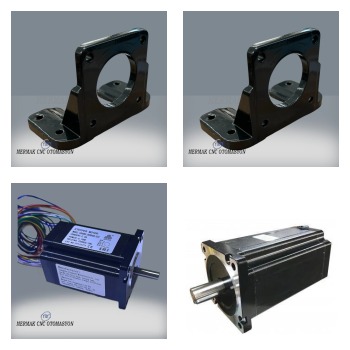
Dual shaft stepper motors operate on the same fundamental principle as their single shaft counterparts: the rotor rotates in discrete steps through the sequential activation and deactivation of magnetic fields. However, the distinguishing feature of these motors is that they offer a shaft extension from both sides of the motor body. This allows one shaft to serve as the primary drive while the other shaft is used for a secondary function. For instance, while one shaft directly moves a mechanical load (gearbox, belt pulley, lead screw, etc.), an absolute encoder or incremental encoder can be attached to the other shaft to provide position feedback. This facilitates easier and more compact integration of closed-loop control systems, thereby increasing position accuracy and repeatability. Furthermore, an electromagnetic brake can be installed on the second shaft, providing additional safety and load-holding capability in case of power failure or when the motor is in a stopped position. This is a critical feature, especially for vertical axis applications or systems requiring precise positioning.
Dual shaft stepper motors also offer advantages in terms of torque distribution and load balancing. By applying load to both shafts of a motor simultaneously, stress on the motor can be reduced, and the mechanical system can operate more stably. This is evident in applications such as long conveyor belts, two different mechanisms requiring synchronized movement, or robotic arms performing two different functions simultaneously. For example, one shaft can drive a motion axis while the other synchronizes a material feeding mechanism. This synchronization increases efficiency in production lines while minimizing potential errors and downtime.
From a technical data perspective, dual shaft stepper motors, like their single shaft equivalents, are available in various sizes (NEMA 17, NEMA 23, NEMA 34, etc.), step angles (1.8°, 0.9°, etc.), holding torque values, and current ratings. The main parameters to consider when making a selection are:
- Holding Torque: The motor’s ability to hold its rotor in a specific position when energized. It must be sufficient to hold the load required by the application in a static state.
- Dynamic Torque: The torque the motor can generate while in motion. It generally decreases as speed increases. Important for the capacity to move and accelerate the load.
- Step Angle: The angle the motor rotates with each electrical pulse (e.g., 1.8° or 0.9°). Smaller step angles provide higher resolution and more precise positioning.
- Current/Phase: The nominal current flowing through the motor windings. This value is critical for selecting the motor driver.
- Inductance and Resistance: Determine the electrical characteristics of the motor and affect driver performance, especially torque at high speeds.
- Inertia: The rotor’s resistance to rotation. High inertia motors can carry larger loads but may take longer to accelerate.
- Shaft Diameter and Length: Important for compatibility with mechanical components to be connected (couplings, gears, encoders).
These motors find application in a wide range of fields such as CNC machines (axis positioning and feedback), 3D printers (axis movements and filament feeding), robotic arms (precise joint movements), textile machinery (thread tension control, fabric feeding), packaging machines (product positioning, film pulling), medical devices (dosing, analysis equipment), imaging and optical systems (camera sliders, lens focusing), and laser cutting/engraving machines. Thanks to their flexibility, they allow multiple functions to be performed with a single motor in complex automation scenarios, which can reduce system cost and complexity.
| Parameter | Value/Description |
|---|---|
| Shaft Configuration | Front and Rear Dual Output |
| Step Angle | 1.8° (Full Step), 0.9° (High Resolution) |
| Holding Torque Range | 0.1 Nm – 20 Nm (varies by NEMA size) |
| Phase Current | 0.5 A – 6.0 A (adjustable by motor model) |
| Operating Voltage | 12 VDC – 80 VDC (depending on driver) |
| Purpose of Use (Secondary Shaft) | Encoder Connection, Brake Connection, Second Load Drive, Manual Control |
| Environmental Protection | IP40 – IP65 (depending on model and application) |
Practical Considerations for Dual Shaft Stepper Motors in the Field
- Correct Load Distribution and Mechanical Connection: When loads are applied to both shafts of a dual shaft motor, ensure that these loads do not exceed the motor’s nominal torque capacity and are distributed evenly. Couplings, gears, or pulleys connected to the shafts must be perfectly aligned axially and radially. Misalignment can put excessive stress on motor bearings, leading to premature failures and vibration. Vibration must be minimized, especially on the shaft where sensitive components like encoders or brakes are attached.
- Thermal Management and Cooling: Stepper motors can generate significant heat, especially at high currents and during prolonged operation. In dual shaft motors, having both sides of the motor body surrounded by mechanical components can restrict natural airflow. This can lead to motor overheating and performance degradation. Adequate air circulation must be ensured to keep the motor operating within its nominal temperature range; if necessary, additional cooling blocks or fans should be used. Overheating can damage winding insulation and shorten motor life.
- Encoder and Brake Integration: When an encoder or brake is attached to the second shaft, ensure these components are compatible with the motor’s dynamics. The encoder’s resolution must meet the application’s precision requirements. The brake’s torque must be sufficient for the load to be stopped or held, and its reaction time must be suitable for critical applications. Furthermore, it is important to ensure that the mounting of the encoder or brake does not adversely affect the motor’s vibration characteristics and that it is securely seated on the shaft. Feedback cables must be properly shielded and routed to prevent electromagnetic interference (EMI).
- Driver Selection and Settings: The performance of dual shaft motors is directly related to the stepper motor driver used. The driver must be compatible with the motor’s nominal current and provide smoother motion and less vibration through micro-stepping features. Additionally, acceleration/deceleration ramps and step frequencies must be set correctly, taking into account the motor’s inertia and load. Incorrect driver settings can lead to step losses, overheating, or unwanted motor noise. Advanced drivers can provide more stable operation with features like resonance damping.
- Environmental Factors: Factors such as temperature, humidity, dust, and vibration of the operating environment must be considered. In industrial environments, motors with a high IP (Ingress Protection) rating are generally preferred. For motors operating in dusty or humid environments, motors with appropriate protection classes (e.g., IP65) should be selected, or the motors should be enclosed in protective housings. Excessive vibration can cause shaft connections to loosen or encoders to read incorrectly.
Common Issues and Solutions for Dual Shaft Stepper Motors
Despite their advantages, dual shaft stepper motors can encounter some common issues in incorrect installation or usage scenarios. One of the most frequent problems is missing steps. This usually occurs when the motor’s instantaneous torque demand exceeds its available torque capacity, due to incorrect driver current settings, overly high acceleration ramps, or excessive friction/load in the mechanical system. As a solution, ensure the motor current is correctly set, extend acceleration/deceleration times, reduce the motor’s load, or consider selecting a higher torque motor. In closed-loop systems, step losses can be detected and corrected instantly with encoder feedback.
Another common issue is overheating. If the motor’s operating temperature exceeds its normal range, it can damage winding insulation and shorten motor life. Causes of overheating include high current settings, insufficient cooling, continuous operation under heavy load, or incompatibility between the driver and the motor. To resolve this, ensure the driver current is set according to the motor’s nominal current, control the ambient temperature, and if necessary, use additional cooling fans or passive cooling elements. Adding a thermal sensor to the motor to monitor temperature can also help detect potential failures in advance.
Vibration and noise are also common problems in stepper motors. This typically results from mechanical resonance, incorrect micro-stepping settings, loose mechanical connections, or excessively high step frequencies. Solutions include increasing the driver’s micro-stepping settings (e.g., moving from full step to 1/8 or 1/16 micro-step), checking and tightening mechanical connections, optimizing speed profiles to avoid resonance regions, or using vibration-damping couplings. Some advanced drivers have active resonance damping algorithms that can solve these problems via software.
Finally, issues related to the encoder or brake attached to the second shaft can occur. Incorrect or inconsistent data from the encoder can be caused by cable connection problems, electromagnetic interference, or the encoder becoming mechanically loose. Malfunctioning brakes can stem from electrical connection issues, wear of the brake disc, or insufficient brake torque. In such cases, all cable connections and shielding should be checked, ensure the encoder is firmly attached to the shaft, and periodically inspect the electrical and mechanical condition of the brake. If necessary, high-quality, industrial-grade encoders and brakes should be preferred.
Dual Shaft Stepper Motors: Conclusion and Expert Advice
Dual shaft stepper motors offer engineers and system integrators significant flexibility and a range of solutions in the increasingly complex and precision-demanding world of industrial automation. The ability to obtain two separate shaft outputs from a single motor body provides critical advantages, especially in space-constrained applications, cost optimization, and simplification of system integration. Whether it’s encoder integration for closed-loop control, a safety brake for vertical axis applications, or synchronized driving of two different mechanical loads, dual shaft motors provide a singular and efficient response to these needs. The correct selection and implementation of these motors directly impact the system’s overall performance, reliability, and lifespan. Therefore, meticulous evaluation of the motor’s technical specifications (torque, step angle, inertia), driver compatibility, and environmental conditions is essential. Based on my field experience, to fully utilize the potential of these motors, I emphasize the utmost attention not only to the motor itself but also to the quality and proper installation of auxiliary components such as encoders, brakes, and couplings. Furthermore, utilizing the diagnostic features offered by motor drivers for periodic system maintenance and early detection of potential faults will minimize unexpected downtime. In the future, with the widespread adoption of Industry 4.0 and smart factories, dual shaft stepper motors will undoubtedly continue to play an indispensable role in more integrated and multifunctional automation solutions. When combined with the right engineering approach, these motors offer a powerful and reliable motion control solution that will add value to your automation projects.
FAQ
What is the main difference between dual shaft and single shaft stepper motors?
Dual shaft stepper motors offer two independent or synchronously usable shaft outputs, one at the front and one at the rear. This allows for connecting a primary load to one shaft and a secondary device like an encoder, brake, or another load to the other shaft, providing greater flexibility and functionality compared to single shaft motors.
What are the primary industrial applications for dual shaft stepper motors?
Dual shaft stepper motors are widely used in CNC machines for axis positioning and feedback, 3D printers for motion and filament feeding, robotic arms for precise joint movements, textile machinery, packaging machines for product positioning, medical devices, imaging systems, and laser cutting/engraving machines.
What technical specifications should be considered when selecting a dual shaft stepper motor?
Key technical parameters include holding torque, dynamic torque, step angle, current per phase, inductance, resistance, inertia, and shaft diameter/length. These factors determine the motor's suitability for specific load requirements, precision needs, and compatibility with other mechanical and electrical components.
What are common problems encountered with dual shaft stepper motors and how can they be resolved?
Common issues include missing steps, overheating, vibration, and noise. Solutions involve correctly setting driver current, optimizing acceleration/deceleration ramps, ensuring proper cooling, improving mechanical alignment, using micro-stepping, and utilizing vibration-damping couplings or advanced driver features like resonance damping.
What are the critical considerations for integrating encoders or brakes with dual shaft stepper motors?
When integrating an encoder or brake, ensure compatibility with the motor's dynamics, sufficient resolution for encoders, adequate torque and reaction time for brakes. Proper mounting to prevent vibration, correct shielding of feedback cables against EMI, and periodic inspection of electrical and mechanical conditions are crucial.