








































































Consequences of Misaligned Coupling Installation on Industrial Machinery

📑 Table of contents (Click to open)
Improperly installed couplings can drastically shorten machine lifespan, leading to excessive vibration, bearing and seal failures, energy loss, and shaft breakage. This results in production downtime and high maintenance costs, reducing industrial plant efficiency.
Practical notes for CNC router, automation and industrial motion systems.
Understanding Coupling Misalignment in Industrial Applications
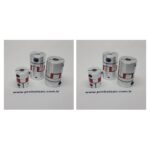
In industrial automation, couplings are essential mechanical components that connect two rotating shafts, facilitating power and motion transmission. Their primary function is to precisely match the shafts of the driving (motor, gearbox) and driven (pump, fan, compressor) machinery, ensuring efficient and safe torque transfer. However, installing a coupling in a “misaligned” state can have devastating consequences for your machinery.
Alignment refers to the precise coaxiality of two shafts, ideally lying on a single straight line or within specific parallel tolerances. Coupling misalignment signifies a deviation from this ideal state, typically manifesting in three main types:
- Angular Misalignment: The shaft centerlines intersect at an angle. Imagine one side of the coupling tilted up while the other is tilted down.
- Parallel Misalignment: The shaft centerlines are parallel but not on the same line; one shaft is offset vertically, horizontally, or both relative to the other.
- Axial Misalignment: While shaft centerlines might be aligned, the coupling experiences excessive axial movement or is compressed beyond its acceptable limits, often due to thermal expansion or installation errors.
These misalignments impose excessive and uneven loads on the coupling’s flexible elements, bearings, seals, and even the motor and driven shafts. Initially, these small deviations might go unnoticed, but over time, they accumulate, leading to severe damage and unexpected failures. Given the precision and continuous operation demands of industrial automation, the importance of accurate coupling alignment cannot be overstated.
How Misalignment Affects Machine Performance and Longevity
Couplings are designed to transfer torque while accommodating a certain degree of misalignment. However, exceeding these limits triggers a cascade of detrimental effects:
- Excessive Vibration and Noise: Misaligned shafts create dynamic imbalances during rotation, causing significant machine vibration. This can damage adjacent equipment, reduce operator comfort, and increase noise pollution. Vibration levels, often measured against ISO 10816 standards, will exceed acceptable limits, signaling a high risk of machine damage.
- Reduced Bearing and Seal Lifespan: Misalignment imposes excessive radial and axial loads on bearings, leading to premature fatigue, overheating, and lubricant film breakdown. Consequently, bearing life can be reduced by up to 50-70% of its expected operational life. Similarly, seals subjected to uneven shaft movement will experience accelerated wear, leading to leaks and environmental contamination.
- Energy Loss and Decreased Efficiency: A misaligned system requires more energy to transmit torque due to increased friction and heat generation. This forces the motor to consume more power than its nominal rating, increasing operational costs and reducing overall plant energy efficiency. Studies indicate that significant misalignment can lead to an additional 5-15% in energy consumption.
- Shaft Breakage and Equipment Damage: Continuous exposure to excessive stress and vibration can cause shafts to fatigue, crack, and eventually break. This catastrophic failure can also damage the connected motor rotor, pump impeller, or other critical components, often resulting in costly repairs and extended production downtime.
- Accelerated Wear of Coupling Components: The coupling itself suffers greatly from misalignment. Flexible elements in couplings (e.g., elastomer, rubber, or grid couplings) wear out, crack, or disintegrate much faster than intended. Gear teeth in gear couplings can wear down, and lamellae in lamellar couplings can fracture, significantly shortening the coupling’s service life and necessitating frequent replacements.
- Production Losses and Safety Risks: Machine failures lead to unplanned downtime, reducing operational efficiency and increasing costs. Furthermore, components ejected from high-speed rotating machinery during sudden failures pose serious safety hazards to personnel.
| Parameter | Value/Description |
|---|---|
| Type of Misalignment | Angular, Parallel, Combined (including axial movement) |
| Acceptable Tolerances | Typically 0.05 mm (0.002 in) parallel offset and 0.05 mm/100 mm (0.0005 in/in) angular offset. Laser alignment achieves higher precision. |
| Bearing Life Impact | Misalignment can reduce bearing life by 50-70%; causes overheating and premature fatigue. |
| Energy Consumption Increase | Significant misalignment can cause an additional 5-15% increase in motor power consumption. |
| Vibration Levels | Misalignment can push vibration levels into “unacceptable” or “dangerous” zones per ISO 10816 standards. |
| Coupling Component Wear | Wear in elastomer elements can occur within 3-6 months; severe damage in metal components within 1-2 years (normal life: 5-10 years). |
| Common Causes | Incorrect installation, ignoring thermal expansion, foundation settling, bearing wear, pipe strain. |
Key Considerations for Industrial Applications
- Proper Coupling Selection and Installation: Choosing a coupling with the correct torque capacity, speed range, and misalignment compensation capability for the specific application is crucial. While flexible couplings can tolerate some misalignment, rigid couplings demand near-perfect alignment.
- Precision Alignment Techniques: Utilizing precision alignment tools, such as laser alignment systems, is essential for achieving and verifying the required shaft alignment tolerances. This is particularly important for high-speed or high-precision machinery.
- Regular Maintenance and Monitoring: Implementing a proactive maintenance schedule that includes regular checks for vibration, temperature, and visual inspection of couplings and seals can help detect misalignment issues early before they cause significant damage.
- Understanding Thermal Expansion: Account for thermal expansion of shafts and machinery components during the alignment process. This is especially critical in applications with significant temperature fluctuations.
- Foundation and Structural Integrity: Ensure the machine’s foundation is stable and free from excessive vibration or deformation, as this can directly impact shaft alignment over time.
Investing in proper alignment procedures and quality components like those found in couplings is not just a maintenance task; it’s a critical factor in ensuring the reliability, efficiency, and longevity of your industrial CNC router machines and other automated equipment. Proper alignment minimizes wear, reduces energy consumption, and prevents costly downtime.
Ensure your industrial CNC router machines and other critical equipment operate at peak performance. Proper alignment of components like couplings is vital for efficiency and longevity. Request a quote on WhatsApp to discuss your specific needs and how Mermak CNC can provide solutions.
Related product categories: Electronics · Combination Packages · Linear Guides, Bearings, and Housings