




















































































CNC Tooling Types: Differences Between Carbide, Diamond, and HSS Cutters
📑 Table of contents (Click to open)
Introduction and Technical Analysis
At the heart of industrial automation, CNC (Computer Numerical Control) machines are indispensable for modern manufacturing. The performance, machining quality, and production efficiency of these machines are directly dependent on the correct selection and optimal use of cutting tools. Among the various CNC tooling types, High-Speed Steel (HSS), Carbide, and Diamond (PCD/CVD) materials constitute the three main categories most commonly encountered in industrial applications, each with distinct differences. This field guide and technical article aims to provide a comprehensive reference for engineers and technicians by deeply examining the technical specifications, operating principles, advantages, disadvantages, and correct selection criteria of these three fundamental cutter types within the context of industrial automation. Proper tool selection is a critical engineering decision that directly impacts not only part quality but also production costs, tool life, and overall operational efficiency. Therefore, understanding the unique characteristics of each material is vital for gaining a competitive advantage in complex manufacturing environments.
Operating Principles and Technical Data
The primary function of CNC cutting tools is to remove material from a workpiece in a controlled manner to achieve the desired geometry. This process is characterized by high mechanical stress, friction, and heat generation at the point where the cutting tool contacts the workpiece. How well the tool material withstands these harsh conditions is the fundamental factor determining cutting performance, tool life, and machining quality.
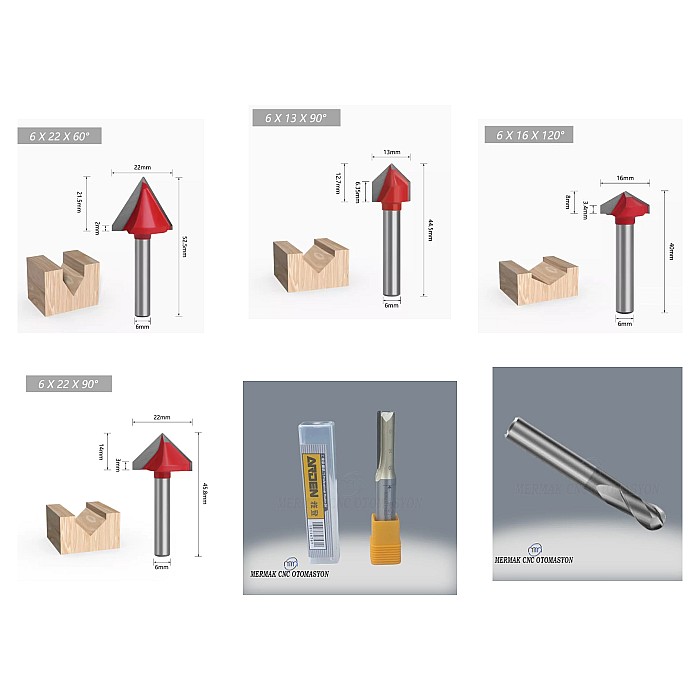
High-Speed Steel (HSS) Cutters
High-Speed Steel (HSS), as its name suggests, is an alloy steel that retains its hardness even at high cutting speeds. It is primarily iron-based, containing carbon along with alloying elements such as tungsten, molybdenum, chromium, vanadium, and sometimes cobalt. These elements increase the steel’s hardenability, wear resistance, and especially its hardness at high temperatures (red hardness). HSS cutters allow for much higher cutting speeds compared to traditional carbon steels. While they have a certain resistance to the heat generated during machining, they tend to lose their hardness at excessively high temperatures. The biggest advantages of HSS tools are their high toughness, resistance to impact, and relatively low cost. Furthermore, they can be easily resharpened, which extends tool life and reduces operating costs. They are generally preferred for machining softer materials such as mild steels, aluminum, brass, and some plastics. They offer an advantage in intermittent cutting operations or on machine tool systems with low rigidity due to their resistance to impact.
Carbide Cutters
Carbide (Hard Metal) cutters are the backbone of modern CNC machining applications, offering significantly superior performance compared to HSS. They are primarily produced by sintering very hard ceramic particles, such as tungsten carbide (WC), within a softer metal binder, typically cobalt (Co). This composite structure ensures that carbide possesses both high hardness and sufficient toughness. Carbide’s hardness is 2-3 times greater than HSS, and it can maintain its hardness even at high temperatures (up to 800-1000°C), exhibiting excellent red hardness. This property allows carbide tools to operate at much higher cutting speeds and feeds than HSS, significantly increasing production efficiency. Carbide tools also surpass HSS in wear resistance, leading to longer tool life and a more stable machining process. However, carbide’s main disadvantage is its greater brittleness compared to HSS, making it more sensitive to impact. Therefore, carbide tools are generally used in more rigid machine tool systems and under more stable machining conditions. Carbide tools can be used in their bare carbide form or enhanced with various coatings (e.g., TiN, TiCN, AlTiN, AlCrN, PVD, CVD) to improve their performance. These coatings increase the tool’s hardness, wear resistance, friction coefficient, and thermal resistance, offering optimized solutions for specific materials and applications. They are widely used for machining stainless steels, cast irons, alloy steels, heat-treated steels, and many non-ferrous metals.
Diamond (PCD/CVD) Cutters
Diamond cutters represent the pinnacle of cutting tool technology, leveraging the unique properties of diamond, the hardest material known. In industrial applications, they typically appear in two main forms: Polycrystalline Diamond (PCD) and Chemical Vapor Deposition (CVD) Diamond. PCD is a composite material produced by sintering synthetic diamond particles under high pressure and temperature with a metal binder (usually cobalt). This structure maintains diamond’s extreme hardness and wear resistance while offering a certain level of toughness. CVD Diamond, on the other hand, is obtained by forming a pure diamond layer on a substrate using the chemical vapor deposition method. CVD diamond has higher purity and a more homogeneous diamond structure than PCD, providing even greater hardness and thermal conductivity. The most distinctive features of diamond tools are their incredibly high hardness (10-20 times greater than HSS, 4-5 times greater than carbide), excellent wear resistance, and very low friction coefficients. These properties enable diamond tools to offer unparalleled tool life and superior quality on machined surfaces. However, due to diamond’s tendency to chemically react with iron-containing materials at high temperatures (carbon diffusion), they are not used for machining iron-based materials such as steel or stainless steel. Diamond tools are particularly preferred for precise and high-speed machining of non-ferrous and abrasive materials such as aluminum and its alloys, copper, brass, bronze, composite materials (carbon fiber, glass fiber), graphite, green ceramics, wood-based panels (MDF, particleboard), and highly abrasive plastics. While their high cost and requirement for specialized tool clamping and machining techniques limit their application to specific niche uses, the efficiency and quality they provide in these applications justify their cost.
| Parameter | Value/Description |
|---|---|
| Material Type | High-Speed Steel (HSS) |
| Main Components | Fe, C, W, Mo, Cr, V, (Co) |
| Hardness (HV) | 600-900 HV |
| Wear Resistance | Medium |
| Heat Resistance (Red Hardness) | Good (up to approx. 600°C) |
| Impact Resistance | Very Good (High Toughness) |
| Typical Applications | Mild steel, aluminum, brass, plastic, general machining, intermittent cutting |
| Max. Cutting Speed (m/min) | 20-60 (Varies by material) |
| Cost Index | Low |
| Resharpening/Coating | Easily resharpenable, coating can be applied |
| Material Type | Carbide (Hard Metal) |
| Main Components | WC (Tungsten Carbide), Co (Cobalt binder) |
| Hardness (HV) | 1400-2000 HV (Uncoated) |
| Wear Resistance | Very Good |
| Heat Resistance (Red Hardness) | Excellent (up to approx. 800-1000°C) |
| Impact Resistance | Medium (More brittle than HSS) |
| Typical Applications | Stainless steel, cast iron, alloy steel, heat-treated materials, high-volume production |
| Max. Cutting Speed (m/min) | 100-300 (Varies by material and coating) |
| Cost Index | Medium – High |
| Resharpening/Coating | Requires special equipment, coating enhances performance |
| Material Type | Diamond (PCD/CVD) |
| Main Components | PCD: Synthetic Diamond, Co binder; CVD: Pure Diamond |
| Hardness (HV) | 5000-10000 HV |
| Wear Resistance | Superior (Highest known in the market) |
| Heat Resistance (Red Hardness) | Excellent (Above 1000°C for non-ferrous materials) |
| Impact Resistance | Low (Very brittle) |
| Typical Applications | Aluminum alloys, composites, graphite, ceramics, wood, abrasive plastics |
| Max. Cutting Speed (m/min) | 200-2000+ (Varies by material and tool rigidity) |
| Cost Index | Very High |
| Resharpening/Coating | Requires special laser or EDM (electro-erosion) sharpening, coating generally not applied (pure diamond) |

Field Considerations
- Material to be Machined and Application Analysis: The first and most critical step in tool selection is understanding the type, hardness, abrasiveness of the material to be machined, and the nature of the machining operation (milling, turning, drilling, etc.). For example, HSS may be sufficient for mild steels, while carbide becomes necessary for hardened steels or stainless steels, and diamond tools are essential for aluminum or composites. The application’s requirement for intermittent or continuous cutting also determines the tool’s toughness needs.
- Optimization of Cutting Parameters: Spindle speed (RPM), feed rate (mm/rev or mm/min), and depth of cut (ap/ae) must be correctly set according to the tool material. HSS tools operate at lower speeds, while carbide and diamond tools allow for much higher speeds. Incorrect parameters can shorten tool life, degrade surface quality, and lead to tool breakage. Manufacturer datasheets are the most reliable source for this information.
- Machine Rigidity and Tool Holder Selection: Carbide and especially diamond tools are brittle due to their high hardness. It is crucial that machines using these tools have high rigidity, minimize vibration, and that tool holders (collets, hydraulic holders, shrink-fit, etc.) offer high precision and runout tolerances. High runout shortens tool life and reduces machining quality.
- Coolant and Chip Management: The correct coolant (cutting oil, emulsion, air, etc.) and application method (external, internal cooling) must be selected to dissipate heat generated during machining, reduce friction, and remove chips from the machining zone. Coolant is critically important, especially for carbide and HSS tools. Diamond tools can often operate dry or with minimal lubrication, as their high thermal conductivity rapidly dissipates heat. Proper chip breaking and evacuation prevent tool jamming and re-cutting.
- Tool Wear Monitoring and Life Management: Tool wear is a significant factor affecting production quality and cost. Wear types (flank wear, crater wear, breakage) should be regularly monitored, and the correct time for tool change or resharpening determined. Modern CNC systems have the capability to automate tool life management.
- Resharpening and Coating Strategies: HSS tools can generally be resharpened, which is a cost-effective solution. Carbide tools can also be resharpened with special equipment, and coatings can be renewed. Diamond tools, however, require very specialized laser or EDM (electro-erosion) methods for sharpening, which can be costly and not always feasible. The selection of coated carbide tools can significantly enhance performance for a specific material and application.
Common Problems and Solutions
Many problems can arise in CNC machining processes related to tool material selection and usage. Correct diagnosis and resolution of these issues are critical for production efficiency.
- Premature Tool Wear or Breakage:
- Problem: Tool wears out or breaks completely much faster than expected.
- Possible Causes: Incorrect tool material selection (e.g., using HSS for hard material), excessive cutting speeds or feeds, insufficient cooling, low machine rigidity, improper workpiece clamping, tool runout.
- Solutions: Switch to an appropriate carbide or diamond tool for the material, optimize cutting parameters according to manufacturer recommendations, check coolant flow and pressure, increase tool holder and machine rigidity, securely clamp the workpiece, check tool runout.
- Poor Surface Quality or Dimensional Deviations:
- Problem: Roughness, burring, waviness on the machined surface, or deviation from desired dimensional tolerances.
- Possible Causes: Worn or dull tool, incorrect cutting geometry, insufficient chip evacuation, tool vibration, incorrect feed rate or depth of cut, lack of rigidity in the machine or tool holder.
- Solutions: Replace or resharpen the tool, select a tool with sharper edges or appropriate rake angle, decrease or increase feed rate (depending on material), shorten tool length or use a more rigid holder to reduce vibrations, ensure proper chip evacuation with correct cooling.
- Chip Jamming and Chip Evacuation Problems:
- Problem: Chips accumulate in the machining zone, wrap around the tool, or damage the workpiece.
- Possible Causes: Incorrect chip breaker geometry, insufficient coolant flow, excessively deep depth of cut, incorrect feed rate, clogged chip flutes.
- Solutions: Select a tool with more suitable chip breaker geometry, adjust coolant pressure and direction, optimize depth of cut and feed, use pauses or special movements in the program to regularly clear chips.
- Built-Up Edge (BUE):
- Problem: Machined material adheres and accumulates on the cutting edge of the tool. This is especially common with soft and sticky materials (aluminum, mild steel).
- Possible Causes: Low cutting speed, insufficient or incorrect coolant, tool surface roughness, incorrect tool geometry (rake angle).
- Solutions: Increase cutting speed (if material allows), use appropriate coolant and optimize its flow, use coated tools with a lower friction coefficient, prefer tools with sharper and positive rake angles.
- Thermal Damage or Discoloration:
- Problem: Discoloration, loss of hardness, or deformation on the workpiece or tool due to excessive heat.
- Possible Causes: Insufficient cooling, excessive cutting speed or feed, dull tool, incorrect tool coating.
- Solutions: Increase coolant volume and pressure, reduce cutting parameters, resharpen or replace the tool, select a tool coating with higher heat resistance (e.g., AlTiN).
Expert Advice
In CNC machining processes, the selection of the correct cutting tool material is not merely a matter of preference but a strategic engineering decision impacting production efficiency, cost-effectiveness, and part quality. While HSS tools still offer a valuable option for general-purpose machining of softer materials due to their low cost and high toughness, the demands for speed and precision in modern manufacturing often necessitate a shift towards carbide tools. Carbide has become an industry standard, capable of operating at high speeds and feeds across a wide range of materials, offering extended tool life and diverse coating options. For specialized applications and abrasive non-ferrous materials, diamond (PCD/CVD) tools meet the most stringent expectations, providing superior surface quality and extraordinary tool life with their unmatched hardness and wear resistance.
As an expert, my advice is never to reduce the tool selection process to a single criterion. The physical and chemical properties of the material to be machined, desired surface quality, dimensional tolerances, production volume, machine power and rigidity, tool holder precision, and, of course, budget, must be evaluated holistically. The most expensive tool is not always the best solution; the key is to achieve the optimal cost/performance balance for the application. With evolving technology, new generations of tool coatings and geometries are further advancing the performance of existing tool materials. Therefore, regularly following current catalogs and technical data sheets from tool manufacturers, staying informed about new products and technologies, is essential for continuous improvement. Furthermore, field experience shows that continuous optimization of cutting parameters, effective coolant management, and careful monitoring of tool wear are vital for extending tool life and improving machining quality. Remember, success in CNC machining is possible through a combination of correct tool material selection, accurate parameter settings, and attention to detail. The future of industrial automation will be shaped by a continuous better understanding and application of these delicate balances.
FAQ
What are the main differences between HSS, Carbide, and Diamond CNC cutters?
HSS (High-Speed Steel) tools are cost-effective and tough, ideal for softer materials and intermittent cutting. Carbide tools offer superior hardness, wear resistance, and higher cutting speeds for a wider range of materials, including harder steels and cast iron. Diamond (PCD/CVD) tools provide the highest hardness and wear resistance, excelling in machining abrasive non-ferrous materials like aluminum alloys and composites, but are not suitable for ferrous metals.
How do I choose the right CNC cutting tool for my application?
The right tool depends on the material to be machined, desired surface finish, production volume, and machine rigidity. For soft steels or plastics, HSS might suffice. For stainless steel, cast iron, or high-volume production, carbide is generally preferred. For highly abrasive non-ferrous materials like aluminum, composites, or graphite, diamond tools offer unmatched performance and tool life.
What are common problems encountered with CNC cutting tools and how can they be resolved?
Common issues include premature tool wear/breakage (due to incorrect tool choice, excessive parameters, or poor cooling), poor surface quality (from dull tools, wrong geometry, or vibration), chip jamming (due to improper chip breakers or coolant), built-up edge (from low speeds or wrong coolant), and thermal damage (from insufficient cooling or high parameters). Solutions involve optimizing tool selection, cutting parameters, coolant management, and machine setup.
What role do coatings play in enhancing the performance of CNC cutting tools?
Tool coatings like TiN, TiCN, AlTiN, and AlCrN are applied to carbide tools to enhance their hardness, wear resistance, and thermal stability. These coatings reduce friction and allow for higher cutting speeds and longer tool life, especially when machining challenging materials. The choice of coating depends on the specific material and machining conditions.
What are the best practices for extending the life of CNC cutting tools?
Optimizing cutting parameters (speed, feed, depth of cut) is crucial. Using the correct coolant type and application method, ensuring high machine and tool holder rigidity to minimize vibration, and regularly monitoring tool wear are key. For HSS and carbide, resharpening can extend tool life, while for diamond tools, specialized sharpening methods are required.