


































































































How Encoder Stepper Motors Prevent Step Loss – Field Guide and Technical Article
📑 Table of contents (Click to open)
Encoder Stepper Motors: Preventing Step Loss – Field Guide and Technical Article
Introduction and Technical Analysis
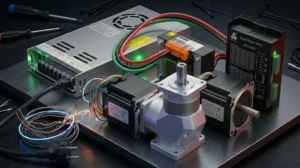
In industrial automation systems, precision, speed, and reliability are critical for the efficiency of production processes. In this context, stepper motors are widely preferred in many applications due to their simple control structures and cost-effectiveness. However, traditional open-loop stepper motors can encounter step loss issues, especially under high loads, during sudden acceleration/deceleration, or when operating at resonance frequencies. Step loss means that the motor fails to reach the commanded position or loses synchronization, which can lead to production errors, product defects, and even system failures. To overcome this serious problem and mitigate the disadvantages of stepper motors while retaining their advantages, closed-loop control mechanisms have been developed through the integration of encoders into these systems. This comprehensive field guide and technical article will detail how encoder stepper motors prevent step loss, their fundamental operating principles, technical specifics, practical application nuances in the field, and solutions for common problems, all tailored for industrial automation professionals. Our aim is to guide users through all processes, from the design to commissioning and maintenance of closed-loop stepper motor systems, helping them maximize their system performance.
Operating Principle and Technical Data
A traditional stepper motor operates on the principle of interaction between permanent magnets on the rotor and electromagnets in the stator windings. Pulse signals from the driver change the current direction and phase in the stator windings, causing the motor to rotate step by step at specific angles. Each pulse triggers the motor to take a predefined angular step. However, in open-loop systems, the driver only sends commands and does not know whether the motor actually complies with these commands or if the load follows these steps. Factors such as overloading, high inertia, incorrect speed profiles, or mechanical friction can cause the motor to skip commanded steps, creating an offset between the actual position and the target position. This is where the encoder comes into play.
An encoder is a feedback device that continuously monitors the actual position, speed, and direction of rotation of the motor shaft or the moved load. Operating on optical or magnetic principles, encoders generate a specific number of pulses for each revolution, converting this information into digital signals. These signals are read by a specially designed closed-loop stepper driver or a PLC/motion controller. The closed-loop control mechanism works as follows:
- Command Transmission: The controller (e.g., PLC) sends the necessary step pulse signals to the stepper driver to reach the target position.
- Motor Movement: In response to these pulses, the driver applies current to the stepper motor windings, causing the motor to move.
- Position Feedback: The encoder attached to the motor continuously measures the instantaneous actual position of the motor shaft and feeds this position information back to the driver or controller.
- Error Detection and Correction: The driver or controller continuously compares the commanded position with the actual position information from the encoder. If the actual position deviates from the target position by more than a certain tolerance (i.e., if there is a risk of step loss), the driver automatically increases the motor current, sends additional step pulses, or adjusts the speed profile instantaneously to pull the motor back to the correct position. This correction mechanism ensures that the motor never loses steps and always follows the commanded position.
This “servo-like” control approach enables stepper motors to utilize their torque capabilities much more efficiently. The motor only produces the required torque, preventing excessive current draw and thus overheating. It also reduces the system’s susceptibility to resonance frequencies and allows for much smoother, vibration-free motion. Closed-loop stepper systems can provide more torque at higher speeds and improve positioning accuracy compared to traditional open-loop stepper systems, while offering a more economical solution than full-fledged servo systems. Especially in applications such as CNC router machines, packaging machines, medical devices, laboratory automation, and precision assembly lines, where step loss is unacceptable, closed-loop stepper motors stand out as an ideal solution.
| Parameter | Value/Description |
|---|---|
| Motor Type | 2-Phase Hybrid Stepper Motor (NEMA 17 to NEMA 42) |
| Encoder Resolution | 1000 CPR (4000 PPR) – 5000 CPR (20000 PPR) optical encoder |
| Control Mode | Closed-Loop Vector Control (FOC-like) |
| Maximum Speed | 600-3000 RPM (Varies by motor and load) |
| Torque Capacity | 0.5 Nm – 20 Nm (Depends on motor size and driver current) |
| Step Accuracy | ±1 step (typically 0.09 degrees) depending on encoder resolution |
| Feedback Mechanism | Quadrature (A/B/Z) or Differential Line Driver Encoder |
| Typical Application Area | CNC Routers, Laser Cutting Machines, Packaging, Labeling, Automatic Assembly Lines |
| Driver Supply Voltage | 24-80 VDC (Must be checked according to manufacturer datasheet) |

Field Considerations
- Correct Motor and Encoder Selection: The torque, speed, and inertia values required by the application must be analyzed correctly. The nominal torque of the motor should be sufficiently higher than the maximum load torque. The encoder’s resolution (CPR – Counts Per Revolution) must meet the desired positioning accuracy. An encoder with too low a resolution may not detect small deviations, while an encoder with too high a resolution can unnecessarily increase processing load. Additionally, the encoder type (incremental, absolute) and output signal (TTL, HTL, differential) must be compatible with the driver.
- Mechanical Mounting and Alignment: Correct and secure mounting of the encoder to the motor shaft or moving system is critically important. Shaft couplings should be selected to absorb vibration and tolerate axial/radial misalignments. Incorrect alignment, encoder
FAQ
How do encoder stepper motors prevent step loss?
Encoder stepper motors prevent step loss by incorporating a closed-loop control system. An encoder continuously monitors the motor's actual position and feeds this data back to the driver. If a discrepancy is detected between the commanded position and the actual position, the driver automatically adjusts the motor current or sends corrective pulses to bring the motor back into synchronization, thus preventing step loss.
What are the key benefits of using encoder stepper motors?
The main advantages include enhanced positioning accuracy, higher torque at higher speeds, reduced motor heating, smoother operation, and improved reliability compared to open-loop stepper systems. They offer a cost-effective alternative to full servo systems for applications requiring high precision without the full complexity and cost of servos.
In which industrial applications are encoder stepper motors most effective?
Encoder stepper motors are ideal for industrial CNC router machines, laser cutting machines, packaging and labeling equipment, automated assembly lines, medical devices, and laboratory automation where precise motion control and prevention of step loss are crucial for product quality and system performance.
What factors should be considered when selecting an encoder stepper motor?
When selecting an encoder stepper motor, consider the application's required torque, speed, and inertia. Ensure the motor's nominal torque exceeds the maximum load. The encoder's resolution (CPR) must match the desired positioning accuracy, and its type (incremental/absolute) and output signal (TTL, HTL, differential) must be compatible with your chosen driver.
Are there any common challenges or considerations when implementing encoder stepper motors?
While closed-loop stepper systems offer many benefits, proper mechanical mounting and alignment are crucial. Misalignment can lead to premature wear or inaccurate feedback. Electrical noise can also interfere with encoder signals, so proper shielding and grounding are essential. Additionally, tuning the driver parameters correctly is important to optimize performance and responsiveness.