




































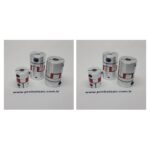

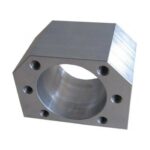


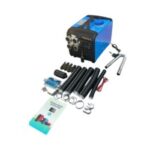






























5 Nm Step Motor Set with JSS860H Driver
Detailed Product Review
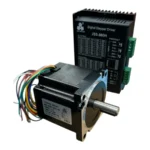
This 5 Nm Step Motor Set offers an integrated motion control solution with the JSS860H digital driver. The system operates on the principle of converting electrical pulse signals from a step motor into precise angular displacements. The JSS860H driver interprets pulse and direction signals from the controller, applying sequential and controlled current pulses to the motor’s phase windings. These current pulses interact with the magnetic field in the motor’s stator and the rotor’s permanent magnets, causing the motor to rotate at a specific angle. Particularly in microstep drive mode, the driver gradually changes the phase currents along a sinusoidal profile, allowing each full step to be divided into smaller subdivisions. This method theoretically increases the motor’s step angle while minimizing vibration and resonance at low speeds, resulting in smoother and quieter operation. The nominal torque value of 5 Nm represents the rotational force the motor can produce under a given load, and this set is optimized to maintain this torque stably across a wide speed range.
The motor’s construction includes a stator made of silicon steel laminations with high magnetic permeability and a rotor composed of high-energy-density permanent magnets. Copper windings are designed for low resistance and high current-carrying capacity. The driver unit features power MOSFETs capable of efficient operation at high switching frequencies, an advanced digital signal processor (DSP) or microcontroller-based control circuit, and an aluminum heatsink for effective heat dissipation. System integration of this set is compatible with standard industrial automation protocols, typically interfacing directly with TTL-level pulse and direction signals from a CNC controller card or PLC. It supports a wide DC voltage range for power supply, ensuring compatibility with various industrial power sources. Applications include medium-sized CNC routers, laser and plasma cutting systems, industrial versions of 3D printers, automated assembly lines requiring precise positioning, labeling machines, textile machinery, and general industrial axis control applications. The pre-matched nature of the set minimizes the risk of component incompatibility issues for field engineers and shortens commissioning time.
Advantages of the 5 Nm Step Motor Set with JSS860H Driver
Optimized Electromechanical Matching and Resonance Management: This set is designed for precise synchronization between the 5 Nm step motor’s electrical characteristics (phase inductance, phase resistance, back EMF coefficient) and the JSS860H digital driver’s current control algorithms and switching frequency. This synchronization minimizes current ripple applied to the motor windings, preventing overheating and ensuring more efficient magnetic field generation. The advanced microstepping capabilities of the JSS860H driver actively prevent the excitation of the motor’s natural resonance frequencies. The sinusoidal division of phase currents results in smoother torque production with each step transition, significantly reducing mechanical vibration and noise, especially at low speeds. Consequently, this optimization ensures smoother, quieter, and more stable axis movements while also reducing stress on the mechanical components of the system.
High Torque Stability Across Wide Speed Range and Step Loss Prevention: Step motor torque tends to decrease as speed increases. This set minimizes this natural torque drop through the JSS860H driver’s wide supply voltage support and high-performance current control algorithms. The driver utilizes a higher supply voltage to more rapidly build and collapse the magnetic field in the motor windings, enabling the motor to respond more effectively to high pulse frequencies (i.e., high speeds). This ensures that the motor’s nominal 5 Nm torque is maintained over a broader operating range, from low to medium and even high speeds. The digital control loop dynamically adjusts phase currents based on the motor’s instantaneous load, eliminating the risk of step loss during sudden load changes or high acceleration/deceleration. This feature is critical for maintaining positioning accuracy and repeatability, especially in CNC applications where processing forces vary.
Simplified Commissioning and Long-Term Operational Reliability: Selecting motors and drivers, conducting compatibility tests, and adjusting parameters in industrial automation projects require significant time and engineering resources. This set significantly simplifies the commissioning process because the JSS860H driver has been pre-selected for optimal compatibility with the motor’s electrical and mechanical characteristics. Users do not need to grapple with complex current limits, microstep resolutions, or resonance suppression settings, as these parameters have already been considered for the set’s optimal operation. This integrated approach prevents performance degradation or equipment failure due to incorrect configurations. Furthermore, the thermally optimized operation of the motor and driver ensures both components remain within their nominal operating temperatures. This extends the lifespan of winding insulation and semiconductor components, contributing to the set’s long-term, uninterrupted, and reliable operation in industrial environments, thereby minimizing maintenance costs and production downtime.
Technical Specifications and Capacity
Feature
Value/Description
Motor Torque Value
5 Nm (Newton meters)
Driver Model
JSS860H Digital Step Motor Driver
Motor Type
Hybrid Bipolar Step Motor
Driver Supply Voltage
24-80 VDC (Recommended 48-70 VDC for optimal performance)
Driver Phase Current
2.0A – 7.2A Peak (Adjustable, optimized for motor nominal current)
Microstep Resolution
200 to 51200 steps (Selectable via DIP switches)
Technical Frequently Asked Questions (FAQ)
What is the relationship between torque and speed in step motor systems, and how does the JSS860H driver optimize this relationship?
The torque-speed curve of step motors is characterized by a decrease in effective torque at higher speeds due to the increasing inductive reactance of the motor windings limiting phase current flow. The JSS860H driver employs two key engineering principles to minimize this effect: Firstly, its wide supply voltage range allows for higher voltage application to the motor windings, enabling faster current build-up and decay, thus ensuring effective magnetic field generation and maintenance even at high pulse frequencies. Secondly, the driver’s digital control algorithms continuously compensate for the motor’s back EMF and dynamically adjust phase currents, resulting in a flatter torque curve across a broad speed spectrum. This optimization guarantees stable performance without step loss, especially during high-speed positioning or cutting operations.
What is the effect of microstepping on mechanical resonance, and what is the role of this set in precision positioning applications?
In full step drive mode, step motors experience abrupt torque changes with each step, which can induce vibrations at the motor’s natural resonance frequencies. These vibrations lead to noise, wear in the mechanical system, and loss of positioning accuracy. The microstepping feature offered by the JSS860H driver divides the motor’s phase currents into numerous small increments along a sinusoidal profile, subdividing each full step. This method allows the motor rotor to move more smoothly and gradually, significantly reducing abrupt torque pulses and consequently mechanical resonance. Microstepping enhances motion smoothness, particularly at low speeds, provides quieter operation, and optimizes system performance in precision positioning applications (e.g., optical alignment, micro-machining, or high-resolution scanning) by increasing repeatability and accuracy.
What are the fundamental engineering principles that ensure long-term, stable operation of this set in industrial environments?
The long-term stability of this 5 Nm Step Motor Set in industrial environments is achieved through a combination of fundamental engineering principles. Firstly, thermal management is critical; heat dissipation for both the motor and driver is optimized to keep them within nominal operating temperatures. Low-resistance motor windings and efficient driver switching elements (MOSFETs) minimize heat generation, while the driver’s integrated heatsink design ensures effective heat transfer. Secondly, immunity to electrical noise (EMI/RFI) is considered; the driver incorporates filtering and protection circuits designed to withstand electromagnetic interference common in industrial settings. Thirdly, all components are selected to meet industrial-grade standards, ensuring high durability and longevity. Finally, the JSS860H driver’s digital control algorithms offer dynamic adaptability to motor load variations, ensuring stable current and torque management even under unexpected load increases, thus guaranteeing system continuity and reliability.
Is the 5 Nm torque value sufficient for specific CNC applications, and what should be considered in system integration for effective utilization of this torque?
The 5 Nm torque value generally offers adequate power for medium-sized CNC routers, laser cutters, plasma cutters, and various automated axis applications. However, the sufficiency of the torque directly depends on the mechanical requirements of the specific application, determined by factors such as the weight of the mass to be moved, friction forces, lead screw pitch (or belt-pulley ratios), cutting forces during operation, and desired acceleration values. Key considerations for effective torque utilization in system integration include selecting an appropriate power supply (within the driver’s recommended voltage range and with sufficient current capacity), using low-resistance motor cables of adequate gauge (to minimize voltage drop), ensuring a rigid and backlash-free coupling between the motor and the motion mechanism, and the overall rigidity of the mechanical system. Furthermore, configuring the driver’s current settings appropriately for the motor’s nominal current and optimizing the microstep resolution to meet both precision and speed requirements are crucial for realizing the full potential of the 5 Nm torque.


Reviews
There are no reviews yet.