






































































How Much Misalignment Can a Flexible Coupling Compensate For?
📑 Table of contents (Click to open)
Practical notes for CNC router, automation and industrial motion systems.
Understanding Flexible Couplings and Misalignment Compensation
In industrial automation and mechanical engineering, couplings are essential components used to connect two rotating shafts, facilitating power transmission. Ideally, all shafts would be perfectly aligned. However, in real-world industrial settings, manufacturing tolerances, assembly errors, thermal expansion, foundation settling, and dynamic loads inevitably lead to some degree of misalignment between shafts. This is where flexible couplings play a crucial role. Designed to absorb these misalignments, dampen vibrations, and extend the lifespan of connected equipment, flexible couplings are specialized mechanical components that ensure smooth system operation.
The primary function of a flexible coupling is to safely compensate for these small but unavoidable alignment differences between shafts. The extent to which a coupling can achieve this compensation varies significantly based on its type, design, materials used, and size. There are three main types of shaft misalignment:
- Radial Misalignment (Parallel Misalignment): Occurs when the centerlines of two shafts are parallel but not concentric, meaning they are offset laterally.
- Angular Misalignment: Occurs when the centerlines of two shafts intersect at a point but are at an angle to each other, causing one or both shafts to be tilted.
- Axial Misalignment (End Float): Occurs when the centerlines of two shafts are concentric but they are displaced from each other along the axial direction (lengthwise).
Flexible couplings are engineered to absorb each of these misalignments to varying degrees. By doing so, they reduce undue stress on critical components like motors, gearboxes, pumps, and compressors, thereby extending the life of bearings and seals and minimizing energy losses. Selecting the correct flexible coupling not only prevents failures but also significantly enhances operational efficiency and reliability.
Operating Principles and Technical Data
The ability of flexible couplings to compensate for misalignment stems from their internal structures, which often incorporate elastomeric elements, metal discs, gear mechanisms, or metal bellows. Each coupling type manages different types of misalignment and load conditions with varying degrees of effectiveness. Here are some common types of flexible couplings and their general compensation capabilities:
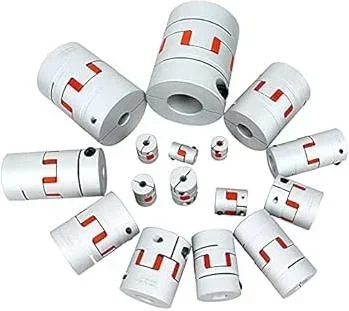
- Elastomeric Couplings (Jaw, Tyre, Bush, Spider): These couplings excel at damping shock loads and vibrations. They typically feature an intermediate element (e.g., a spider, tire, or bush) made from materials like rubber, polyurethane, or nylon.
- Radial Misalignment: Generally between 0.2 mm and 1 mm. Tire-type couplings can accommodate higher tolerances (2-5 mm).
- Angular Misalignment: Typically from 0.5° to 2°.
- Axial Misalignment: Usually between 1 mm and 5 mm.
These couplings are popular due to their low maintenance requirements, electrical insulation properties, and relatively low cost.
- Disc Couplings (Diaphragm, Disc Pack): Utilizing stainless steel disc packs or diaphragms, these couplings offer high torque capacity and torsional stiffness while compensating for shaft misalignment through the flexibility of the discs. They are ideal for high-speed and high-torque applications.
- Radial Misalignment: Generally between 0.1 mm and 0.5 mm.
- Angular Misalignment: Typically from 0.5° to 1.5°.
- Axial Misalignment: Usually between 1 mm and 3 mm.
They provide maintenance-free and long-lasting solutions.
- Gear Couplings: These operate with internal and external gear teeth, offering high torque transmission and a compact design. The rolling motion of the gear teeth allows them to compensate for misalignment. They require lubrication.
- Radial Misalignment: Generally between 0.05 mm and 0.2 mm (requiring very precise alignment).
- Angular Misalignment: Typically from 0.5° to 1.5°.
- Axial Misalignment: Limited, ranging from 0.5 mm to 2 mm depending on gear backlash.
They carry a risk of gear wear under overload conditions.
- Grid Couplings: Known for their high torque capacity and vibration damping capabilities, using a spring steel grid element.
- Radial Misalignment: Generally between 0.1 mm and 0.5 mm.
- Angular Misalignment: Typically from 0.5° to 1°.
- Axial Misalignment: Usually between 1 mm and 3 mm.
Preferred for heavy-duty applications.
- Bellows Couplings: Commonly used in precision control systems and servo motor applications. Their metal bellows structure offers very low inertia and high precision.
- Radial Misalignment: Generally between 0.01 mm and 0.2 mm (very precise).
- Angular Misalignment: Typically from 0.1° to 0.5°.
- Axial Misalignment: Usually between 0.5 mm and 2 mm.
They can be expensive but are indispensable where precision is paramount.
The misalignment compensation capacity of a coupling is also influenced by factors such as shaft rotational speed (RPM), transmitted torque, ambient temperature, and the coupling’s size. Higher speeds and torques increase stress on the coupling, thereby reducing the amount of misalignment it can compensate for. Therefore, all these operating conditions must be considered when selecting a coupling.
| Parameter | Value/Description |
|---|---|
| Misalignment Type | Description |
| Radial Misalignment (mm) | 0.1 mm – 5 mm (Varies by coupling type; disc couplings are low, rubber types are high) |
| Angular Misalignment (Degrees) | 0.1° – 3° (Bellows couplings are low, elastomeric types are high) |
| Axial Misalignment (mm) | 0.5 mm – 10 mm (Gear couplings are low, elastomeric types are high) |
| Coupling Type Influence | Elastomeric > Rubber > Grid > Disc > Gear > Bellows (General flexibility order) |
| Material Influence | Rubber/Polyurethane (more flexible), Steel/Aluminum (more rigid) |
| Temperature Effect | High temperatures reduce the life and flexibility of elastomeric elements. |
| Speed and Torque Effect | High speed and torque reduce the amount of compensable misalignment. |
Field Considerations for Flexible Couplings
- Correct Coupling Selection and Sizing: Beyond misalignment compensation, factors such as maximum transmissible torque, operating speed, ambient temperature, chemical exposure, and vibration damping needs must be considered. Manufacturer catalog data and selection charts are critical at this stage. Selecting a coupling that is too large or too small will negatively impact performance.
- Initial Alignment and Tolerances: While flexible couplings compensate for misalignment, this does not mean shafts can be installed with poor alignment. Operating within the coupling’s maximum compensation limits shortens its lifespan and increases energy losses. Therefore, using modern tools like laser alignment devices to bring shafts as close to perfect alignment as possible is recommended to extend the life of the coupling and connected equipment. It is generally advised to operate within 25-50% of the coupling’s compensation capacity.
- Installation and Removal Procedures: Proper installation of couplings is vital for their performance and longevity. Ensure shafts are clean and free of burrs. Use appropriate tools for installation and avoid hammering or forcing the coupling, which can damage its components. Follow manufacturer guidelines for torque specifications if applicable.
- Maintenance and Inspection: Regularly inspect couplings for signs of wear, cracking, or material degradation, especially in elastomeric elements. For lubricated couplings like gear couplings, adhere to the recommended lubrication schedule. Listen for unusual noises that might indicate excessive vibration or wear.
By understanding the capabilities and limitations of different flexible coupling types and adhering to best practices in selection, installation, and maintenance, you can ensure the reliable and efficient operation of your industrial machinery. Choosing the right coupling is a critical step in preventing costly downtime and extending the service life of your valuable equipment.
For expert advice on selecting the ideal flexible coupling for your specific CNC router machine or industrial CNC router application, or to discuss your motion control needs involving spindle motors, servo drives, or linear guide rails, contact us today. We can help you find the perfect solution to optimize your system’s performance and durability.
Ready to ensure your machinery runs smoothly? Request a quote on WhatsApp for the best flexible coupling solutions!
Explore our range of mechanical components, including high-quality couplings, to enhance your industrial systems.
Related product categories: Genel · 40 mm Kaplin GS19
