






























































































































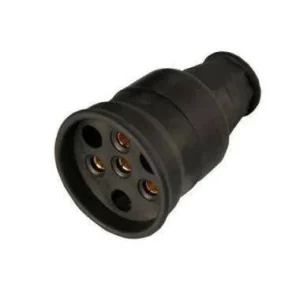
16/25A 380V FLAT STRAIGHT PLUG
Detailed Product Review
This industrial-type flat straight plug is a critical electromechanical component designed to ensure a safe and stable connection of machinery and equipment requiring high power to three-phase alternating current (AC) mains. Its primary function is to conduct energy at voltages ranging from 380V to 450V, with a nominal current capacity of 16A or 25A. The operational principle relies on the plug’s internal conductive pins making physical and electrical contact with the corresponding sockets in the connected receptacle, thereby completing the electrical circuit. The 3P+E (three-phase + earth) pole configuration maintains phase balance in three-phase systems while the earth connection minimizes the risk of electric shock by safely conducting any leakage currents to the ground, keeping the metal casing of the connected equipment at zero potential. This structure provides an indispensable layer of safety for the continuous and reliable operation of industrial machinery. The plug’s design is optimized to ensure the cable connection is resistant to mechanical stresses, maintaining connection integrity even in vibrating or moving environments. This product is supplied to markets including the United Kingdom, United States, Canada, Australia, Ireland, and New Zealand, among others.
The plug’s housing is manufactured from Polyamide 6 (PA6) thermoplastic, a material known for its superior mechanical and chemical properties. PA6 exhibits high impact strength, abrasion resistance, and resilience against oils, greases, and many industrial chemicals. It also performs stably across a wide temperature range, ensuring long-term usability in demanding industrial conditions, such as areas with high humidity, dust, or temperature fluctuations. For system integration, this plug is compatible with both 50Hz and 60Hz frequencies, adapting to global electrical grid standards, making it suitable for international projects and a broad geographical scope. Its applications span a wide range, from CNC machining centers and automation panels to heavy industry machinery and high-power electrical tools on construction sites. Particularly in applications where continuous and reliable power supply is critical, such as production lines, robotic systems, and power distribution boards, the plug’s robust construction and high current capacity are fundamental to supporting uninterrupted system operation.
Advantages of the 16/25A 380V FLAT STRAIGHT PLUG
High Electrical Performance and System Safety: With a nominal current capacity of 16A or 25A and a wide voltage range of 380V-450V, this industrial plug ensures stable and safe energy transmission for industrial loads. The 3P+E pole configuration guarantees balanced connection of phase conductors in three-phase systems and continuous grounding of the equipment casing. In case of an electrical fault (e.g., a phase conductor touching the metal casing), the earth line rapidly directs leakage currents to the ground, triggering overcurrent protection devices (fuses, circuit breakers) to trip, thus maximizing both operator safety and protection of the connected equipment. Furthermore, 50Hz-60Hz frequency compatibility allows adaptation to electrical grid standards in different geographical regions, offering operational flexibility on a global scale and helping to minimize harmonic distortions.
Superior Mechanical and Chemical Durability: The plug’s housing is made from Polyamide 6 (PA6), an engineering thermoplastic. PA6 stands out for its high tensile strength, impact resistance, and fatigue resistance, increasing the plug’s resilience against physical impacts and continuous use in industrial environments. Chemically, it shows significant resistance to common industrial substances like mineral oils, greases, solvents, and weak acids/bases, ensuring the plug maintains its integrity even in chemically aggressive environments. Its thermal stability allows it to retain its electrical and mechanical properties within a wide operating temperature range (-20°C to +80°C), preventing deformation or performance loss in extreme hot or cold conditions. These properties ensure the product operates reliably for many years in harsh industrial conditions, reducing maintenance costs.
Optimum Ease of Installation and Connection Security: The ergonomic flat plug design is optimized for quick and error-free cable connections. The internal screw terminals ensure conductors are securely clamped, offering low contact resistance and high current-carrying capacity. These screw terminals minimize cable slippage and loosening, reducing the risk of overheating and arcing at connection points. Additionally, the plug’s internal structure features a strain relief mechanism on the cable’s outer sheath, preventing damage to conductors due to pulling or bending. Post-installation, the plug’s robust housing and internal mechanism demonstrate high resistance to vibrations, impacts, and mechanical stresses inevitable in industrial settings, guaranteeing long-term connection reliability and minimizing unplanned downtime.
Technical Specifications and Capacity
Feature
Value/Description
Amperage
16A / 25A (High current capacity, offering flexibility to adapt to different industrial load profiles.)
Voltage Range
380V – 450V (Provides a wide and safe operating voltage range for three-phase industrial power systems.)
Frequency Compatibility
50Hz – 60Hz (Full compatibility with global electrical grid standards, enabling wide geographical use.)
Pole Configuration
3P+E (Ensures phase balance in three-phase systems and maximum electrical safety with protective earthing.)
Housing Material
Polyamide 6 (Engineering plastic offering high mechanical strength, impact resistance, chemical, and thermal stability.)
Housing Type
Flat Plug (Compact and ergonomic design for easy installation and use in industrial applications.)
Technical Frequently Asked Questions (FAQ)
What is the critical importance of the 3P+E pole configuration in industrial systems for electrical safety and performance?
The 3P+E configuration is designed for three-phase (trifaze) industrial power systems and forms the basis of electrical safety and system performance. “3P” represents the three phase conductors (L1, L2, L3), while “E” denotes the protective earth (PE) conductor. Three-phase systems provide more efficient power transmission for high-power motors and industrial machinery. The 3P structure in this plug ensures balanced distribution of phases, thus enabling optimal efficiency for motors or other loads. The critical component, the earth (E) line, safely directs leakage currents to the ground in case of any electrical fault (e.g., a phase conductor touching the machine casing), ensuring overcurrent protection devices (circuit breakers, residual current devices) trip quickly. This mechanism protects operators from electric shock risk and prevents damage to connected equipment due to insulation failures. Earthing is also important for electromagnetic compatibility (EMC), as it helps dissipate unwanted noise and interference from the system, which is a critical performance factor, especially in sensitive automation and control systems.
What are the contributions of Polyamide 6 (PA6) material to the durability of this plug in industrial environments, and why was it chosen?
Polyamide 6 (PA6) is a preferred engineering thermoplastic for industrial plug and connector applications, directly contributing to this plug’s superior durability in harsh industrial conditions. PA6’s main contributions include: High Mechanical Strength: PA6 possesses high tensile, flexural, and impact strength. These properties enhance the plug’s resistance to mechanical stresses like drops, impacts, or crushing, minimizing the risk of physical damage. Abrasion Resistance: In cases of continuous plugging/unplugging or contact with external elements, PA6’s high abrasion resistance preserves the plug’s surface integrity, extending its lifespan. Chemical Resistance: It exhibits significant resistance to chemicals commonly encountered in industrial environments, such as oils, greases, solvents, weak acids, and bases. This prevents material degradation or loss of electrical performance when exposed to chemicals. Thermal Stability: PA6 can maintain its physical and electrical properties over a wide temperature range (-20°C to +80°C), ensuring reliable functionality in industrial areas with both cold storage and high operating temperatures. Electrical Insulation: With its high dielectric strength, PA6 provides safe electrical insulation, preventing short circuits and leakage currents. The combination of these properties makes PA6 an ideal material for industrial plugs, meeting critical requirements for both safety and longevity.
What are the selection criteria between 16A and 25A nominal current capacities, and what is the impact of frequency compatibility on system integration?
The selection between 16A and 25A nominal current capacities is determined directly by the maximum continuous operating current (nominal current) and potential instantaneous peak currents of the industrial equipment to be connected. According to engineering principles, the plug’s current capacity should be at least 25% higher than the load’s nominal current, reducing thermal stress and extending the plug’s lifespan. For example, a 25A plug would be preferred for a motor drawing 15A continuously, while a 16A plug might suffice for a 10A load. Incorrect current capacity selection can lead to plug overheating, increased contact resistance, energy losses, and safety risks. Frequency compatibility (50Hz-60Hz) offers global flexibility for system integration. Electrical grids operate at either 50Hz (most of Europe, Asia) or 60Hz (North America) depending on the geographical region. This plug’s compatibility with both frequencies ensures seamless integration with equipment manufactured or used in different regions. Frequency incompatibility, especially with inductive loads like motors, can cause performance degradation, overheating, and even equipment failure. Therefore, the plug’s wide frequency range simplifies spare parts management in international projects or facilities with different grid standards and enhances the system’s overall adaptability.
What are the technical requirements for cable cross-section selection and periodic inspection after installation in industrial plug connections?
Cable cross-section selection in industrial plug connections is a critical engineering parameter determined by the plug’s nominal current capacity and the ambient temperature the cable will be exposed to. The cable cross-section must be selected in accordance with relevant national and international standards (e.g., IEC 60364) to safely conduct the maximum current the plug will carry and prevent overheating. For instance, a 25A plug requires a suitable cross-section (typically 4mm² or 6mm²) and type (e.g., H07RN-F) of cable; otherwise, an undersized cable can lead to insulation breakdown, energy loss, and fire risk due to excessive current density causing overheating. Periodic inspection after installation is vital for ensuring the long-term reliability and safety of industrial electrical connections. These inspections should include checking for loose connections, integrity of cable insulation, cracks or deformations in the plug housing, and signs of corrosion or overheating (discoloration, melting) on contact surfaces. Vibration, thermal expansion/contraction, and mechanical stresses can loosen connections over time. Periodic checks (typically every 6 months or annually) detect these potential faults early, preventing unplanned downtime, maintaining electrical efficiency, and ensuring compliance with workplace safety standards. Loose connections can cause overheating and energy losses due to increased contact resistance, raising operating costs and reducing overall system reliability.

Reviews
There are no reviews yet.