




































































Closed Loop Stepper Motor vs. Open Loop Stepper Motor: A Field Guide for Industrial Buyers
📑 Table of contents (Click to open)
Closed Loop Stepper Motor vs. Open Loop Stepper Motor: A Field Guide and Technical Article
Introduction and Technical Analysis
At the heart of industrial automation, motion control systems are critical for the efficiency and precision of production lines. Stepper motors, as fundamental components of these systems, are preferred in many different applications by providing precise angular movements with digital pulses. However, with the advancement of technology and increasing industrial expectations, some limitations of traditional normal (open loop) stepper motors have emerged. These limitations have led engineers and system integrators to more advanced solutions, especially in applications requiring high precision, continuous performance under dynamic loads, and energy efficiency. This is precisely where closed loop stepper motors come into play, offering a hybrid solution that addresses the shortcomings of traditional stepper motors. This guide aims to provide guidance to experts and field engineers by deeply examining the fundamental differences between both motor types, their operating principles, technical advantages and disadvantages, critical application areas in industrial automation, and selection criteria.
Open loop stepper motors operate on the assumption that each electrical pulse from the controller will move the motor shaft by a specific angle. This “open loop” operating principle means that the system does not know the motor’s actual position or load status. In cases where the load suddenly increases, the motor’s speed limits are exceeded, or an obstacle is encountered, there is a risk of the motor losing steps (step loss). This can lead to unacceptable errors in applications requiring precise positioning. On the other hand, closed loop stepper motors continuously monitor the actual position of the motor shaft via an integrated encoder and transmit this feedback to the drive. The drive detects the difference between the target position and the actual position, dynamically adjusting the motor current and phases. This prevents the motor from losing steps, achieves higher torque and speed performance, and increases energy efficiency. This comprehensive analysis will provide the necessary technical background and field experience to make the correct motor selection in the complex world of industrial automation.
Operating Principle and Technical Data
Stepper motors are essentially brushless DC motors that move the rotor in discrete steps via magnetic fields. However, the difference between open and closed loop systems lies in how this fundamental movement is controlled and monitored.

Open Loop (Normal) Stepper Motors
Open loop stepper motors, as the name suggests, operate without any feedback mechanism. The controller (typically a PLC or microcontroller) sends a specific frequency and number of pulses to the motor driver. Each pulse changes the direction of current in the motor’s stator windings, moving the magnetic field and causing the rotor to rotate by a predetermined angle. For example, a 1.8-degree stepper motor rotates a full turn (360 degrees) with 200 pulses. The driver converts these pulses into appropriate current pulses for the motor windings. The system assumes that the motor always takes the expected step. This simple operating principle makes open loop stepper motors highly cost-effective and easy to implement. However, this simplicity comes with some disadvantages:
- Risk of Step Loss: When the load on the motor exceeds the torque it can produce, or when acceleration/deceleration ramps are set too aggressively, the motor may fail to take the expected step. This leads to an error in the final position, and the system cannot detect this error.
- Resonance Problems: At certain speeds, vibrations can occur that coincide with the motor’s natural frequency. This can cause the motor to run noisily, lose torque, and even lose steps.
- Limited High-Speed Performance: At high speeds, the motor’s inductive reactance increases, which prevents the current in the windings from changing fast enough, leading to a drop in torque.
- Energy Inefficiency: The motor is often run at its nominal current continuously to provide maximum torque, which can lead to unnecessary energy consumption and overheating.
These motors are generally preferred in applications where cost is a primary concern, precision is not critical, or the load is constant and predictable. For example, simple conveyor belts, automatic doors, printers, or low-speed indexing systems fall into this category.

Closed Loop Stepper Motors
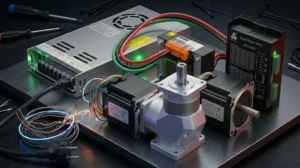
Closed loop stepper motor systems are designed to overcome the disadvantages of open loop systems and are often referred to as “hybrid servos.” These systems use a high-resolution encoder integrated into the motor shaft. The encoder continuously measures the motor’s instantaneous angular position and speed and feeds this information back to the motor driver. The driver continuously compares the target position information from the controller with the actual position information from the encoder (position error) using control algorithms such as PID (Proportional-Integral-Derivative). If there is a position error, the driver dynamically adjusts the current and phases applied to the motor windings to pull the motor to the correct position.
This feedback mechanism provides a number of significant advantages to closed loop stepper motors:
- No Step Loss: The biggest advantage is the complete elimination of step loss. The system reacts instantly to load changes or external factors, ensuring the motor always stays in the target position.
- High Torque and Speed Performance: The driver can adjust the current according to the motor’s instantaneous load. This allows the motor to produce higher torque over a wider speed range and improves dynamic response time. Torque losses are minimized, especially at high speeds.
- Less Vibration and Noise: Thanks to dynamic current control, resonance points are managed more effectively or completely eliminated, resulting in smoother and quieter operation.
- Energy Efficiency: The motor draws only as much current as it needs. When not under load or in a standby position, the current can be significantly reduced, which means energy savings and less heat generation.
- Error Detection and Reporting: The driver can generate an error (alarm) if the motor fails to position within specified tolerances. This facilitates system fault diagnosis and maintenance.
Closed loop stepper motors are particularly preferred in CNC machines, robotic systems, automated assembly lines, medical devices, optical alignment systems, and all types of industrial automation applications requiring high precision. Although initial costs are higher than open loop systems, the precision, reliability, and efficiency they provide in the long run justify this cost.
| Parameter | Open Loop (Normal) Stepper Motor | Closed Loop Stepper Motor |
|---|---|---|
| Operating Principle | Pulse-based, no feedback (assumed positioning). | Pulse-based with encoder feedback (real-time position correction). |
| Position Feedback | None. | Yes (via Encoder). |
| Risk of Step Loss | High (especially under load or at speed limits). | Negligible (instant correction thanks to encoder). |
| Torque Performance | Significant torque drop at high speeds. Constant current draw. | High and consistent torque over a wide speed range. Dynamic current adjustment based on load. |
| Speed Range | Limited, performance decreases at high speeds. | Wider and more efficient speed range. |
| Energy Efficiency | Low (due to constant high current draw). | High (current optimization based on load). |
| Cost | Lower initial cost. | Higher initial cost (encoder and advanced driver). |
| Complexity | Simple setup and control. | More complex setup and parameter adjustment (may require tuning). |
| Application Areas | Simple indexing, low-precision positioning, cost-focused projects. | CNC machines, robotics, medical devices, high-precision automation. |
| Error Detection | None. | Yes (position error or alarm via encoder feedback). |

Field Considerations for Industrial Buyers
- Motor and Driver Matching: For both motor types, it is critical that the motor’s nominal current and voltage values are compatible with the driver’s output capacities. In closed loop systems, the driver must support encoder inputs and control algorithms. Incorrect matching can lead to insufficient motor performance or failure. Manufacturer datasheets should be carefully reviewed.
- Mechanical Load and Inertia: Especially in open loop systems, the inertia and friction forces of the load to be driven by the motor must not exceed the motor’s torque capacity. High inertia loads require careful adjustment of acceleration and deceleration ramps. Closed loop systems can manage higher inertia loads better, but the motor’s torque and inertia ratios should still be considered. Excessive load can lead to a “following error” alarm even in closed loop systems.
- Cabling and Noise Management: Separation of power and signal cables, use of shielded cables, and proper grounding are vital to prevent electrical noise (EMI/RFI), especially in closed loop systems where encoder signals are sensitive. Noise can cause incorrect readings and control instability. It is recommended to keep encoder cables as short as possible and route them separately from power cables.
- Thermal Management: Stepper motors tend to heat up, especially at high currents or during long periods of operation. Excessive heat shortens motor life and degrades performance. Factors such as the motor’s operating ambient temperature, driver current settings, and cooling (heat sink, fan) should be considered. Closed loop systems generally run cooler and are more energy-efficient because they can adjust current based on load, but adequate cooling should still be provided.
- Resonance and Vibration: In open loop stepper motors, resonance can occur at certain speeds. To reduce this, microstepping, mechanical dampers, or drivers with resonance suppression algorithms can be used. Closed loop systems suppress resonance much more effectively through feedback control and provide smoother motion.
- Tuning and Optimization: Closed loop stepper motor systems often require parameter adjustment (tuning) for optimal performance. PID gains, inertia ratios, and other control parameters should be adjusted according to load characteristics and desired dynamic response. Incorrect tuning can lead to unstable operation, oscillation, or slow response. Most modern drivers have auto-tuning features, which simplify setup.
- Environmental Factors: Environmental factors such as dust, moisture, extreme temperatures, or chemicals can affect the performance and lifespan of the motor and encoder. Especially for closed loop motors with encoders, the IP protection class should be selected to suit the operating environment.

Common Problems and Solutions
Below are some common problems encountered when working with stepper motors in industrial automation and proposed solutions for these problems:
- Step Loss (Open Loop Systems Only):
- Problem: The motor fails to reach the target position or skips steps during movement. This usually occurs under high load, during rapid acceleration/deceleration, or at resonance points.
- Solution:
- Reduce loads exceeding the motor’s torque capacity or select a higher torque motor.
- Adjust acceleration/deceleration ramps to be smoother.
- Check the driver’s current setting and ensure it matches the motor’s nominal current.
- Improve motion smoothness by increasing microstepping settings (e.g., from 1/8 to 1/16).
- Identify resonance points and change the speed profile to avoid these speeds or use mechanical dampers.
- If the problem persists and precision is critical, consider switching to a closed loop stepper motor system.
- Motor Vibration and Noise:
- Problem: The motor vibrates excessively or makes loud noises during operation. This is usually caused by resonance or incorrect driver settings.
- Solution:
- Improve motion smoothness by increasing microstepping settings (e.g., from 1/8 to 1/16).
- Check mechanical connections between the motor and the load; loose connections can increase vibration.
- Enable the driver’s resonance suppression features (if available).
- Absorb motor vibration using mechanical dampers.
- In closed loop systems, review tuning settings; incorrect PID gains can cause vibration.
- Overheating:
- Problem: The motor or driver heats up abnormally.
- Solution:
- Correctly set the driver’s output current according to the motor’s nominal current; excessively high current causes overheating.
- Adjust the motor’s holding current to reduce it when the motor is stationary (if the driver supports it). Closed loop systems do this automatically.
- Ensure the motor and driver have adequate cooling (airflow, heat sink, fan).
- Check the motor’s continuous duty cycle; prolonged high-load operation increases heating.
- Ensure the motor’s winding resistance and inductance values are compatible with the driver.
- Positioning Error (Closed Loop Systems):
- Problem: The closed loop system experiences delays in reaching the target position or gives a “following error” alarm.
- Solution:
- Check encoder connections; loose or damaged cables can cause incorrect feedback.
- Re-tune the driver’s PID gains. Insufficient gains can lead to slow response, while excessive gains can cause oscillation. Use the auto-tuning feature.
- Check for backlash or friction in the mechanical system; these can make it difficult for the motor to achieve the correct position.
- Ensure the motor’s torque capacity is sufficient for the load. Excessive load can lead to following error.
- Verify that the encoder has the correct resolution and is securely mounted to the motor shaft.
- Motor Not Rotating or Rotating in the Wrong Direction:
- Problem: The motor does not move at all or rotates in an unintended direction despite the control signal.
- Solution:
- Check motor winding connections and connections to the driver; incorrect phase connection can cause the motor to not rotate or to vibrate.
- Ensure the power supply voltage and current are sufficient.
- Check pulse and direction (DIR) signals from the controller with an oscilloscope; ensure signals are at the correct level and timing.
- Check the driver’s dip switch or software settings; are step/revolution, direction, and current settings configured correctly?
- In closed loop systems, verify that the encoder’s rotation direction is compatible with the motor’s rotation direction; if necessary, reverse the encoder direction in the driver settings.
Expert Advice
In the constantly evolving world of industrial automation, stepper motor technology has undergone significant developments. Open loop stepper motors still maintain their validity in many applications due to their simple structure, low cost, and easy integration. In systems where low precision is sufficient, the load is constant and predictable, and high speed and dynamic response requirements are absent, open loop stepper motors will continue to offer an economical and practical solution. However, the increasing demands of modern production processes, especially critical parameters such as high precision, stability under dynamic loads, energy efficiency, and error detection capability, have made closed loop stepper motors an indispensable option. By eliminating step loss through encoder feedback, optimizing torque and speed, minimizing resonance, and reducing energy consumption, closed loop systems provide a clear superiority over their open loop counterparts in terms of performance and reliability.
As an expert, my advice based on field experience is this: when selecting a motor, first analyze the application’s requirements in great detail. While budget is always an important factor, long-term operating costs, ease of maintenance, production quality, and the overall reliability of the system should also be considered. If the risk of step loss is unacceptable in your application, precision is critical, the load is dynamic and variable, or torque performance at high speeds is essential, investing in a closed loop stepper motor system, even if the initial cost is slightly higher, is generally a smarter decision. This investment will reduce production errors, minimize downtime, decrease energy consumption, and increase the overall efficiency of the system, paying for itself in a short period. Furthermore, the advanced fault diagnosis capabilities offered by closed loop systems will help reduce maintenance costs by accelerating problem-solving processes. It would not be wrong to predict that these hybrid servo systems will become even more widespread in the future and become standard in many areas of automation. The correct motor selection is not just a component choice; it is a strategic decision that directly affects the performance and competitiveness of your entire automation system. Request a quote on WhatsApp today to learn more about Mermak CNC’s advanced motion control solutions.
FAQ
What is the fundamental difference between open loop and closed loop stepper motors?
Open loop stepper motors operate without feedback, assuming each pulse results in a specific movement. Closed loop stepper motors, also known as hybrid servos, incorporate an encoder that provides real-time feedback on the motor's actual position, allowing the driver to correct any discrepancies and prevent step loss.
What are the key advantages of using a closed loop stepper motor in industrial automation?
Closed loop stepper motors offer several advantages, including no step loss, higher torque and speed performance over a wider range, reduced vibration and noise, improved energy efficiency due to dynamic current adjustment, and error detection capabilities. These benefits lead to greater precision and reliability in industrial applications.
When should I choose an open loop stepper motor versus a closed loop stepper motor for my industrial application?
Open loop stepper motors are suitable for applications where cost is a primary concern, precision is not critical, and the load is constant and predictable, such as simple indexing or low-precision positioning. Closed loop stepper motors are ideal for high-precision applications like CNC router machines, robotics, medical devices, and automated assembly lines where step loss is unacceptable and dynamic load handling is required.
What are common problems encountered with stepper motors and how can they be resolved?
Common issues with open loop systems include step loss, vibration, and overheating. Solutions involve optimizing load, adjusting acceleration/deceleration ramps, using microstepping, and ensuring proper current settings. For closed loop systems, positioning errors might indicate encoder connection issues or incorrect PID tuning, which can often be resolved with auto-tuning features.
What expert advice should industrial buyers consider when choosing between these motor types?
When selecting a motor, analyze your application's requirements for precision, load dynamics, speed, and reliability. While open loop motors are cost-effective for simpler tasks, closed loop systems offer superior performance, energy efficiency, and error detection, making them a better long-term investment for critical and high-precision industrial processes. Always ensure proper motor-driver matching and thermal management.