
No products in the cart.
%35 Discount


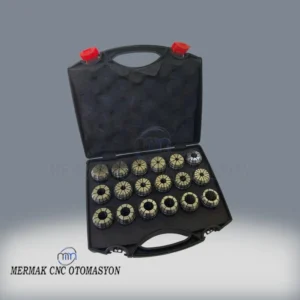
ER20 Collet Set in Plastic Case
Original price was: 44.87$.29.04$Current price is: 29.04$.
Out of stock
🔥 Special for Today Only %35 Discount Opportunity!📦 Category: Spindle Collets Sets
Mermak assuranceFrom factory to end user · importer / main dealer · strong stock
ImporterMain dealer / distributorStrong stockGood priceCorporate invoice
Contact us for stock information · 14-day return for standard unused products; conditions may vary for custom size/cut products.
The ER20 Collet Set in a Plastic Case is a standardized tool holder component designed for high accuracy and repeatability in connecting cutting tools for industrial automation and precision machining applications. The collets in this set are ER20 type, fully compliant with the international standard DIN 6499/ISO 15488, and feature a tapered design. Their working principle involves the collet’s tapered outer surface being compressed between the collet nut and the inner tapered surface of the tool holder. This clamping force causes the flexible segments of the collet to deform radially inward, gripping the tool centrally and with uniform force. This mechanism is critical for minimizing the axial and radial runout of the cutting tool, especially at high speeds and during heavy material removal operations, directly impacting machining precision, surface quality, and tool life. The set offers a universal solution for various CNC machine applications such as milling, turning, drilling, reaming, and grinding.
The material composition of this collet set is high-quality 65Mn spring steel. This special alloy steel combines high tensile strength, excellent flexibility, and fatigue resistance, enabling the collets to withstand repeated clamping and unclamping cycles. The material undergoes special heat treatment processes to achieve an optimized hardness in the HRC 44-48 range. This hardness enhances the collets’ resistance to wear while maintaining the necessary toughness to prevent brittleness. For system integration, ER20 collets are fully compatible with all ER20 collet nuts and tool holders compliant with DIN 6499/ISO 15488 available on the market, ensuring seamless adaptability to existing CNC systems. Application areas cover sectors requiring high accuracy such as aerospace, automotive, mold making, medical device manufacturing, and general precision engineering. The plastic case protects the collets from impacts, moisture, and corrosion effects in industrial environments, extending tool life and providing organized storage.
Advantages of the ER20 Collet Set in Plastic Case
High Runout Control and Machining Precision: This collet set is manufactured with a radial runout tolerance of less than 0.015 mm. This low runout value minimizes the deviation of the cutting tool from its rotational axis, significantly reducing vibrations during machining. Consequently, each cutting edge of the tool contacts the material equally, leading to extended tool life, reduced surface roughness (better surface quality), and tighter control over dimensional tolerances. This precision is a critical parameter for part geometry accuracy and repeatability, especially in micro-machining and high-speed machining applications.
Wide Diameter Range Coverage and Operational Flexibility: Thanks to the broad clamping range offered by the ER20 standard, this set typically provides the ability to securely hold various cutting tools, drills, reamers, and other tools with cylindrical shanks ranging from 1 mm to 13 mm using a single collet type. Each collet can clamp tools of different diameters by flexing within a specific tolerance range (generally -0.5 mm from its nominal diameter). This feature simplifies tool inventory, reduces the need for separate collets for different tool diameters, and optimizes tool change times, thereby increasing operational efficiency. This flexibility allows for rapid adaptation to various machining tasks.
Superior Material Science and Mechanical Durability: The collets are made from high-quality 65Mn spring steel and have undergone special controlled heat treatment processes. This metallurgical treatment optimizes the steel’s microstructure, imparting a high hardness level in the HRC 44-48 range. This hardness increases the wear resistance of the collets, while the natural flexibility and toughness of 65Mn steel provide superior resistance to deformation and fatigue under dynamic loads. The high elastic limit ensures that the collets maintain their original clamping force and geometric accuracy even after thousands of clamping-unclamping cycles. This combination of material and processing guarantees that the collets will perform reliably and consistently for many years, even in demanding industrial environments, thus minimizing maintenance and replacement costs.
Technical Specifications and Capacity
Feature: Value/Description
Collet Type: ER20 (Compliant with DIN 6499 / ISO 15488 standard, universal compatibility)
Collet Material: High-Quality Spring Steel (65Mn), optimized flexibility and toughness
Hardness: HRC 44-48 (High wear resistance achieved through controlled heat treatment)
Runout Tolerance: < 0.015 mm (0.0006 inches) (Critical for high-precision machining and tool life optimization)
Holding Range: 1 mm to 13 mm (Set includes collets of various diameters; each collet has a clamping capacity of nominal diameter -0.5 mm)
Surface Treatment: Special anti-corrosion treatment (typically black oxide or similar protective coating)
Packaging: Impact-resistant plastic case for organized storage (Protection against corrosion and physical damage)
Technical Frequently Asked Questions (FAQ)
How do ER20 collets center the cutting tool and generate clamping force?
ER20 collets have a tapered outer geometry and flexible segments that extend axially and are equally spaced. When placed between the inner tapered surface of the tool holder and the inner tapered surface of the collet nut, tightening the collet nut forces the collet’s outer tapered surface against the inner tapered surface of the tool holder. This axial movement causes the collet’s flexible segments to deform radially inward. This deformation reduces the collet’s inner diameter, causing it to grip the tool evenly around its circumference with uniform force. The segmented structure of the collet and the elastic properties of the spring steel material ensure that the tool is centered with high precision and held securely with strong clamping force. This mechanism minimizes axial runout during rotation, thereby increasing machining accuracy.
What are the direct impacts of a runout tolerance below 0.015 mm on machining performance and tool life?
A radial runout tolerance below 0.015 mm means that the deviation of the cutting tool from its rotational axis is extremely limited. This situation provides a series of critical technical advantages during machining operations. Firstly, each cutting edge of the tool contacts the workpiece material equally and balanced. This ensures uniform wear of the cutting edges, significantly extending tool life and reducing the frequency of tool changes. Secondly, low runout minimizes radial vibrations and resonances during machining. This leads to reduced surface roughness, higher surface quality, and prevents the occurrence of surface defects known as “chatter.” Thirdly, the axial accuracy of the tool allows for tighter control over the dimensional tolerances of machined parts, improving part quality in high-precision applications. Finally, low runout can enable the use of more aggressive cutting parameters (higher speeds, feeds), thereby increasing material removal rates and consequently, production efficiency.
How do 65Mn spring steel and the applied heat treatment contribute to the longevity and durability of the collets?
65Mn spring steel is an alloy with excellent mechanical properties due to its high carbon and manganese content. This steel is known for its high tensile strength, elasticity, and fatigue resistance, which are vital for collets to maintain their original form without deforming under continuous clamping and unclamping cycles. The special heat treatment process applied optimizes the microstructure of the collets, imparting a controlled hardness in the HRC 44-48 range. This hardness increases the wear resistance of the surfaces of the collets that come into contact with the cutting tool and the tool holder, thereby extending their lifespan. At the same time, the heat treatment preserves the material’s toughness, reducing the collets’ susceptibility to breakage from sudden impacts or excessive loads. This combination of material and heat treatment ensures that the collets operate reliably for many years, even under high-speed and heavy cutting conditions, maintaining their clamping force and geometric accuracy, which reduces maintenance costs and supports production continuity.
What technical maintenance procedures are recommended to maintain the optimal performance and extend the life of ER collets?
Regular and technical maintenance procedures are essential to ensure the optimal performance and long life of ER collets. Firstly, after each use, the collets and collet nuts must be cleaned of chips, oil, and other contaminants. This cleaning should be done with compressed air and an appropriate cleaning solution to prevent jamming and protect the precise clamping surfaces. Secondly, high-quality tool holder oil or grease should be regularly applied to the threaded parts and tapered surfaces of the collets and collet nuts. This lubrication reduces friction, ensures more efficient transmission of clamping force, and prevents corrosion. Thirdly, collets and collet nuts should be regularly visually inspected for signs of wear, deformation, or cracks. Deformations, especially at the ends of the collet segments, or wear on the tapered surfaces can directly affect the runout tolerance and indicate that they need replacement. Finally, when not in use, collets should be stored neatly in the impact-resistant plastic case provided with the set, away from moisture and corrosive environments. These procedures maximize tool life by preserving the collets’ precision and ensure consistency in machining quality.
Mermak has 16 years of experience in the industrial automation sector. Our products are manufactured in the Ankara Uzay Sanayi factory and warehouse. Current stock quantities and prices are updated on our website. Stocked products are dispatched directly from our warehouse without production waiting times. We ensure careful packaging and meticulous follow-up of invoices and documents. We partner with reliable logistics providers, and the Mermak team closely monitors the shipment process. Upon request, we can arrange product videos or factory viewings via WhatsApp or other contact channels. We proudly supply our products to customers in the United Kingdom, United States, Canada, Australia, Ireland, New Zealand, South Africa, and similar countries and international markets.
| Collet Standard |
|---|
You must be logged in to post a review.
Taksit Tablosu
Related Products
 %30 DiscountER32 Collet Chuck Set in Plastic CaseOriginal price was: 85.25$.59.59$Current price is: 59.59$.View
 %35 DiscountER11 Collet Set with Plastic Case - 7 PiecesOriginal price was: 35.89$.23.23$Current price is: 23.23$.View
 %35 DiscountER40 Collet Set with Case, 23 PiecesOriginal price was: 98.08$.63.48$Current price is: 63.48$.View
Reviews
There are no reviews yet.