
No products in the cart.


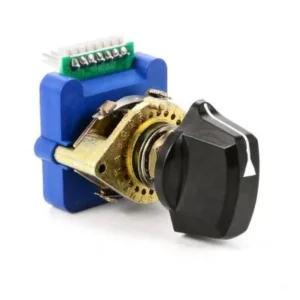
DCRS-03J Digital Mode Switch
23.18$
High-performance digital mode switch for industrial automation, offering precise control and robust durability.
In stock
📦 Category: Control Buttons and Signal Lamps
Mermak assuranceFrom factory to end user · importer / main dealer · strong stock
ImporterMain dealer / distributorStrong stockGood priceCorporate invoice
In stock / available to order · 14-day return for standard unused products; conditions may vary for custom size/cut products.
DCRS-03J Digital Mode Switch
INDUSTRIAL AUTOMATION PARTS | SUPERIOR PERFORMANCE SERIES
Detailed Product Review
The DCRS-03J Digital Mode Switch is an electromechanical interface component that allows the operator to precisely select machine operating modes, axis movements, and other critical functions in industrial automation systems. This switch converts 24 mechanically defined fixed positions, with an angular rotation of 15° for each position, into digital signal outputs, transmitting instantaneous and reliable status information to the control system. Its operating principle relies on the internal contacts of the rotary mechanism closing and opening at specific positions, sending binary logic signals to the connected CNC or PLC system. This digital signal transmission offers higher immunity to electrical noise compared to traditional analog signal-based switches, enhancing data integrity and system stability. Each position transition, achieved through physical operator input, is supported by distinct tactile feedback, which helps prevent incorrect mode selections and maximizes reliability in human-machine interaction.
The product’s material structure is designed with a special alloy body to withstand harsh industrial conditions; this structure exhibits high resistance to wear, corrosion, and impact, guaranteeing a long operational life. The DCRS-03J features an IP65 protection class in accordance with IEC 60529 standard, indicating that the switch is completely protected against dust ingress and is resistant to low-pressure water jets from any direction, ensuring uninterrupted operation even in machining environments or production lines where liquid splashes may occur. For system integration, the DCRS-03J is optimized for direct compatibility with industry-leading CNC control systems such as Fanuc, Siemens, and Mitsubishi. This compatibility is achieved through discrete I/O connections via standard industrial communication protocols and 24VDC logic levels. Application areas range from CNC lathe, milling, and machining centers for manual/automatic mode selection, rapid traverse (jog), and axis designation functions, to task selection in robotic systems and control of functions requiring operator intervention in production lines.
DCRS-03J Digital Mode Switch Advantages
High-Resolution and Deterministic Control Integration: The DCRS-03J is designed with 24 fixed positions and a precise mechanical rotation angle of 15° between each position. This engineering approach ensures that each mode or function selected by the operator is transmitted to the control system as an error-free and repeatable digital signal. Mechanical detents provide clear tactile feedback at each position, preventing the operator from inadvertently resting in intermediate positions or making unintended mode transitions. This deterministic structure ensures definitive identification of machine states, especially in critical production processes, minimizing the possibility of operator error and thereby enhancing overall system stability and operational safety.
Superior Mechanical and Environmental Durability Against Harsh Industrial Conditions: The product has an IP65 protection class according to IEC 60529 standard, meaning the switch is fully protected against dust ingress and resistant to low-pressure water jets from all directions (e.g., washing or cooling fluids). This feature guarantees reliable and uninterrupted operation even in demanding industrial applications such as machining, grinding, or in humid environments with chemical vapors. Furthermore, the special alloy body structure provides high resistance to continuous mechanical wear, corrosion, and impact, allowing the switch to maintain its operational life for many years without performance degradation, significantly reducing maintenance costs.
Wide Industrial Control System Compatibility and Rapid Integration: The DCRS-03J is designed for direct and seamless integration with leading CNC control systems in the industrial automation sector, such as Fanuc, Siemens, and Mitsubishi. This compatibility is typically achieved through discrete digital signal outputs at 24VDC logic levels, allowing the switch to be directly connected to the digital input modules of a PLC or CNC. Digital signal outputs are less susceptible to electrical noise compared to analog signals, eliminating the need for signal converters and reducing installation complexity and cost. This ease of integration offers the possibility of quick and efficient adaptation to existing automation infrastructures, shortening commissioning times and providing flexibility in system upgrades.
Technical Specifications and Capacity
FeatureValue/Description
Number of Positions and Rotation Angle24 fixed positions; high precision with 15° mechanical rotation angle between each position and distinct tactile feedback.
Control Output TypeDigital signal outputs; optimized for direct integration with modern CNC/PLC systems, with high noise immunity.
Protection ClassIP65; complete protection against dust ingress and low-pressure water jets from all directions according to IEC 60529 standard.
Structural MaterialSpecial alloy body structure; high mechanical resistance against wear, corrosion, and impact, ensuring long-lasting performance.
Operating Temperature Range-10°C to +70°C; reliable and stable operation capacity within a wide thermal range.
System Integration CompatibilityFull compatibility and easy integration with industry-leading CNC systems such as Fanuc, Siemens, Mitsubishi.
Technical Frequently Asked Questions (FAQ)
What technical advantages do the digital signal outputs of the DCRS-03J offer in industrial automation systems compared to traditional analog mode switches?
The digital signal outputs of the DCRS-03J offer a number of significant technical advantages in industrial automation systems. Firstly, digital signals exhibit much higher immunity to electrical noise (EMI/RFI) compared to analog signals. This is critical for maintaining signal integrity, especially in industrial environments with motor drives, high-frequency sources, and other sources of electromagnetic interference. Secondly, digital signals can be directly connected to the digital input modules of Programmable Logic Controllers (PLCs) or Computer Numerical Control (CNC) systems, eliminating the need for Analog-to-Digital Converters (ADCs). This reduces system complexity, lowers costs, and eliminates delays or errors that may arise from signal conversion. Thirdly, the binary (on/off) nature of digital signals transmits the switch’s position definitively and deterministically, eliminating the risk of misinterpretation and ensuring the control system is always operating in the correct mode. These features significantly enhance overall system reliability and response time.
How does the DCRS-03J’s 24 fixed positions and 15° mechanical rotation angle provide an engineering advantage in terms of operator precision and system stability?
The DCRS-03J’s 24 fixed positions and 15° mechanical rotation angle for each position are key engineering features that directly contribute to operator precision and system stability. This design provides a physically defined, precise detent for each mode or function selection. The operator feels a distinct “click” or tactile feedback at every 15 degrees as they turn the switch, confirming that the selection is made correctly and the switch is locked in the desired position. This mechanical locking prevents the switch from resting in intermediate positions or shifting to an unintended mode due to external factors like vibration, thus ensuring the system always remains in the state intended by the operator. The high number of positions offers flexibility to control a wide range of functions with a single switch, while the precise rotation angle minimizes operator errors, supporting uninterrupted and error-free flow in production processes. This is particularly important for critical mode transitions in complex CNC machines or robotic systems, enhancing operational safety and efficiency.
What does the IP65 protection class mean for the long-term and reliable operation of the DCRS-03J in industrial environments, and what test standards is this classification based on?
The IP65 protection class is a critical technical feature for the long-term and reliable operation of the DCRS-03J Digital Mode Switch in industrial environments. The abbreviation “IP” stands for “Ingress Protection” and is determined according to the IEC 60529 international standard. The first digit of this coding, “6”, indicates the level of protection against solid particles, meaning it is “dust-tight”; no dust can enter the switch. The second digit, “5”, indicates the level of protection against liquids, meaning it is protected against low-pressure water jets from any direction. This implies the switch is resistant to water splashes or jets that it might be exposed to during operations involving cooling fluids, cutting oils, or cleaning. This protection class prevents contamination and corrosion of the product’s internal mechanisms in dusty, humid, or splash-prone environments, such as those found in machining, metalworking, food processing, or chemical plants, thereby minimizing electrical failures. Consequently, the IP65 classification ensures that the DCRS-03J maintains its high performance and operational reliability for many years even under harsh industrial conditions, reducing maintenance costs and optimizing the total cost of ownership.
How is the integration of the DCRS-03J with leading CNC systems like Fanuc, Siemens, and Mitsubishi achieved in terms of electrical interface and software compatibility?
The integration of the DCRS-03J Digital Mode Switch with industry-leading CNC systems such as Fanuc, Siemens, and Mitsubishi is primarily achieved through standard industrial electrical interfaces and the flexible programming capabilities of the control systems. In terms of the electrical interface, the DCRS-03J typically offers discrete digital signal outputs at 24VDC logic levels. These outputs can be directly connected to the digital input modules of CNC controllers or connected PLCs. Each switch position usually sends a unique binary code or a single signal by changing the state (on/off) of one or more digital inputs to the control system. For example, for a 24-position switch, each position might trigger a unique combination of digital inputs or transmit position information using an encoder logic. Software compatibility is then achieved by reading and processing these digital input signals within the CNC or PLC programming environment (e.g., Fanuc’s Ladder Logic, Siemens’ TIA Portal, or Mitsubishi’s GX Works). Engineers develop logical programs (ladder diagrams, function blocks, etc.) that detect the current position of the switch based on these input signals and, in turn, control the machine’s operating mode (Manual, Automatic, MDI, etc.), axis selection (X, Y, Z), or other functions (Rapid Traverse, Feed Rate Adjustment). This direct and standardized integration method ensures compatibility with different brands of CNC systems, simplifying installation and offering high flexibility in system configuration.
You must be logged in to post a review.
Reviews
There are no reviews yet.