
No products in the cart.
%47 Discount


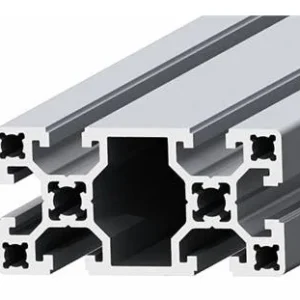
40×80 Sigma Profile 8 Channel Heavy Duty Wholesale
Original price was: 56.92$.30.36$Current price is: 30.36$.
High-strength extruded aluminum profile for industrial automation, machine building, and construction. Optimized for high structural rigidity and load-bearing capacity.
In stock
🔥 Special for Today Only %47 Discount Opportunity!📦 Category: Sensors and Switches🏷️ Dimensions: 40 mm🏷️ Slot Size: 8 Slots🏷️ Profile Size: 40x80
Mermak assuranceFrom factory to end user · importer / main dealer · strong stock
ImporterMain dealer / distributorStrong stockGood priceCorporate invoice
In stock / available to order · 14-day return for standard unused products; conditions may vary for custom size/cut products.
40×80 Sigma Profile 8 Channel Heavy Duty Wholesale
INDUSTRIAL AUTOMATION PARTS | SUPERIOR PERFORMANCE SERIES
Detailed Product Review
This 40×80 mm cross-section, 8-T-slot heavy-duty sigma profile is a structural element designed for critical applications in industrial automation systems, machine manufacturing, and construction projects requiring high structural rigidity and load-bearing capacity. The profile’s 40×80 mm rectangular cross-section geometry is optimized with a moment of inertia that ensures minimal deformation, especially over long spans and under high axial or bending loads. The heavy-duty design features thicker wall sections and increased material density compared to standard profiles, providing superior stability and operational accuracy even under dynamic loads, vibrations, and torsional stresses. This feature directly impacts the repeatability and longevity of systems, particularly in applications like robotic cells, CNC machines, precision measurement systems, and heavy-duty conveyors.
The product is typically manufactured from high-strength extruded aluminum alloy conforming to EN AW-6063 T5 standards. This alloy offers excellent machinability, high corrosion resistance, and a good strength-to-weight ratio. The anodized (anodized) surface treatment increases the profile’s surface hardness, enhancing its resistance to scratches and abrasion, while also improving its chemical resistance against environmental factors and providing electrical insulation. The 8 T-slots allow for quick and flexible integration of a wide range of fasteners, sensors, cable trays, pneumatic/hydraulic lines, and other automation components. This modular structure enables bolted connections without the need for welding or special tooling, reducing assembly times, simplifying system modifications, and offering maximum flexibility for future expansions.
Advantages of 40×80 Sigma Profile 8 Channel Heavy Duty Wholesale
High Structural Rigidity and Moment of Inertia: The heavy-duty 40×80 mm cross-section possesses a higher moment of inertia (Ix and Iy) and torsional constant (J) compared to standard profiles. This ensures less deformation under axial, bending, and torsional loads. This is critical for maintaining geometric accuracy and operational precision in applications such as high-speed motion systems, heavy-load conveyors, and main chassis for robotic manipulators. The increased material cross-section reduces stress concentrations, extending fatigue life and enhancing long-term system reliability.
Modular and Precise Assembly Flexibility: The modular nature of sigma profiles allows for quick and precise assembly using specialized fasteners (T-nuts, corner brackets, profile connection kits) without the need for thermal deformation-inducing joining methods like welding. This enables tight control over assembly tolerances, improving system geometric accuracy. It significantly shortens project development and commissioning times while providing maximum flexibility for future system upgrades, configuration changes, or disassembly. This feature offers cost and time savings in production line modifications or prototyping.
Versatile Integration and Functional Expandability: The profile’s eight T-slots provide a standard interface for integrating a wide array of industrial components. These channels can be used as internal conduits for organized routing of cables and pneumatic/hydraulic lines, while also allowing for easy mounting of various accessories such as sensors, switches, safety barriers, lighting fixtures, control panels, and linear motion systems. This integration capability simplifies the creation of complex and multifunctional industrial structures on a single platform, enhancing system functionality and offering broad potential for future technological integrations.
Technical Specifications and Capacity
Specification|Value/Description
Profile Type|Sigma Profile
Profile Dimensions|40×80 mm
Number of Channels|8 Channels (T-Slot)
Material|High-Strength Extruded Aluminum Alloy (EN AW-6063 T5)
Design Type|Heavy Duty – Optimized for high moment of inertia and load-bearing capacity.
Surface Treatment|Anodized (Anodized) – Increased scratch and corrosion resistance.
Technical Frequently Asked Questions (FAQ)
What advantages do the moment of inertia (I) and section modulus (W) values of this heavy-duty profile offer in structural design?
The increased cross-sectional area and optimized wall thicknesses of the 40×80 heavy-duty sigma profile provide significantly higher moments of inertia (Ix and Iy) and section moduli (Wx and Wy) compared to standard profiles. The moment of inertia directly determines an element’s bending stiffness; a high I value means less deflection and deformation under the same load. This is critical in applications with long spans or those requiring high precision, such as optical/laser alignment systems. The section modulus indicates the material’s resistance to bending stress; a high W value means lower maximum stress under a given bending moment, allowing the profile to safely carry higher loads or have a longer fatigue life under the same load. These engineering parameters maximize the overall stability and operational life of systems with dynamic loads and vibrations, such as machine chassis and robotic platforms.
What technical considerations are important for fastener selection and assembly of heavy-duty sigma profiles?
When selecting fasteners and assembling heavy-duty sigma profiles, the type and magnitude of applied loads, the system’s dynamic characteristics, and environmental conditions must be considered. High-strength T-nuts (e.g., steel or special alloys) and bolts of appropriate strength class (e.g., 8.8 or 10.9) should be preferred. For corner connections, internally or externally reinforced, multi-bolt connectors should be used to maximize load transfer and ensure torsional rigidity. During assembly, bolt torque values must be set according to manufacturer specifications; overtightening can lead to profile deformation or thread damage, while undertightening can cause connection looseness and system instability. For applications with dynamic loads, additional safety measures like spring washers or chemical thread lockers should be considered to prevent vibration-induced loosening. Furthermore, insulation may be required between dissimilar metals to prevent galvanic corrosion at connection points.
How does the anodized surface treatment contribute to the mechanical and chemical properties of the profile?
The anodized (anodization) process significantly enhances the mechanical and chemical properties of aluminum profiles by increasing the thickness of the natural aluminum oxide layer through a controlled electrolytic oxidation process. The resulting hard and porous aluminum oxide layer increases the profile’s surface hardness, improving its resistance to scratches and abrasion. This layer, which can reach Mohs hardness values of 8-9, enhances the profile’s durability against mechanical stress in industrial environments. Chemically, the anodized layer increases aluminum’s passivation, significantly improving corrosion resistance, especially in humid, acidic, or alkaline environments, thereby extending the profile’s lifespan. Additionally, this layer exhibits electrical insulating properties, allowing the profile to be used in applications with electrical components or in environments sensitive to electrostatic discharge (ESD). The porous nature of the surface also provides a base for coloring or applying additional protective coatings for aesthetic purposes.
How should the thermal expansion coefficient of this profile be considered in long structural applications?
The thermal expansion coefficient of aluminum alloys (approximately 23 x 10-6 m/(m·°C)) is higher than that of other common structural materials like steel. This is a critical design parameter to consider for 40×80 sigma profiles in long structural applications, especially in environments exposed to wide temperature variations. For instance, a 10-meter profile subjected to a 50°C temperature change could experience a dimensional change of approximately 11.5 mm. This expansion or contraction can lead to significant internal stresses at fixed points or disrupt the alignment of moving components. When designing long structures, expansion joints, sliding connections, or flexible mounting elements are necessary to accommodate thermal expansion and contraction. Furthermore, when joining with components made of different materials, detailed engineering analyses should be performed to account for stresses and deformations caused by differential expansion due to varying thermal expansion coefficients. This is vital for the long-term performance and structural integrity of the system.
| Dimensions | 40 mm |
|---|---|
| Slot Size | 8 Slots |
| Profile Size | 40x80 |
You must be logged in to post a review.
Taksit Tablosu
Related Products
 %47 Discount45x90 Sigma Profile 10 Channel Heavy Duty WholesaleOriginal price was: 60.70$.32.38$Current price is: 32.38$.View
 %47 Discount45x135 Sigma Profile 10 Channel BulkOriginal price was: 86.04$.45.89$Current price is: 45.89$.View
 %47 Discount45x45 Sigma Profile 10 Channel Standard Type WholesaleOriginal price was: 30.52$.16.27$Current price is: 16.27$.View
Reviews
There are no reviews yet.