
No products in the cart.
%38 Discount


30 mm Linear Guide Rail Standard
Original price was: 41.72$.26.04$Current price is: 26.04$.
High-precision linear motion component for industrial automation.
In stock
🔥 Special for Today Only %38 Discount Opportunity!📦 Category: 30 mm Linear Guides and Bearings
Mermak assuranceFrom factory to end user · importer / main dealer · strong stock
ImporterMain dealer / distributorStrong stockGood priceCorporate invoice
In stock / available to order · 14-day return for standard unused products; conditions may vary for custom size/cut products.
30 mm Linear Guide Rail Standard
INDUSTRIAL AUTOMATION PARTS | SUPERIOR PERFORMANCE SERIES
Detailed Product Review
The 30 mm Linear Guide Rail Standard is a critical mechanical component designed to provide highly precise and repeatable linear motion in industrial automation systems. This rail allows linear carriages (guide blocks) mounted on it to move smoothly and stably with a low coefficient of friction. Its operating principle is based on the circulation of balls or rollers within the linear carriage, distributing the load and minimizing motion resistance on the precisely ground surface of the rail. This kinematic structure effectively carries both radial and axial loads, as well as moment loads, ensuring the system maintains high rigidity and positioning accuracy even under dynamic and static conditions. The rail’s square cross-section geometry offers high resistance to torsional and bending deformations, helping to preserve the system’s geometric precision, especially in long-stroke and heavy-load applications.
This linear guide rail is manufactured from high-carbon alloy steel, with a surface hardness of HRC 58-62 to maximize wear resistance and operational life. The material selection and heat treatment process guarantee the rail’s high load-carrying capacity and fatigue resistance, while the precision grinding process ensures micron-level straightness and surface roughness, creating an optimal contact surface with the linear carriages. Thanks to its modular structure, beyond standard 4-meter lengths, theoretically infinite travel distances can be achieved by using specially designed joining mechanisms for end-to-end connection, offering flexible solutions for large-scale and long-stroke applications. The product’s assembly compatibility allows for easy integration with various socket head cap screws, and it precisely matches linear carriages in wide/narrow types of Hiwin, DMS, and SHN standards from 15mm to 45mm, making it usable in a wide range of applications. These features provide reliable and high-performance linear motion solutions in various industrial fields, from CNC machining centers to robotic automation lines, precision measuring instruments, and heavy material handling systems.
Advantages of the 30 mm Linear Guide Rail Standard
Precision Surface Treatment and Low Friction Coefficient: This linear guide rail features a surface treated with precision grinding techniques controlled at the micron level. This surface treatment minimizes surface roughness in the contact area where the linear carriages move, significantly reducing static and dynamic friction coefficients. Low friction reduces the stick-slip effect, ensuring smooth and vibration-free motion characteristics even at low speeds and micro-movements. Furthermore, reduced friction lowers energy losses, increasing the system’s overall efficiency and minimizing positioning errors caused by thermal expansion. This feature offers a critical advantage in applications requiring high positioning accuracy and repeatability.
Superior Rigidity and Load Capacity: The 30 mm Linear Guide Rail Standard exhibits high rigidity in both horizontal and vertical directions due to its optimized square cross-section geometry. This structural feature increases the rail’s resistance to bending, torsion, and deflection, thus preserving the system’s geometric integrity and positioning accuracy even under dynamic loads. The high-carbon alloy steel material and HRC 58-62 surface hardness allow the rail to safely carry high static and dynamic loads. This superior rigidity directly impacts workpiece quality and system stability by increasing vibration damping capacity, especially in applications such as heavy machining operations, high-speed robotic movements, and precision measurement systems.
Modular Structure and Flexible Length Integration: While this linear guide rail is offered in standard 4-meter lengths, it provides the possibility to create continuous systems for much longer travel distances using a specially designed wedge-supported end-joining mechanism. The wedge mechanism ensures precise alignment between the joined rail sections, minimizing straightness and parallelism deviations at the connection points and ensuring motion continuity. This modular design offers cost-effective and flexible solutions for specific project requirements, such as large-scale machines or long conveyor lines. Additionally, Mermak CNC’s free cutting service ensures precise preparation of rails according to specific project dimensions, simplifying the assembly process and eliminating the need for additional on-site machining.
Technical Specifications and Capacity
SpecificationValue/Description
Nominal Rail Size30 mm
Cross-Section GeometrySquare Profile (Optimized for High Rigidity)
Surface TreatmentPrecision Ground (Low Friction, High Accuracy)
MaterialHigh-Carbon Alloy Steel
Surface HardnessHRC 58-62
Straightness AccuracyHigh Precision Class (Minimum Deviation and Vibration)
Technical Frequently Asked Questions (FAQ)
What are the engineering implications of the HRC 58-62 surface hardness value on the performance and lifespan of a linear motion system?
The HRC 58-62 surface hardness is a critical parameter that directly affects the wear resistance and fatigue life of the linear motion system. This hardness value increases the rail surface’s resistance to microscopic deformations and wear that occur under continuous contact and rolling loads from the linear carriage’s circulating balls or rollers, especially in high-speed and heavy-load applications. High surface hardness delays surface fatigue (pitting) and abrasive wear mechanisms, allowing the rail to maintain its initial geometric accuracy for a longer period. Furthermore, the hardened surface is more resistant to impact and shock loads, increasing the system’s overall reliability. This hardness is achieved through a heat treatment process that keeps the inner core of the rail more ductile, ensuring maximum durability on the surface while reducing brittleness.
How does the “High Precision Class” straightness accuracy of this linear guide rail affect the overall positioning accuracy of an automation system?
“High Precision Class” straightness accuracy refers to the straightness and deviation-free nature of the rail along its length, measured in the thousandths of a millimeter (micron range). This feature has a direct and critical impact on the overall positioning accuracy of the linear motion system. High straightness minimizes deviations in the moving axis reaching and maintaining its target position. Especially in multi-axis systems like CNC machining centers, the straightness accuracy of each axis determines the final geometric tolerances and surface quality achieved on the workpiece. Low straightness deviations reduce vibrations, improve dynamic response, and optimize load distribution on the linear carriage, increasing the system’s repeatability and lifespan. This accuracy is continuously monitored during the manufacturing process using advanced measuring equipment such as laser interferometers.
How does the rail’s “wedge-supported” end-joining mechanism maintain system integrity and accuracy in long-distance applications?
The wedge-supported end-joining mechanism is an engineering solution that allows for long travel distances by joining multiple linear guide rails end-to-end. This mechanism works by using conical or flat wedges that ensure precise alignment at the rail connection points. The wedges are placed in specially machined slots on the side surfaces of the rails, creating a tight connection and geometric continuity between the joined parts in both horizontal and vertical directions. This minimizes angular or positional deviations at the connection point, ensuring that the linear carriage moves smoothly and without vibration when passing over the joint. The wedge support also optimizes load transfer, reduces stress concentration at the joint, and maintains the system’s overall rigidity and load-carrying capacity uniformly along its length. This method is critically important in applications such as long conveyor systems or large-scale CNC gantry machines.
What does the phrase “Hiwin-Dms-Shn Precision Compatibility” mean for selecting a linear carriage for this 30mm linear guide rail, and what technical factors should be considered?
The phrase “Hiwin-Dms-Shn Precision Compatibility” indicates that the 30mm linear guide rail is fully compatible in terms of dimensions and functionality with linear carriages from brands such as Hiwin, DMS, and SHN, which are widely recognized and adhere to high precision standards in the industry. This compatibility means that the dimensions and tolerances of the rail and carriage are manufactured according to specific industrial standards, ensuring seamless integration between components from different manufacturers. Technical factors to consider when selecting a linear carriage include: First, the static and dynamic load capacity required by the application; the carriage must be able to carry these loads without deformation. Second, the preload level; this affects the system’s rigidity and vibration damping capacity and is important for backlash-free motion. Third, the carriage’s precision class; selecting a carriage that matches the rail’s high precision class maximizes the system’s overall positioning accuracy. Fourth, sealing and lubrication features; for systems operating in dusty, dirty, or humid environments, the carriage’s effective sealing elements and appropriate lubrication system directly impact its lifespan and performance. Finally, the carriage’s size (wide/narrow type) and mounting hole pattern should be compatible with the existing system design and space constraints.
Mermak CNC has 16 years of experience in the industrial automation sector, operating from our factory and warehouse in Ankara Uzay Sanayi. Our website features up-to-date stock quantities and prices. Stocked products are dispatched directly from our warehouse, eliminating production waiting times. We ensure careful packaging, meticulous invoice and document follow-up, and utilize reliable logistics partners. The Mermak team closely monitors the shipment process. Upon request, we can arrange product videos or factory viewings via WhatsApp or other contact channels. We proudly supply our products to numerous countries, including the United Kingdom, United States, Canada, Australia, Ireland, New Zealand, and South Africa, as well as similar countries and international markets worldwide.
| Dimensions |
|---|
You must be logged in to post a review.
Taksit Tablosu
Related Products
 %46 DiscountNEMA 42 20 Nm Stepper MotorOriginal price was: 316.80$.170.28$Current price is: 170.28$.View
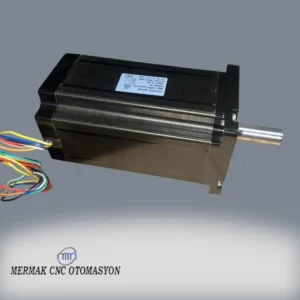 %46 DiscountNema 42 Stepper Motor 28 NmOriginal price was: 375.60$.202.00$Current price is: 202.00$.View
 %49 Discount3 Axis USB Mach3 Control Board 2000 kHzOriginal price was: 312.02$.160.66$Current price is: 160.66$.View
Reviews
There are no reviews yet.