
No products in the cart.
%30 Discount
200×4 Sanou Lathe Chuck
Original price was: 311.90$.218.33$Current price is: 218.33$.
4 Independent Jaws, 200mm Diameter, High Precision for Asymmetrical Workpieces.
Out of stock
🔥 Special for Today Only %30 Discount Opportunity!📦 Category: General🏷️ Chuck Jaw Count: 4 Jaws🏷️ Dimensions: 200
Mermak assuranceFrom factory to end user · importer / main dealer · strong stock
ImporterMain dealer / distributorStrong stockGood priceCorporate invoice
Contact us for stock information · 14-day return for standard unused products; conditions may vary for custom size/cut products.
200X4 SANOU LATHE CHUCK
INDUSTRIAL AUTOMATION PARTS | SUPERIOR PERFORMANCE SERIES
Detailed Product Review
The 200×4 Lathe Chuck is a workholding device designed with four independent jaws to axially secure workpieces and provide rotational motion on lathes. This mechanism allows for precise centering of the workpiece or intentional eccentric clamping. Each jaw can be moved independently via its own lead screw, enabling secure and rigid clamping of workpieces with non-circular, asymmetrical, or irregular geometries. The chuck mounts directly to the lathe’s spindle or via an intermediate backplate, transferring rotational motion from the spindle to the workpiece to create the necessary kinematic chain for cutting operations. This independent jaw structure plays a critical role, especially in applications requiring high precision or where standard three-jaw chucks are insufficient, offering the ability to adjust workpiece runout to micron levels.
The structural integrity of this lathe chuck is ensured by a main body made of high-strength alloy steel and hardened, ground tool steel jaws. The body material has undergone thermal treatment to exhibit minimal deformation under high torque and cutting forces, while the jaws have been subjected to special heat treatment and surface hardening processes to increase wear resistance and provide a long-lasting gripping surface. System integration typically occurs through ISO standard backplate connection geometries (e.g., A2-5, A2-6, or D1-5, D1-6 tapered connections), facilitating the adaptation of the chuck to different brands and models of lathes. Application areas span a wide range, from machining eccentric parts like crankshafts or camshafts in the automotive industry, to precise turning of asymmetrical mold cores or blanks in mold making, and machining square or rectangular cross-section materials in general machine manufacturing. This chuck is a preferred engineering solution, particularly when the workpiece geometry is incompatible with standard clamping methods or when high-precision centering adjustment is required during machining.
Advantages of the 200X4 SANOU LATHE CHUCK
High Adaptability and Precision Offered by Independent Jaws: The four independent jaw mechanism of this lathe chuck allows the user to clamp the workpiece precisely in the center or at a specific eccentricity. The ability to adjust each jaw individually ensures secure clamping of workpieces that are non-circular, asymmetrical, or lack pre-machined reference surfaces. This feature enables micron-level adjustment of workpiece runout with a comparator gauge, offering a critical advantage in applications where final machining tolerances are tight. Furthermore, this independent movement capability provides the necessary flexibility for machining special geometries by rotating or fixing the workpiece in an off-center position.
Optimized Mechanical Structure and Material Science: The Sanou 200X4 lathe chuck consists of a main body made from high-strength alloy steel and heat-treated, precision-ground tool steel jaws. The body material is designed to maintain its structural integrity under high cutting forces and dynamic loads, ensuring minimal vibration and maximum rigidity. Special heat treatment and surface hardening processes on the jaws enhance wear resistance and minimize deformation of the gripping surfaces, providing long-term and repeatable clamping accuracy. This material selection and manufacturing methodology ensure that the chuck maintains its performance even under heavy-duty conditions and extends its operational life.
Wide Workpiece Spectrum and Machining Flexibility: This 200 mm diameter lathe chuck offers a broad capacity for machining both small and medium-sized workpieces. Thanks to the four independent jaw configuration, not only cylindrical parts but also square, rectangular, oval, or completely irregular shaped castings and forgings can be securely clamped. This flexibility allows for various operations such as turning, drilling, boring, and threading to be performed on workpieces of different geometries using a single clamping device. This increases overall efficiency by reducing tool change times on the production line and enabling rapid adaptation to different machining requirements.
Technical Specifications and Capacity
Feature
Value/Description
Chuck Diameter
200 mm
Jaw Type and Quantity
4 Pcs Independent Jaws
Body Material
High-Strength Alloy Steel (Heat Treated)
Jaw Material
Hardened and Ground Tool Steel
Maximum Safe RPM
2500 RPM
Mounting Type
Suitable for Backplate Mounting
Product Barcode No
8692024003130
Technical Frequently Asked Questions (FAQ)
What is the fundamental technical difference between the independent jaws of this lathe chuck and a standard three-jaw chuck, and in which situations should it be preferred?
The fundamental technical difference lies in the jaw movement mechanism. Three-jaw chucks are typically self-centering; meaning all jaws move simultaneously via a single mechanism (scroll plate) to automatically center the workpiece. This is advantageous for quick clamping but is limiting if the workpiece geometry is non-circular or requires precise eccentric machining. A four-independent-jaw chuck allows each jaw to be moved by a separate screw mechanism. This feature enables secure clamping of non-circular (square, rectangular, oval, etc.) or asymmetrical workpieces, as well as allowing the workpiece to be clamped in an off-center (eccentric) position for special machining operations. Independent jaws should be preferred, especially in high-precision applications where workpiece runout needs to be adjusted to micron levels, or for the initial clamping of irregularly shaped castings/forgings, as this is critical for meeting final machining tolerances.
What engineering principles and steps should be followed to minimize spindle-to-chuck runout during the installation of the 200X4 lathe chuck?
To minimize runout during chuck installation, first ensure absolute cleanliness of all contact surfaces between the spindle flange and the chuck backplate; even the slightest chip or dirt can cause runout. The mounting bolts should be tightened crosswise and incrementally using a torque wrench to the specified torque values. This guarantees that the chuck seats evenly and balanced on the spindle flange. After installation, runout should be checked on the outer diameter of the chuck or on a special test bar using a comparator gauge. If the runout exceeds acceptable tolerances, the mounting bolts may need to be loosened, and the chuck rotated slightly or adjusted to the optimal position using special adjustment screws (if available). In some cases, precisely turning the backplate on the machine after it is mounted to the spindle to achieve zero runout is a practiced engineering method. These steps are essential for ensuring dynamic balance and centering accuracy, which directly affect machining precision.
What is the maximum workpiece size and weight that can be machined with this chuck, considering its technical capacity?
The maximum workpiece size and weight are determined not only by the chuck diameter (200 mm) but also by a range of parameters such as the lathe’s swing over bed, swing over cross slide, spindle bearing load capacity, and the chuck’s gripping force. The 200 mm diameter is an indicator of the chuck’s external jaw capacity and internal jaw capacity. The workpiece weight should not overload the spindle bearings and should not disrupt dynamic balance, especially at high speeds. For heavy workpieces, lower speeds should be preferred, and care must be taken to ensure that the centrifugal forces of the workpiece do not exceed the stresses on the chuck. Furthermore, the length of the workpiece is limited by the machine’s center distance and its ability to absorb vibrations that may occur during machining. For long and slender workpieces, using a tailstock support or a steady rest will increase rigidity and improve machining quality. Therefore, when determining maximum capacity, the lathe’s overall mechanical characteristics and dynamic stability limits must be evaluated as a whole.
What periodic maintenance procedures should be included to ensure the long-term and high-performance operation of the Sanou 200X4 lathe chuck?
Periodic maintenance is critical for long-term and high-performance operation. These procedures should primarily include cleaning off swarf and dirt residues with compressed air or a brush after each use. Particularly, the jaw sliding surfaces and screw mechanisms should be cleaned regularly to prevent the accumulation of abrasive particles. Secondly, moving parts such as jaw screws and the scroll plate (if applicable) should be periodically lubricated with an appropriate type of grease or oil (usually high-pressure, containing molybdenum disulfide). This reduces friction, prevents wear, and ensures smooth jaw movement. Thirdly, the torque values of all mounting bolts should be checked at regular intervals and retightened if necessary, ensuring the chuck remains rigidly attached to the spindle. Fourthly, a visual inspection should be performed for any signs of cracks, deformation, or excessive wear on the jaws and chuck body. Worn or damaged jaws should be replaced as they negatively affect clamping force and precision. Finally, checking the chuck’s runout value with a comparator gauge at specific intervals indicates whether accuracy is being maintained and helps in the early diagnosis of potential issues.
| Chuck Diameter | |
|---|---|
| Chuck Jaw Count | 4 Jaws |
| Dimensions | 200 |
You must be logged in to post a review.
Taksit Tablosu
Related Products
 %42 Discount750W Servo Motor Set 80AST-A1C02430 with T3D-L20A-RABF DriverOriginal price was: 382.81$.221.63$Current price is: 221.63$.View
 43V AC Power Supply Toroid 200W + DC Converter Bridge Diode109.94$View
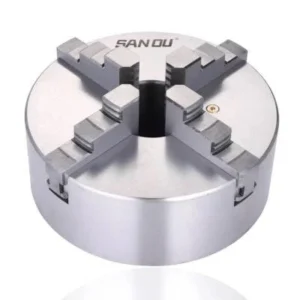 %30 Discount125x4 Sanou 4-Jaw Independent ChuckOriginal price was: 173.14$.121.20$Current price is: 121.20$.View
Reviews
There are no reviews yet.