
No products in the cart.

1.5 kW 220V 210 m³/h Vacuum Pump Blower
412.82$
High-performance regenerative blower for industrial automation, providing stable vacuum and airflow for CNC, material handling, and ventilation.
In stock
📦 Category: 210 m³/h Vacuum Pump Varieties🏷️ Operating Voltage: 220V🏷️ Flow Rate: 210 m3/h🏷️ Power: 1.5 kW
Mermak assuranceFrom factory to end user · importer / main dealer · strong stock
ImporterMain dealer / distributorStrong stockGood priceCorporate invoice
In stock / available to order · 14-day return for standard unused products; conditions may vary for custom size/cut products.
1.5 kW 220 Volt 210 m³/h Vacuum Pump Blower
INDUSTRIAL AUTOMATION PARTS | SUPERIOR PERFORMANCE SERIES
Detailed Product Review
The RTS -RB510-7AA21/M Vacuum Pump Blower is a 1.5 kW (2 HP) side channel (regenerative/ring blower) unit designed to meet industrial vacuum and pressure requirements, operating on a 220V single-phase supply. These blowers work by accelerating and compressing airflow in a spiral path around the rotor, creating high flow rates and medium pressure/vacuum differentials. Air enters the intake port, is accelerated by the rotor vanes, directed into the side channel, and compressed with increasing kinetic energy with each rotation. This multi-stage compression process minimizes friction losses and wear due to its non-contact operation. Consequently, with a maximum air flow rate of 210 m³/hour and a maximum vacuum capacity of -210 mbar, it provides stable and continuous performance for securing workpieces on CNC router vacuum tables, transferring granular or powdered materials in pneumatic conveying systems, and various industrial ventilation/drying applications.
The product’s material structure is optimized for long-lasting and reliable operation. The housing is made of high-quality aluminum die-cast with integrated fins to maximize heat dissipation, preventing overheating of the motor and bearings, thus ensuring thermal stability even during continuous operations. The motor features an IP55 protection class, offering high resistance against environmental factors like dust and moisture. For system integration, the 220V AC 50Hz single-phase supply voltage allows direct connection to standard workshop and factory electrical infrastructure without needing a three-phase converter or special electrical installation, significantly reducing setup costs and complexity. Its applications are extensive, serving as a reliable vacuum or pressure source in numerous industrial processes, from vacuum table applications in CNC routers and laser cutting machines to vacuum conveying and fixing in the packaging industry, pneumatic transport systems, and yarn tensioning and waste collection processes in textile machinery. It can also be used as a central vacuum source in dental and medical aspirator systems and for creating air jets in pool/SPA systems.
Advantages of the 1.5 kW 220 Volt 210 m³/h Vacuum Pump Blower
High Flow Rate and Stable Airflow: With its 1.5 kW motor and optimized side channel geometry, this blower achieves a high air flow rate of 210 m³/hour. This high flow rate effectively compensates for vacuum losses, especially when processing porous materials like MDF or plywood on CNC vacuum tables. Continuous evacuation of air leaking through micro-gaps on the material surface prevents workpiece slippage on the table, enhancing machining precision and safety. It also ensures the continuous and clog-free high-volume airflow required for transporting granular or powdered materials in pneumatic conveying systems.
Superior Thermal Management and Structural Durability: The blower housing is made of highly thermally conductive aluminum die-cast with integrated external fins. This finned design maximizes surface area, enhancing heat transfer through natural convection and preventing motor overheating even under continuous load. Minimizing thermal stress extends the life of motor windings and bearings, increasing the overall service life of the unit and reducing failure rates. The aluminum die-cast structure also offers high resistance to mechanical impacts and vibrations common in industrial environments, reinforcing operational reliability.
Simple Integration and Minimum Maintenance: The 220V single-phase supply voltage allows easy integration into standard industrial or workshop electrical grids, eliminating the need for a three-phase converter and reducing installation complexity and cost. The device’s non-contact and oil-free operating principle means no physical contact between the rotor and stator, and no lubrication is required. This design completely eliminates routine maintenance tasks such as periodic oil changes, oil filter replacements, or inspection of worn carbon vanes. High-speed, sealed bearings ensure a long, maintenance-free operating life, lowering operational costs and minimizing production downtime.
Technical Specifications and Capacity
Feature
Value/Description
Model Number
RTS -RB510-7AA21/M
Motor Power
1.5 kW (2 HP)
Supply Voltage
220V AC – 50 Hz (Single-Phase)
Maximum Air Flow
210 m³/hour
Maximum Vacuum
-210 mbar (Negative Pressure)
Maximum Pressure
+220 mbar (Positive Pressure)
Operating Principle
Side Channel (Regenerative / Ring Blower)
Housing Material
Aluminum Die-Cast (Finned Design)
Technical Frequently Asked Questions (FAQ)
How does the side channel (regenerative) operating principle differ from other vacuum pump technologies, and what are its specific advantages for industrial applications?
Side channel blowers operate similarly to centrifugal principles, accelerating and progressively compressing airflow through specially designed side channels around the rotor. The vanes on the rotor push air radially outwards, and this air enters the side channel, being redirected to the next rotor vane. This cyclical motion increases the kinetic energy of the air with each pass, thus raising its pressure. Compared to other vacuum pump technologies, such as oil-lubricated rotary vane pumps which can achieve high vacuum levels, side channel blowers offer much higher air flow rates at lower vacuum levels (typically up to -500 mbar). This characteristic is critical for applications requiring rapid, high-volume air evacuation, such as CNC vacuum tables with large surface areas. Furthermore, the non-contact, oil-free operation eliminates the risk of air flow contamination and significantly reduces maintenance costs. There is no need for periodic oil changes or oil mist filters as with oil-lubricated pumps, making it an ideal solution for clean rooms or sensitive production environments.
When integrating this 220V single-phase blower into an existing industrial electrical infrastructure, what critical aspects regarding power quality and protection should be considered?
When integrating this 220V single-phase blower into an industrial system, the compatibility of the existing electrical grid’s nominal voltage and frequency (220V AC, 50Hz) should be checked first. The 1.5 kW motor power will draw a nominal current of approximately 6.8 Amps (assuming P=V*I*cosφ, with cosφ ≈ 0.9). However, the inrush current during motor startup can reach 5-7 times the nominal current and must be considered when selecting fuses or circuit breakers for the connected circuit. Using an automatic fuse or a thermal-magnetic switch with motor protection features (e.g., Type C or D) will provide protection against overcurrent and short circuits. Additionally, voltage fluctuations or harmonic distortions, common in industrial environments, can negatively affect motor efficiency and lifespan. Therefore, monitoring grid quality and, if necessary, using additional protective equipment such as voltage regulators or harmonic filters is recommended for stable and long-lasting blower operation. Proper grounding is also vital for electrical safety.
Considering the 210 m³/hour air flow rate and -210 mbar vacuum capacity, how should appropriate filtration and safety components be selected for optimal performance and longevity, especially in dusty CNC environments?
It is critical to install a suitable filter on the blower’s intake line in dusty CNC environments to prevent the accumulation of foreign particles (chips, dust, small debris) within the rotor and side channel, which can cause wear. Filter selection should be based on the particle size and density in the environment; typically, a combination of G4 or F7 class coarse and fine dust filters can provide adequate protection. Regular cleaning or replacement of the filter prevents restricted airflow and reduced blower efficiency. Furthermore, using a safety valve (pressure relief valve) is strongly recommended to prevent the system from being exposed to overpressure or over-vacuum conditions. In vacuum applications, an adjustable vacuum relief valve should be integrated to prevent negative pressure exceeding the blower’s maximum vacuum (-210 mbar). In pressure applications, a pressure relief valve should be used to prevent positive pressure exceeding +220 mbar. These valves prevent the blower from being subjected to mechanical stress, extending its life and enhancing system safety. Using vacuum and pressure-resistant, leak-proof hoses and connectors is also important for system efficiency.
How does the finned aluminum die-cast housing design contribute to the blower’s thermal management and overall operational lifespan under continuous heavy-duty cycles?
The finned aluminum die-cast housing design plays a vital role in the blower’s thermal management, directly impacting its operational lifespan. Aluminum, a metal with high thermal conductivity, rapidly transfers heat generated within the motor and side channel to the housing surface. The integrated fins on the housing significantly increase the blower’s external surface area. This increased surface area maximizes heat transfer efficiency through natural convection and radiation by expanding the contact area with ambient air. This effective heat dissipation keeps the operating temperature of the motor windings and bearings within optimized limits. Overheating of motor windings can lead to degradation of insulation materials and motor failure, while overheating of bearings reduces lubricant viscosity, accelerates wear, and shortens bearing life. The finned aluminum die-cast housing minimizes these thermal stresses, allowing the motor and mechanical components to operate longer, with higher efficiency, and with a lower risk of failure. This is a critical factor for durability and reliability, especially in industrial applications operating under continuous heavy-duty cycles.
Mermak is a trusted name with 16 years of experience in industrial automation parts. Our products are stocked and ready for immediate dispatch from our Ankara Uzay Sanayi factory/warehouse. We ensure up-to-date stock quantities and prices on our website. Stocked items are shipped directly from our warehouse without production delays. We provide careful packaging, meticulous invoice and document handling, and partner with reliable logistics providers. The Mermak team closely monitors the shipment process. Upon request, we can arrange video tours of our products or factory via WhatsApp or other contact channels. We proudly supply to numerous countries including the United Kingdom, United States, Canada, Australia, Ireland, New Zealand, and South Africa, as well as similar international markets.
| Operating Voltage | 220V |
|---|---|
| Flow Rate | 210 m3/h |
| Power | 1.5 kW |
You must be logged in to post a review.
Taksit Tablosu
Related Products
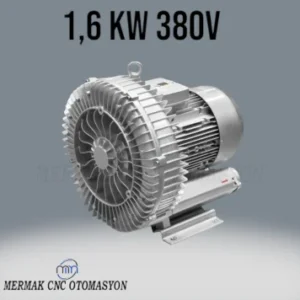 Blower Motor Vacuum Pump 1.6 kW 210 m³/h437.17$View
 %45 Discount1.5 kW 210 m³/h Blower Vacuum Pump MotorOriginal price was: 498.96$.273.94$Current price is: 273.94$.View
 %45 Discount0.75 kW 145 m³/h Blower Vacuum Pump MotorOriginal price was: 361.15$.198.26$Current price is: 198.26$.View
Reviews
There are no reviews yet.