Why is My Servo Motor Vibrating Under Load But Running Smoothly Unloaded?

📑 Table of contents (Click to open)
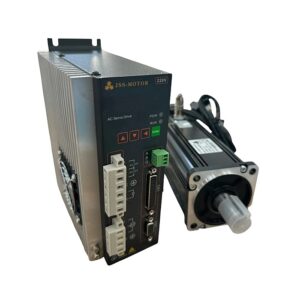
If your servo motor vibrates under load but runs silently when unloaded, it typically indicates issues with PID gain settings, mechanical backlash, inertia mismatch, wiring problems, or undersized motor/drive components. This points to an inability to properly manage load response.
Practical notes for CNC router, automation and industrial motion systems.
Understanding Servo Motor Vibration Under Load
In industrial automation, a servo motor vibrating under load while operating smoothly when unloaded is a common and critical issue. This symptom suggests a problem not with a fundamental electrical or mechanical failure, but rather with system integration and control loop incompatibility. Servo motors are engineered for precise position, speed, and torque control. Vibration under load arises when the motor overreacts, continuously overshooting and undershooting its target position or speed, leading to oscillations. These oscillations can degrade product quality, shorten machine lifespan, and reduce energy efficiency. The root cause is typically found in control settings, mechanical linkages, load characteristics, or electrical signal integrity.
Operating Principles and Technical Data
Servo motors operate using a feedback loop (usually an encoder or resolver) that reports position, speed, or torque data to the controller. The controller compares this feedback to the command signal, calculates the error, and sends the appropriate current to the motor to eliminate the error. This loop is managed by a PID (Proportional-Integral-Derivative) control algorithm. Vibration under load often stems from PID gain settings (P, I, D values) that are not optimized for the specific motor and load combination. For instance, excessively high proportional (P) gain can cause rapid response but lead to overshoot and oscillation. Insufficient derivative (D) gain may struggle to dampen these oscillations, while integral (I) gain, while correcting static errors, can introduce delays and instability.
Another crucial factor is load inertia mismatch. Each servo motor is designed to operate efficiently within a specific inertia ratio. The ratio of motor inertia to load inertia is typically expected to be between 1:1 and 1:10. Deviations from this range can destabilize the control loop and cause vibration. For example, a load inertia significantly higher than the motor’s inertia makes it difficult for the motor to control the load, leading to oscillations. Conversely, very low load inertia can cause the motor to overreact and become unstable.
Mechanical issues such as backlash in the system, loose couplings, gearbox wear, or bearing problems can also induce vibration under load. These mechanical gaps prevent the motor from responding instantly and accurately to motion commands, creating a “dead band” in the control loop. The motor’s attempts to overcome this backlash result in oscillations. Furthermore, undersizing the motor or drive for the application’s torque and speed requirements can lead to similar symptoms. When a motor is constantly forced to operate at or beyond its maximum capacity, it can overheat and vibrate. On the electrical side, noisy encoder feedback signals, damaged cables, grounding issues, or electromagnetic interference (EMI) can corrupt the control signal, causing unstable motor operation.
| Parameter | Value/Description |
|---|---|
| Control Mode | Typically Position or Speed Control. Vibration in torque control may exhibit different dynamics. |
| PID Gain Settings | P (Proportional), I (Integral), D (Derivative) values. Incorrect settings lead to oscillation and instability. |
| Load Inertia Ratio | Motor inertia / Load inertia ratio. Ideally between 1:1 and 1:10. Large differences cause instability. |
| Feedback Resolution | Encoder or resolver precision. Low resolution can contribute to micro-oscillations. |
| Mechanical Backlash | Gaps in gearboxes, couplings, or reducers. A common cause of vibration. |
| Cabling Condition | Integrity, shielding, and grounding of power and signal cables. Prevents EMI issues. |
| Motor/Drive Sizing | Selection of motor and drive appropriate for application torque and speed demands. Undersizing causes vibration. |
Field Troubleshooting Considerations
- Systematic Diagnosis and Documentation: A step-by-step approach is essential for root cause analysis. Observe and meticulously record under which conditions the vibration occurs (e.g., at specific speeds, loads, or during motion initiation/termination). This data helps narrow down potential causes. Reviewing machine history, maintenance logs, and recent modifications is critical.
- Mechanical Integrity Checks: Mechanical issues are frequent culprits. Thoroughly inspect all mechanical connections between the motor and the load. Ensure couplings are tight and properly aligned; loose or misaligned couplings induce vibration. Check for excessive backlash in gearboxes; significant backlash hinders precise load control. Examine bearings for signs of wear or damage. Verify the tightness of all mounting bolts.
- Feedback and Cabling Verification: Confirm the functionality of feedback devices like encoders or resolvers. Ensure feedback cables are undamaged, correctly connected, shielded against electromagnetic interference (EMI), and properly grounded. Noisy or intermittent feedback signals can destabilize the control loop, leading to vibration. Signal integrity can be checked with insulation tests or an oscilloscope.
- PID Gain Optimization: Most servo drives offer an auto-tuning function. Utilize this to obtain initial PID values suitable for the motor-load combination. While auto-tuning may not yield perfect results, it provides a good starting point. Fine-tune manually, typically adjusting P first, then D, and finally I, to minimize vibration. High P gain offers quick response but can cause oscillation; D gain dampens this oscillation; I gain corrects steady-state errors but can introduce lag.
- Inertia Mismatch Assessment: Evaluate the ratio between the motor’s nominal inertia and the application’s load inertia. If this ratio falls outside the motor’s acceptable tolerance (often 1:1 to 1:10), it could be the primary cause of vibration. In such cases, selecting a motor with a more suitable inertia ratio or using a gearbox might be necessary. A gearbox can help reduce the reflected load inertia to the motor shaft into a manageable range.

Common Scenarios and Solutions
- Scenario: Motor Resonates at a Specific Speed or Load.
- Solution: This often occurs when the system’s mechanical resonance frequencies coincide with the control loop’s operating frequencies. Many servo drives feature resonance suppression filters or notch filters that can be tuned to dampen vibrations at specific frequencies. Adjusting the PID gains, particularly the D gain, can also help shift the system’s response away from these resonant frequencies. Ensure all mechanical components are securely fastened to prevent amplifying resonance.
- Scenario: Vibration Occurs During Rapid Acceleration/Deceleration.
- Solution: This points to insufficient torque or inadequate PID tuning for dynamic conditions. Verify that the motor and drive are adequately sized for the peak torque demands. Increase the P and D gains cautiously to improve tracking performance during rapid movements, but monitor for instability. Consider using a higher-resolution encoder for better feedback accuracy during fast transients.
- Scenario: Intermittent Vibration or Jerkiness.
- Solution: This can be caused by intermittent electrical issues, such as loose connections, intermittent encoder signal loss, or voltage fluctuations. Thoroughly inspect all power and signal wiring, connectors, and terminal blocks. Check the drive’s diagnostic logs for any error codes related to feedback or power. Ensure a stable power supply to the servo drive.
- Scenario: Motor Feels “Stiff” or Lacks Smoothness Even Unloaded.
- Solution: While the prompt specifies unloaded smoothness, if this symptom appears, it might indicate internal motor issues (e.g., bearing friction, winding problems) or incorrect drive configuration parameters unrelated to PID tuning. Check motor resistance and insulation. Review drive parameters related to motor identification and commutation.
Addressing servo motor vibration requires a methodical approach, combining mechanical inspection, electrical verification, and careful control parameter tuning. By systematically investigating these potential causes, you can restore smooth and reliable operation to your industrial machinery.
If you’re experiencing persistent issues with your CNC machinery’s servo systems, don’t hesitate to reach out for expert assistance. Request a quote on WhatsApp to discuss your specific needs and find the optimal solution for your production.
Related product categories: Genel · Mekanik · AC Servo Motor