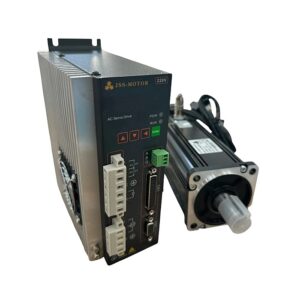
Understanding the Difference: Servo Motor Mechanical Zero vs. Home Position

📑 Table of contents (Click to open)
In industrial automation, understanding the difference between a servo motor’s Mechanical Zero and its Home Position is crucial for precise operation. Mechanical Zero is a fixed, hardware-defined reference point on the motor’s encoder, often tied to an index pulse. In contrast, the Home Position is a programmable, application-specific starting point, typically found using sensors or limit switches. While Mechanical Zero provides an absolute hardware reference, the Home Position offers a flexible, software-defined operational start. This article clarifies these concepts and their importance in systems like CNC routers.
Practical notes for CNC router, automation and industrial motion systems.
Servo Motor Mechanical Zero vs. Home Position: Defining the Reference Points
In the realm of industrial automation, the precise and repeatable movement of servo motors is fundamental to the operation of sophisticated machinery, from CNC routers to robotic arms. Two critical concepts that define a motor’s starting point are Servo Motor Mechanical Zero and Home Position. While often used interchangeably by those new to the field, these terms represent distinct reference points with different origins and functions. Understanding their differences is key to ensuring optimal performance, accuracy, and reliability in automated systems.
What is Servo Motor Mechanical Zero?
The Mechanical Zero, also known as the hardware zero or encoder index, refers to a fixed, unchangeable reference point determined by the motor’s physical encoder. For incremental encoders, this is typically marked by a single index pulse (Z-pulse) that occurs once per motor revolution. For absolute encoders, it’s the specific position that corresponds to the encoder’s zero reading. This point is an inherent characteristic of the encoder’s design and manufacturing. It provides a stable, hardware-based reference that remains constant regardless of power cycles. This is vital for establishing an absolute position reference, especially in applications requiring high precision or the preservation of position data after a power interruption.
What is Home Position?
The Home Position, or reference position, is a programmable starting point defined by the specific requirements of the machine or application. It’s not an inherent property of the motor itself but rather a location designated for the beginning of an operational cycle. This position is typically found using external sensors such as limit switches, proximity sensors, or optical sensors, or by utilizing the encoder’s index pulse in conjunction with a homing procedure. The homing process involves moving the motor until the designated sensor is triggered or the index pulse is detected, at which point that location is registered as the Home Position. This position can be adjusted and redefined based on the machine’s task, such as the tool change position on a CNC router or the starting point for a robotic arm’s movement. It ensures the machine starts its operations from a known, safe, and correct location.
Key Differences Summarized
The fundamental distinction lies in their nature and purpose:
- Mechanical Zero: Hardware-defined, fixed, inherent to the encoder, provides an absolute reference.
- Home Position: Software-defined, programmable, application-specific, establishes an operational starting point.
While Mechanical Zero is a static, physical marker, the Home Position is a dynamic, operational marker. The Home Position is often established by referencing the Mechanical Zero or a sensor trigger, ensuring that the machine starts from a consistent and predictable location relative to the motor’s physical capabilities.
Practical Industrial Examples
Consider a CNC router machine. The spindle motor has a Mechanical Zero defined by its encoder. However, for cutting operations, the machine needs a Home Position. This might be set at the corner of the workpiece or a designated tool-change location. The homing procedure, often using limit switches, guides the machine axes to this Home Position before starting a job. Similarly, in a robotic assembly line, each robot arm’s servo motor has a Mechanical Zero, but the Home Position is programmed to be the ‘rest’ or ‘ready’ state for picking and placing components. The servo drive controlling these motors interprets both reference points to execute commands accurately.
Technical Considerations for Precision
Achieving high precision in automated systems relies heavily on the correct implementation of these reference points. The resolution of the encoder dictates the accuracy of the Mechanical Zero. For the Home Position, the reliability and precision of the sensors used (like linear guide rail position sensors or limit switches) and the homing algorithm are paramount. Factors like backlash in gearboxes or lead screws can affect the repeatability of reaching the Home Position, necessitating careful calibration and homing strategies. A vacuum table on a CNC machine, for instance, relies on precise positioning to ensure optimal material holding and cutting accuracy, directly influenced by the correct establishment of the Home Position.
Conclusion: Ensuring Operational Integrity
In summary, the Servo Motor Mechanical Zero is the unalterable physical reference point of the encoder, while the Home Position is the application-defined starting point for machine operations. Both are essential for the accurate functioning of industrial machinery. Mechanical Zero provides the foundational absolute reference, crucial for system initialization and position retention. The Home Position, established through homing procedures, ensures that the machine begins each task from a consistent and safe operational state. Understanding and correctly implementing these concepts is vital for any industrial application relying on precise motion control, ensuring efficiency, accuracy, and reliability in demanding manufacturing environments.
Frequently Asked Questions
What is the primary function of Mechanical Zero in a servo motor system?
The primary function of Mechanical Zero is to provide a fixed, hardware-based absolute reference point for the servo motor’s encoder. This is crucial for establishing the motor’s exact position, especially after power loss (with absolute encoders) or for calibrating the system’s reference frame.
How is the Home Position typically determined in an industrial CNC machine?
The Home Position in an industrial CNC machine is typically determined through a homing procedure. This often involves moving the machine axes until a limit switch or sensor is triggered. The system then registers this point, or a point relative to it (like the encoder’s index pulse), as the Home Position. This ensures the machine starts from a known and consistent location for each operation.
Can the Home Position be changed after initial setup?
Yes, the Home Position is a programmable parameter and can be changed or redefined based on the specific application’s needs or changes in workpiece setup. This flexibility allows for adaptation to different tasks and operational requirements.
Related product categories: Genel · Mekanik · Incremental Encoder Servo Motor ve Sürücüleri