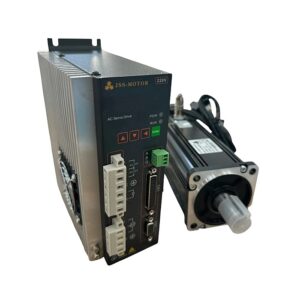
Why Does the Z-Axis Drop When the Servo Motor Brake Cable is Not Connected?

📑 Table of contents (Click to open)
A disconnected servo motor brake cable can cause the Z-axis to drop uncontrollably when power is cut or the motor is de-energized. This poses a significant safety risk, especially in vertical applications, as the brake fails to hold the load. This article explains the critical function of servo motor brakes and the consequences of improper connection.
Practical notes for CNC router, automation and industrial motion systems.
The Critical Role of Servo Motor Brakes in Vertical Axis Control
In industrial automation, particularly in CNC machines, robotic arms, and lifting mechanisms that utilize a vertical axis (Z-axis), servo motors are essential for precise movement. However, these motors must also counteract gravity, especially when holding a load. This is where servo motor brakes become indispensable. Typically integrated into the rear of the motor, these are electrically controlled mechanical braking systems. Most industrial servo motor brakes operate on a power-off brake or fail-safe brake principle: when de-energized (e.g., cable disconnected or power failure), the brake automatically engages, locking the motor shaft and preventing load movement. For Z-axis applications, this is vital for preventing the tool, workpiece, or robotic arm from falling during power interruptions, emergency stops, or system shutdowns.
If a servo motor’s brake cable is disconnected or incorrectly wired, the brake mechanism will not receive the necessary electrical signal to disengage. Consequently, when the motor loses power or the system stops, the brake will not engage to hold the Z-axis load. Gravity will then cause the Z-axis and its attached components (tool, workpiece, etc.) to descend uncontrollably, potentially leading to severe equipment damage, production downtime, and serious safety hazards for personnel.
Understanding the Technical Principles of Servo Motor Brakes
Servo motor brakes commonly employ an electromagnetic design, often referred to as a “spring brake.” In this system, a brake pad is held under constant pressure by a set of springs, clamping onto the motor shaft to prevent rotation. To release the brake, electrical current (typically DC voltage) is applied to the brake coil, generating an electromagnetic field that counteracts the spring force, freeing the motor shaft for movement. The Z-axis itself is usually driven by a ball screw or lead screw mechanism, where the servo motor rotates the screw to move a nut or table vertically. While these mechanisms reduce friction for precise motion, ball screws, due to their high efficiency, can be back-drivable, meaning they can be easily moved by gravity when motor power is removed. Lead screws offer higher friction and may be self-locking, but this is not always sufficient for heavy loads. Therefore, a brake is crucial for secure holding during stops.
A disconnected brake cable prevents the necessary DC power from reaching the brake coil. While the fail-safe design implies the brake should engage when power is lost, the control system typically manages brake engagement and disengagement. The brake is usually released just before the motor starts moving and re-engaged shortly after it stops. If the brake cable is not connected, the servo drive may detect this as an error, preventing motor operation. In other scenarios, if the control circuit responsible for energizing the brake fails (often powered via the same cable), the brake will not disengage when needed, leading to the Z-axis dropping. The critical function is the brake’s ability to engage when the motor is de-energized. If the brake itself is faulty or its control circuit is compromised, this essential safety feature can fail.
Consequences of a Disconnected Brake Cable
The primary consequence is the uncontrolled descent of the Z-axis. This can result in:
- Damage to Workpieces: A falling tool or workpiece can destroy the part being machined.
- Machine Damage: The impact at the bottom of the travel can damage the Z-axis mechanism, spindle, or machine bed.
- Tool Breakage: Sudden drops can break expensive cutting tools.
- Safety Hazards: Falling components pose a risk to operators.
- Production Downtime: Repairs and resets lead to significant lost production time.
Ensuring Proper Brake Cable Connection
It is imperative that the servo motor brake cable is correctly and securely connected to both the servo motor and the servo drive, following the manufacturer’s wiring diagrams. Regular inspection of cables and connections for wear or damage is also recommended. Integrating brake status monitoring into the machine’s control system can provide early warnings of potential issues.
For industrial CNC router machines and other automated systems relying on precise vertical motion, the servo motor brake is not an optional component but a critical safety feature. Ensuring its proper function through correct installation and maintenance is paramount.