No products in the cart.
Understanding Differential Pulse vs. Open Collector Pulse in Servo Drives
Contents
Servo drive pulse signals are crucial for motion control. This article explains the differences between Differential Pulse and Open Collector Pulse, detailing their technical principles, advantages, and disadvantages for industrial applications. Understand which signal type is best suited for your CNC router machine.
Mermak CNC Technical Guide
Practical notes for CNC router, automation and industrial motion systems.
Servo Drive Differential Pulse vs. Open Collector Pulse: What’s the Difference?
In industrial automation, precise motion control is paramount, especially for servo motors used in applications like CNC router machines. Servo drives are typically commanded by pulse signals from a PLC or motion controller. Two common methods for transmitting these signals are Differential Pulse and Open Collector Pulse. Understanding their distinctions is key to ensuring reliable and accurate machine operation.
Differential Pulse offers superior noise immunity and supports long-distance communication through a balanced signal transmission method. It uses two complementary lines for each signal, effectively canceling out common-mode noise. This makes it ideal for high-speed, long-range, and high-precision requirements.
Conversely, Open Collector Pulse features a simpler structure that requires an external pull-up resistor. It is suitable for shorter distances and applications where noise sensitivity is less critical.
Technical Principles and Operation
Differential Pulse Operation
Differential signaling, often adhering to standards like RS-422 or RS-485, uses two complementary lines per signal (e.g., A+ and A-, B+ and B-). These lines are typically run over shielded, twisted-pair cables. The servo drive’s receiver detects the voltage difference between these two lines. Any electrical noise or interference affecting both lines equally (common-mode noise) is largely rejected, preserving signal integrity. This robust method allows for reliable transmission over distances of 100 meters or more at high frequencies, often reaching MHz levels. The signal drivers are usually line driver integrated circuits, operating at standard voltages like 5V or 24V.
Open Collector Pulse Operation
Open Collector outputs utilize NPN or PNP transistors. In the common NPN configuration (sink type), the transistor pulls the signal line to ground (logic 0) when active. When inactive, the line is left floating and is pulled up to the supply voltage (logic 1) by an external pull-up resistor. A PNP configuration (source type) works in reverse. The presence of a pull-up (or pull-down for PNP) resistor is essential for establishing a stable logic level. While simpler and requiring fewer wires, Open Collector systems are more susceptible to noise and are generally limited to shorter cable runs (typically under 10 meters) and lower pulse frequencies (hundreds of kHz). The choice of pull-up resistor value is critical; too high a value slows down signal rise times, limiting frequency, while too low a value can overload the output transistor.
Comparison Table
| Parameter | Differential Pulse | Open Collector Pulse |
|---|---|---|
| Signal Transmission | Balanced (two complementary lines) | Single-ended (one signal line) |
| Noise Immunity | High (common-mode rejection) | Lower (susceptible to noise) |
| Max Cable Length | Long (100m+) | Short (up to 10m) |
| Max Pulse Frequency | High (MHz range) | Lower (hundreds of kHz) |
| Cable Type | Shielded Twisted Pair | Standard signal cable |
| Required Components | Termination resistor (long distances) | External pull-up resistor |
| Typical Applications | High precision, speed, long distance | Simple, short distance, cost-sensitive |
Practical Considerations for Industrial CNC
- Cable Selection and Routing: For differential signals, always use shielded, twisted-pair cables to maximize noise immunity. While not strictly required for Open Collector, shielded cables are still recommended. Crucially, route signal cables away from high-power motor cables and other noise sources. Avoid running them parallel for extended lengths.
- Termination Resistors (Differential): On long differential cable runs, installing termination resistors (typically 120 ohms) at the end of the line (receiver side) is vital to prevent signal reflections and ensure signal integrity.
- Pull-up Resistor Selection (Open Collector): The correct value for the pull-up resistor is essential for Open Collector systems. It impacts signal rise time and maximum operating frequency. Consult your servo drive and controller manuals for recommended values, typically ranging from 1kΩ to 10kΩ.
- Voltage Level Compatibility: Ensure the pulse signal voltage level from the controller matches the input requirements of the servo drive. Mismatched voltages can damage components or cause signal misinterpretation.
- Grounding and Shielding: Implement a proper grounding strategy. Shielded cables should typically be grounded at a single point (e.g., at the controller) to prevent ground loops.
- Consult Documentation: Always refer to the technical manuals for your specific servo drive and motion controller. Manufacturers provide detailed guidelines on cabling, termination, and signal requirements.
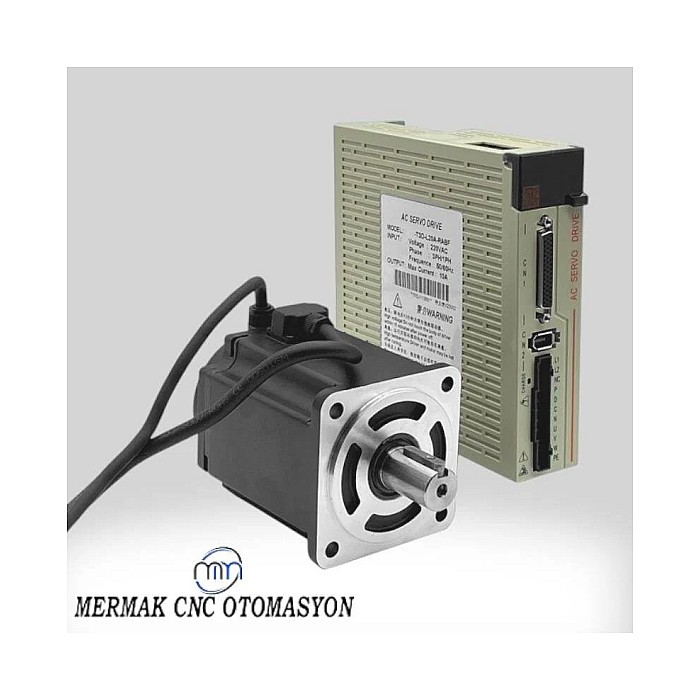
Choosing the right pulse signal type depends on your application’s specific needs regarding distance, speed, and environmental noise. For demanding industrial CNC applications requiring high precision and reliability, differential pulse signals are generally the preferred choice. For simpler setups over short distances, open collector signals can be a cost-effective solution.
Need to optimize your CNC machine’s motion control? Discuss your requirements with our experts and get a tailored solution. Request a quote on WhatsApp today!
Related product categories: Genel · Kumanda Butonları ve Sinyal Lambaları · AC Servo Motor