

































































Step Motor Torque Drop-off at High Speeds: Causes and Prevention
📑 Table of contents (Click to open)
- Step Motor Torque Drop-off at High Speeds: Introduction and Technical Analysis
- Step Motor Torque Drop-off at High Speeds: Operating Principle and Technical Data
- Step Motor Torque Drop-off at High Speeds: Field Considerations and Best Practices
- Step Motor Torque Drop-off at High Speeds: Common Problems and Solutions
- Step Motor Torque Drop-off at High Speeds: Conclusion and Expert Advice
- FAQ
Step Motor Torque Drop-off at High Speeds: Introduction and Technical Analysis
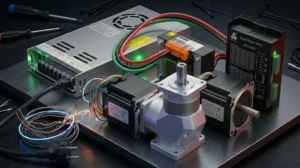
As indispensable components in industrial automation and precision motion control systems, stepper motors are favored across a wide range of applications due to their open-loop control capabilities, simple structure, and cost-effectiveness. They play a critical role in many machine and robotic systems requiring positioning, indexing, speed control, and precise movement. However, one of the fundamental challenges directly affecting stepper motor performance, especially in high-speed applications, is the phenomenon of torque drop-off. This condition means that the usable torque a motor can produce significantly decreases as its speed increases, ultimately leading to synchronization loss (step loss), positioning errors, and even complete system shutdown. This comprehensive field guide and technical article will delve into the physical reasons underlying torque drop-off in stepper motors at high speeds, detailing engineering solutions and field practices that can be applied to prevent or minimize this issue. Our goal is to provide industrial automation professionals with the necessary knowledge and tools to understand and effectively manage this critical performance limitation when designing and optimizing their stepper motor-based systems.
Step Motor Torque Drop-off at High Speeds: Operating Principle and Technical Data
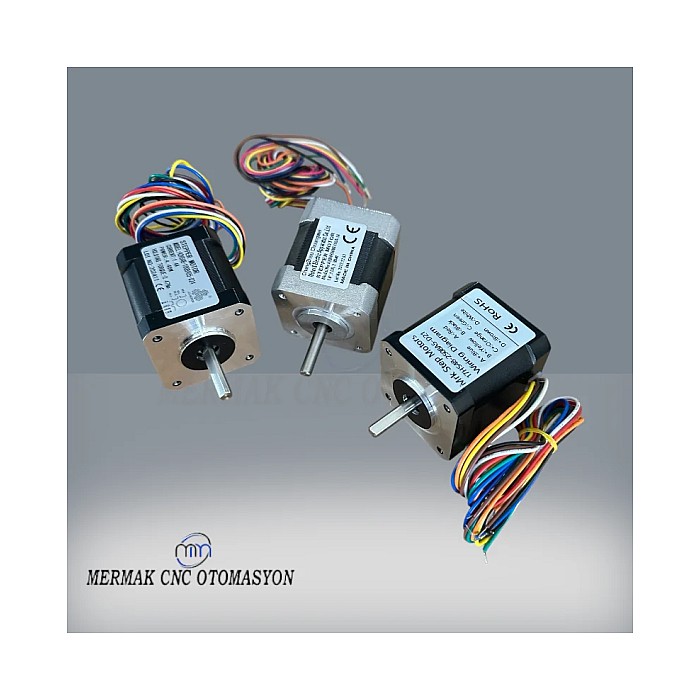
Stepper motors operate on the principle of rotating the rotor at specific angles (step angle) by sequentially changing the current flowing through the stator windings. This precise movement corresponding to each step allows for open-loop control of the motor’s position, meaning without feedback. The torque produced by the motor is directly proportional to the current flowing through the stator windings and the strength of the magnetic field. However, as the motor’s speed increases, this torque production mechanism encounters certain physical limitations.
The primary reasons for torque drop-off at high speeds are:
- Back Electromotive Force (Back EMF): When a motor rotates, the movement of the rotor induces a voltage in the stator windings. This voltage is called Back Electromotive Force (Back EMF) and, according to Lenz’s Law, acts in opposition to the voltage applied to the windings. As the motor’s speed increases, the magnitude of the induced Back EMF also increases. This reduces the net voltage applied to the windings (V_applied – Back EMF) and consequently decreases the current flowing through the windings. When the current decreases, the torque the motor can produce also diminishes. This is the most dominant reason for torque drop-off at high speeds.
- Winding Inductance: Stepper motor windings have significant inductance (L). Inductance resists the flow of current through the windings and limits instantaneous current changes. A stepper motor driver switches the current by applying square wave voltage pulses to the windings. At high speeds, this switching frequency increases, leaving less time for the current in the windings to reach its maximum level with each step. Due to the effect of inductance, the current cannot rise fast enough, causing the average current value to drop, which leads to a reduction in torque. The current rise time is directly related to the winding resistance (R) and inductance (L) (τ = L/R). Motors with a high L/R ratio experience more pronounced torque drop-off at high speeds because the current rises more slowly.
- Driver Limitations: Stepper motor drivers are designed to provide a specific voltage and current to the motor windings. At high speeds, higher voltages are required to overcome the effects of Back EMF and inductance. If the driver’s supply voltage or current capacity is insufficient, the motor cannot produce enough torque at high speeds. Especially PWM (Pulse Width Modulation)-based current-chopping drivers are effective in controlling current, but the driver’s switching frequency and voltage capacity form an upper limit.
- Magnetic Saturation: Although not the primary cause of torque drop-off at high speeds, above a certain current level, the motor’s magnetic core reaches saturation. In this state, despite an increase in current, the strength of the magnetic field does not increase proportionally, and torque production is limited. This condition is usually observed when the motor is operated well above its nominal current or at its design limits.
When these factors combine, the speed-torque curve of a stepper motor typically shows a dramatic drop at high speeds. System designers must carefully analyze these curves when selecting a motor and driver combination that will meet the maximum speed and minimum torque requirements of their applications.
| Parameter | Value/Description |
|---|---|
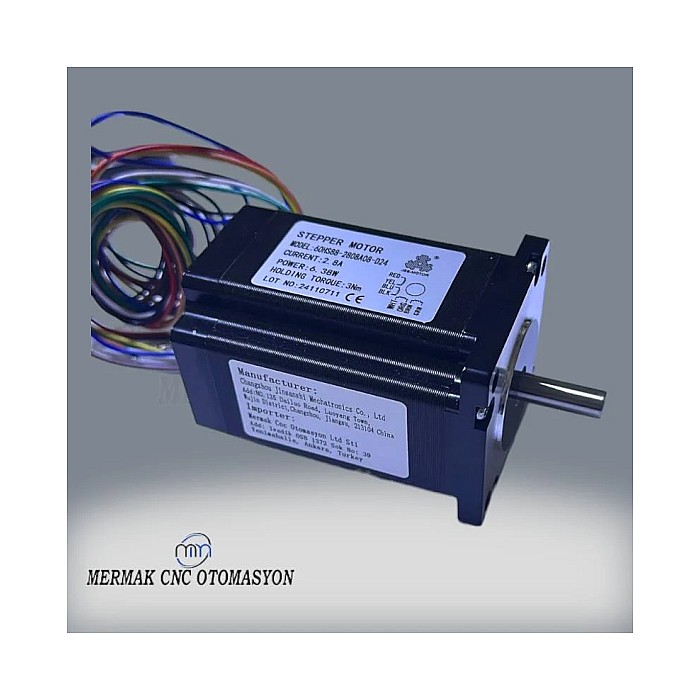
| Motor Type | Hybrid Stepper Motor (NEMA 23) |
| Step Angle | 1.8°/step (200 steps/revolution) |
| Holding Torque (Static) | 1.2 Nm (170 oz-in) |
| Nominal Current (Per Phase) | 3.0 A |
| Winding Resistance (Per Phase) | 0.8 Ohm |
| Winding Inductance (Per Phase) | 2.5 mH |
| Max. Operating Speed (No-load) | Approximately 1200 RPM (20 revolutions/second) |
| Recommended Driver Voltage | 24V – 48V DC |
| Speed-Torque Drop-off Start | Becomes noticeable after approximately 300 RPM (5 revolutions/second) |
Step Motor Torque Drop-off at High Speeds: Field Considerations and Best Practices
- Using High-Voltage Drivers: One of the most effective ways to prevent torque drop-off in stepper motors at high speeds is to use drivers with a higher supply voltage to maintain the motor’s nominal current even at elevated speeds. Higher voltage more easily overcomes the effect of Back EMF and shortens the current rise time caused by inductance. Typically, a driver supply voltage 5-20 times higher than the motor’s nominal voltage is recommended. However, the maximum voltage tolerances of the driver and motor must be considered.
- Selecting Low-Inductance Motors: If your application requires high-speed performance, choosing stepper motors with low winding inductance is crucial. Low inductance allows the current to rise and fall faster, which helps maintain a higher average current in the motor windings even at high switching frequencies, thereby reducing torque drop-off. When selecting a motor, attention should be paid to the inductance value as much as the holding torque.
- Microstepping and Resonance Management: Microstepping smooths movement by allowing the motor to move in smaller steps, reducing vibration and resonance. However, in microstepping mode, the current applied to each winding is closer to a sine wave, making it harder to achieve the same peak torque as full-step mode. This can lead to a noticeable torque drop-off, especially at high microstep ratios and high speeds. Resonance can increase motor vibration and noise at certain speeds, leading to performance degradation. Anti-resonance algorithms and vibration damping features found in modern drivers play a critical role in solving this problem.
- Smart Driver Technologies: Today’s advanced stepper motor drivers use various smart algorithms to minimize torque drop-off. These include current-chopping PWM control, adaptive current control, and Field-Oriented Control (FOC)-like algorithms. These drivers dynamically adjust the current according to the motor’s speed and load, aiming to provide optimal torque over the widest possible speed range.
- Load Matching and Inertia Management: The inertia of the load driven by the motor directly affects the motor’s ability to accelerate and decelerate. High-inertia loads cause the motor to expend more torque, making torque drop-off more pronounced at high speeds. Whenever possible, a load suitable for the motor’s inertia should be selected, or gearboxes should be used to reduce the load inertia to the motor shaft. Determining correct acceleration and deceleration ramps is vital for the motor to provide sufficient torque at every speed.
- Cable Length and Cross-Section: The length and cross-section of the cable between the motor and driver can also affect performance. Long and thin cables can cause voltage drop and signal distortion, reducing the voltage and current reaching the motor windings. This can increase torque drop-off, especially at high speeds. Cables with adequate cross-section and shielding, suitable for the application requirements, should be used.
Step Motor Torque Drop-off at High Speeds: Common Problems and Solutions
When working with stepper motors in industrial automation applications, it is possible to encounter various problems due to torque drop-off at high speeds. Recognizing these problems and implementing the correct solutions improves system reliability and efficiency.
-
Problem 1: Synchronization Loss (Step Loss)
Symptom: The motor fails to reach the commanded position, pauses during movement, or operates with vibration. This usually occurs at high speeds or during sudden acceleration/deceleration. The machine loses position and performs incorrect operations.
Causes:
- Insufficient motor torque for the application (especially at high speeds).
- Excessive load or friction.
- Incorrect acceleration/deceleration ramps (too aggressive).
- Low driver supply voltage.
- Motor and load inertia mismatch.
Solutions:
- Upgrade the Motor or Select a Higher Torque Model: Consider motors with a flatter torque curve at high speeds and low inductance.
- Increase Driver Supply Voltage: Using a higher supply voltage, without exceeding the maximum voltage limits of the driver and motor, reduces the effect of Back EMF and allows the current to rise faster.
- Optimize Acceleration/Deceleration Ramps: Prevent the motor from encountering excessive torque demand by using smoother (longer) ramps.
- Reduce Load or Use a Gearbox: Reducing the mechanical load or using a gearbox to reduce load inertia to the motor shaft allows the motor to operate more easily.
- Use Closed-Loop Stepper Systems: Stepper motor systems using feedback (encoders) can detect and correct step loss, providing higher reliability.
-
Problem 2: Overheating
Symptom: Abnormal heating of the motor or driver, emitting odors, or entering protection mode.
Causes:
- High current setting.
- Insufficient cooling (for motor or driver).
- Continuous high torque demand.
- High friction or mechanical binding.
Solutions:
- Optimize Current Setting: Reduce the current setting on the driver to provide the minimum torque required by the application. It is especially important to reduce the holding current.
- Add Cooling Solutions: Provide a cooling fan or heatsink for the motor, and adequate airflow or heatsink surface area for the driver.
- Reduce Mechanical Friction: Ensure proper lubrication of moving parts and eliminate mechanical binding.
- Choose a More Efficient Motor/Driver: Consider a motor/driver combination with lower losses or higher efficiency.
-
Problem 3: Vibration and Noise at High Speeds
Symptom: Excessive motor vibration and unpleasant noises within certain speed ranges.
Causes:
- Mechanical resonance.
- Incorrect microstepping settings.
- Loose motor mounting.
- Unbalanced load.
Solutions:
- Use Microstepping: Higher microstepping ratios (e.g., 1/8, 1/16, 1/32) smooth movement and reduce resonance effects.
- Use Drivers with Anti-Resonance Features: Many modern drivers include algorithms that automatically detect and dampen resonance.
- Mechanical Damping: Add rubber or vibration-absorbing pads to the motor mount.
- Check Mounting: Ensure the motor and load are securely and stably mounted.
-
Problem 4: Failure to Reach Maximum Speed
Symptom: The motor cannot reach its specified maximum speed or operates unstably at that speed.
Causes:
- Low driver supply voltage.
- High motor inductance.
- Excessive load.
- Insufficient current capacity of the driver.
Solutions:
- Increase Driver Supply Voltage: This is the most common solution.
- Select a Lower Inductance Motor: Pay attention to this parameter, especially for high-speed applications.
- Reduce Load: Decrease mechanical resistance or inertia.
- Use a Higher Current Capacity Driver: Ensure the driver can supply the motor’s nominal current even at high speeds.
Step Motor Torque Drop-off at High Speeds: Conclusion and Expert Advice
Torque drop-off experienced by stepper motors at high speeds is a critical engineering challenge that directly impacts performance in industrial automation applications. Understanding the physical principles underlying this phenomenon, such as Back EMF and winding inductance, is indispensable for system designers and maintenance engineers. The key to a successful stepper motor-based system is not just focusing on the motor’s static torque values, but also comprehensively evaluating its dynamic torque performance across the application’s required speed range. Our field experience shows that many problems arise from incorrect motor-driver matching, insufficient supply voltage, or inaccurate calculation of mechanical load.
As expert advice, a holistic approach should always be adopted when designing stepper motor systems or optimizing existing ones. The motor itself, driver electronics, supply voltage, mechanical load, and control strategy are interacting components. For high-speed and high-torque applications, a combination of low-inductance motors with high supply voltage drivers featuring advanced current control algorithms (e.g., with anti-resonance capabilities) typically offers the most ideal solution. While microstepping is important for reducing vibration and ensuring smooth movement, its potential effects on torque drop-off should not be overlooked. In complex applications or those requiring critical precision, transitioning to closed-loop stepper motor systems or servo motors may also be an option to consider. Finally, it should be remembered that every system has its unique dynamics. No matter how accurate theoretical calculations are, prototyping and comprehensive testing under real-world conditions are vital for verifying system performance, preventing unexpected problems, and ensuring long-term reliability. By utilizing the information in this guide, industrial automation professionals can fully unleash the potential of their stepper motor-based solutions and build more efficient, reliable, and precise systems. Request a quote on WhatsApp for Mermak CNC industrial solutions today.
FAQ
What are the main causes of torque drop-off in stepper motors at high speeds?
Torque drop-off in stepper motors at high speeds is primarily caused by Back Electromotive Force (Back EMF) and winding inductance. As motor speed increases, Back EMF opposes the applied voltage, reducing the effective voltage and thus the current in the windings. High inductance prevents the current from rising quickly enough to its maximum level during rapid switching, leading to a lower average current and reduced torque.
How can torque drop-off in stepper motors be prevented or minimized?
To prevent torque drop-off, consider using higher voltage drivers (5-20 times the motor's nominal voltage), selecting low-inductance stepper motors, optimizing acceleration/deceleration ramps, and reducing mechanical load or using gearboxes. Advanced drivers with adaptive current control and anti-resonance features can also significantly improve performance.
What is synchronization loss (step loss) and how is it related to torque drop-off?
Synchronization loss, or step loss, occurs when the motor cannot keep up with the commanded steps, leading to positioning errors. This is often due to insufficient torque at high speeds, excessive load, or aggressive acceleration ramps. Solutions include upgrading to a higher torque motor, increasing driver voltage, optimizing ramps, or considering closed-loop stepper systems.
Does microstepping affect torque drop-off in stepper motors?
Microstepping helps smooth motor movement and reduce vibration by dividing each full step into smaller increments. While it improves precision and reduces resonance, very high microstepping ratios, especially at high speeds, can sometimes lead to a slight reduction in peak torque compared to full-step operation due to the sinusoidal current distribution.
What causes overheating in stepper motor systems and how can it be resolved?
Overheating in stepper motors or drivers can be caused by high current settings, insufficient cooling, continuous high torque demand, or excessive mechanical friction. To address this, optimize current settings, ensure adequate cooling (fans, heatsinks), reduce mechanical friction, and consider more efficient motor/driver combinations.