


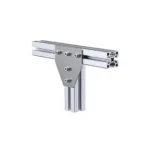
Three-Way Connector Plate 45×45 K10 Zinc
1.74$
High-strength steel connector plate for 45x45mm K10 aluminum profiles, providing rigid three-axis connections without additional profile processing. Zinc-plated for corrosion resistance.
In stock
In stock / available to order · 14-day return for standard unused products; conditions may vary for custom size/cut products.
Three-Way Connector Plate 45×45 K10 Zinc
Detailed Product Review
This Three-Way Connector Plate is a structural component engineered to meet the need for high-strength and rigid corner connections in industrial automation systems, specifically for 45×45 mm K10 channel aluminum profiles across three axes. Its primary function is to provide a secure joint at profile intersections without requiring any additional processing such as drilling, milling, or welding. This connection method significantly saves time and labor costs during assembly while maximizing the overall structural integrity, torsional resistance, and rigidity of modular systems in applications like rapid prototyping, assembly line setup, and the construction of precision machine frames. Its geometric design is optimized to fit precisely into the inner channels of the profiles, minimizing stress concentration and optimizing load distribution at connection points.
The product is manufactured from high-quality structural steel and surface-treated with an electro-galvanized zinc coating to provide superior resistance to the corrosive conditions of industrial environments. This zinc coating forms a passive protective layer against corrosion caused by moisture, dust, mild chemical vapors, and other environmental factors, extending the product’s operational lifespan. The connector plate not only serves as a structural element but also acts as an additional reinforcement at load-bearing profile intersections, enhancing the system’s vibration damping capacity and supporting stability in systems subjected to dynamic loads. Finding application in a wide range of areas such as machine frames, protective panels, robotic cells, conveyor systems, test benches, and industrial control cabinets, this component forms the foundation of automation solutions by offering flexibility, reliability, and long-term performance in engineering projects. Its modular nature allows for easy adaptation to future system modifications or expansion needs.
Advantages of the Three-Way Connector Plate 45×45 K10 Zinc
Fast Assembly Requiring No Additional Profile Processing: This connector plate eliminates the need for any drilling, milling, welding, or special processing on the surfaces or ends of 45×45 mm K10 aluminum profiles. Assembly is directly integrated into the profile channels using standard T-nuts or flange nuts and appropriate bolts. This feature significantly reduces assembly time, optimizes labor costs, and increases efficiency in prototyping and mass production processes. Furthermore, it preserves the integrity of the profiles, preventing structural weaknesses and simplifying future disassembly or modification operations.
High Structural Rigidity and Load-Bearing Capacity: Manufactured from high-strength steel and precisely designed to fit the 45×45 mm K10 profile geometry, this connector plate offers superior structural rigidity and load-bearing capacity at connection points. Its three-way connection capability effectively distributes bending, torsional, and shear stresses at profile intersections. This is critical in environments with vibration, systems subjected to dynamic loads, and machine frames requiring high precision, thereby enhancing the system’s overall stability and operational accuracy, ensuring long-term reliability.
Enhanced Chemical and Environmental Resistance with Zinc Coating: The surface of the connector plate is treated with an electro-galvanized zinc coating. This coating acts as a barrier protecting the steel substrate from moisture, oxidation, mild acidic and alkaline vapors, industrial dust, and other corrosive agents. Zinc, being more reactive than steel, acts as a sacrificial anode, reacting first with environmental factors and preventing the steel from rusting. This enhanced corrosion resistance ensures a long service life for the product even in harsh industrial environments, reduces maintenance requirements, and contributes to uninterrupted system operation.
Technical Specifications and Capacity
FeatureValue/Description
Product Code8692024020779
Connection TypeThree-Way Corner Connector Plate (90° Orthogonal)
Compatible Profile Size45x45 mm Aluminum Profile (K10 Channel Geometry)
MaterialHigh-Strength Carbon Steel (e.g., S235JR or equivalent)
Surface TreatmentElectro-galvanized Zinc Coating (Minimum 8-12 micron thickness, RoHS compliant)
Mounting MethodDirect Connection to Profile Channel with T-nut, Flange Nut, and Bolt
Application AreasAutomation Frames, Robotic Cells, Conveyor Systems, Machine Enclosures, Control Cabinets
Technical Frequently Asked Questions (FAQ)
Is this connector plate compatible with channel types other than the K10 geometry for 45×45 mm profiles?
No, this Three-Way Connector Plate is specifically optimized for the K10 channel geometry of 45×45 mm aluminum profiles. The K10 channel standard defines the inner channel width and depth of the profile, which in turn dictates how T-nuts and the connector plate fit into the profile. Using it with 45×45 mm profiles of different channel geometries (e.g., K8 or K12) may lead to incompatibility issues, such as the connector plate not fitting properly into the profile, the bolts and nuts not achieving the correct torque, or the connection not providing the expected mechanical strength. This can result in looseness at the connection point, structural weakness, and compromised overall system stability. Therefore, it is recommended for use only with the specified K10 channel profiles for optimal performance and safety.
What is the maximum static and dynamic load-bearing capacity of the connector plate?
The maximum static and dynamic load-bearing capacity of the connector plate depends on several factors, including the quality (strength class) of the bolts and nuts used, the tightening torque, the properties of the profile material, and the direction of the applied load. While the plate itself is made of high-strength steel, it is typically not the weak link before the profile experiences local deformation or the bolts reach their shear/tensile strength. Typically, when tightened with M8 grade 8.8 bolts and appropriate T-nuts to a torque of 25-30 Nm, each connection point can achieve a load-bearing capacity of approximately 10-15 kN in shear and 5-8 kN in tension. Under dynamic loads, fatigue life must be considered; for such applications, operating at 50% or less of the nominal static load capacity is recommended for system longevity. For precise values, finite element analysis (FEA) or physical testing may be required based on the overall system design and applied load scenarios.
Can you provide technical information about the wear resistance and performance in chemical environments of the zinc coating?
The electro-galvanized zinc coating on the Three-Way Connector Plate is typically applied with a thickness of 8 to 12 microns, conforming to standards like ISO 2081 or ASTM B633. This coating significantly enhances the steel’s resistance to atmospheric corrosion. In neutral salt spray tests (NSS), it typically provides protection for 72 to 120 hours before the onset of white rust and 200 to 500 hours before red rust formation. In chemical environments, the zinc coating performs well in environments with a pH between 6 and 12, but it can rapidly corrode in strongly acidic (pH 12) conditions. Additionally, corrosion rates can increase in environments with high concentrations of chloride ions or gases like sulfur dioxide. In terms of wear resistance, zinc coating is a relatively soft metal (Mohs hardness of approx. 2.5) and shows limited resistance to mechanical abrasion; therefore, in applications with high friction or impact exposure, the integrity of the coating can be compromised, increasing the risk of corrosion to the underlying steel substrate.
Can this connector plate be used in high-temperature applications, or how is it affected by temperature changes?
The general operational temperature range for zinc-coated steel components is typically between -40°C and +200°C. However, the performance and lifespan of the zinc coating can be affected at high temperatures. Above approximately 150°C, the oxidation rate of the zinc coating increases, and its protective properties gradually diminish over time. Above 200°C, the zinc coating can form intermetallic compounds with the steel substrate, severely degrading the coating’s integrity and corrosion resistance. Furthermore, the difference in thermal expansion coefficients between zinc and steel can cause the coating to crack or peel during repeated high-temperature cycles. Therefore, for applications continuously exposed to temperatures above 150°C, it is technically more appropriate to use stainless steel or connector elements made from special alloys resistant to high-temperature corrosion instead of zinc-coated connector plates. At low temperatures, the zinc coating generally performs well without experiencing embrittlement issues.
With 16 years of experience, Mermak serves industrial automation needs from its factory and warehouse in Ankara. We ensure up-to-date stock quantities and prices on our website. Stocked products are dispatched directly from our warehouse, eliminating production waiting times. We provide careful packaging, meticulous invoice and document follow-up, and collaborate with reliable logistics partners. The Mermak team monitors the shipment process closely. Upon request, product videos and factory tours can be arranged via WhatsApp or other contact channels. We proudly supply to markets including the United Kingdom, United States, Canada, Australia, Ireland, New Zealand, and South Africa, as well as similar countries and international markets.
| Weight | 109.5 Gr |
|---|---|
| Dimensions | 120x160 |
| Direction | 3 |
You must be logged in to post a review.


Reviews
There are no reviews yet.