
No products in the cart.
%68 Discount


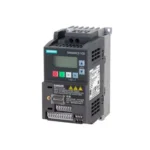
0.55 kW 220V Single-Phase Input 3-Phase Output Variable Frequency Drive – Siemens SINAMICS V20 (Model: 6SL3210-5BB15-5UV1)
Original price was: 338.66$.109.44$Current price is: 109.44$.
High-performance 0.55 kW (0.75 HP) variable frequency drive for precise control of 3-phase AC asynchronous motors, operating from a 200-240V single-phase AC input.
In stock
🔥 Special for Today Only %68 Discount Opportunity!📦 Category: 220V Speed Control Devices
Mermak assuranceFrom factory to end user · importer / main dealer · strong stock
ImporterMain dealer / distributorStrong stockGood priceCorporate invoice
In stock / available to order · 14-day return for standard unused products; conditions may vary for custom size/cut products.
0.55 kW Variable Frequency Drive Siemens 220V
INDUSTRIAL AUTOMATION PARTS | SUPERIOR PERFORMANCE SERIES
Detailed Product Review
The Siemens SINAMICS V20 series 6SL3210-5BB15-5UV1 variable frequency drive is designed to precisely control the speed and torque of standard three-phase AC asynchronous motors with a power rating of 0.55 kW (0.75 HP). It achieves this by converting a single-phase 200-240V AC mains voltage into an adjustable three-phase output voltage in terms of frequency and amplitude. This device modulates the motor’s mechanical output speed by altering the supply frequency and thus the synchronous speed. It optimizes the motor’s magnetic flux and torque production capacity by maintaining a constant V/f (voltage/frequency) ratio. With various control modes such as Linear V/f, Quadratic V/f (for pump/fan applications), and Flux Current Control (FCC), it ensures the most suitable operating regime for the motor’s load characteristics, thereby increasing energy efficiency, preventing motor overheating, and reducing stress on the mechanical system. Soft start and stop ramps eliminate sudden torque shocks, extending system life and contributing to more stable process operation.
The material construction of this variable frequency drive is designed to withstand the demanding conditions of industrial environments. The electronic boards (PCBs) are reinforced with a protective coating against moisture, dust, and chemical vapors. The device’s compact dimensions and IP20 protection class make it suitable for vertical mounting within standard industrial control cabinets, offering reliable cooling performance when adequate airflow is provided. For system integration, it supports USS (Universal Serial Interface) and MODBUS RTU communication protocols via an integrated RS485 port, allowing for easy integration with PLCs, HMIs, and other automation controllers, thus enabling centralized control and monitoring. Its application areas are extensive, ranging from precise control of material flow in small-scale conveyor systems using 0.55 kW motors, to flow rate adjustment of centrifugal pumps, optimization of airflow speed for ventilation fans, speed adjustment of mixers in the food industry based on viscosity, synchronization of product feed rates in packaging machines, and even speed adjustment for auxiliary axes in hobby CNC machines or tension control in textile machinery’s yarn winding/unwinding units, offering an efficient solution for numerous industrial and commercial applications.
Advantages of the 0.55 kW Variable Frequency Drive Siemens 220V
Advanced Motor Control Algorithms and Process Stability: The Siemens 6SL3210-5BB15-5UV1 is equipped with optimized V/f (Linear, Quadratic, Programmable) and Flux Current Control (FCC) modes for 0.55 kW motors. Linear V/f control ensures constant motor flux for constant torque applications (conveyors, mixers), while quadratic V/f control minimizes energy consumption in fan and pump applications requiring variable torque. The FCC mode provides a more dynamic response to load variations, maintaining motor speed more stably and increasing process efficiency. These control algorithms allow for precise speed adjustment across a wide range, from below nominal speed to nominal speed, ensuring the system operates continuously and reliably within the desired performance parameters.
Industrial Durability and Long-Term Operation: This model from the SINAMICS V20 series reflects Siemens’ engineering quality in industrial automation products. Its wide input voltage tolerance (200-240V AC ±10%) resists mains fluctuations, while the advanced cooling design ensures the device operates at optimal temperatures even under nominal load. The special protective coating on the electronic boards (PCBs) offers high resistance against environmental factors such as dust, moisture, vibration, and chemical vapors commonly encountered in harsh industrial settings. These structural features enable the 6SL3210-5BB15-5UV1 model to deliver long-lasting, uninterrupted, and low-maintenance performance, thereby reducing the total cost of ownership.
Fast Commissioning and Maximum Energy Efficiency: The device offers quick configuration of basic parameters through integrated application macros (e.g., pump, fan, conveyor), significantly shortening commissioning time. Furthermore, the ability to upload or copy parameters via a USB adapter without power connection saves time during mass production or field service. In terms of energy efficiency, the built-in ECO mode automatically optimizes motor flux in V/f and V²/f control modes, preventing unnecessary energy consumption. The “Standby Mode” puts the drive into sleep mode when the motor is not used for a specified period, minimizing energy expenditure and leading to significant reductions in operating costs. These features offer the potential to maximize energy savings, even in low-power applications.
Technical Specifications and Capacity
Feature
Value/Description
Model Number
6SL3210-5BB15-5UV1 (Siemens SINAMICS V20 Series)
Motor Power Capacity
0.55 kW (0.75 HP)
Input Voltage and Phase
1 Phase, 200 V – 240 V AC (±10% tolerance)
Output Voltage and Phase
3 Phase, 0 V – Input Voltage (Adjustable)
Nominal Output Current
3.0 A
Control Methods
V/f (Linear, Quadratic, Programmable), Flux Current Control (FCC)
Overload Capacity
150% of nominal current (60 seconds), 200% (3 seconds)
Communication Interface
USS, MODBUS RTU (via RS485 port)
EMC Filter
Unfiltered
Protection Class
IP20 (Suitable for control cabinet installation)
Technical Frequently Asked Questions (FAQ)
What are the technical implications of this variable frequency drive providing a 3-phase output from a single-phase input on motor performance?
The ability of the Siemens 6SL3210-5BB15-5UV1 model to produce a 3-phase 220V output from a single-phase 220V input allows the use of 3-phase AC motors, particularly in situations where a 3-phase mains infrastructure is unavailable in industrial facilities or workshops. Technically, the drive converts the single-phase AC input voltage into a DC voltage using a rectifier bridge, and then an IGBT-based inverter circuit transforms this DC voltage into a 3-phase sinusoidal output voltage with adjustable frequency and amplitude. This conversion enables the motor to operate at its nominal power and torque values. However, the current drawn from the single-phase input will be higher than that of a 3-phase drive of the same power rating. This must be considered when selecting the input fuse or circuit breaker and determining the supply cable cross-section. Additionally, fluctuations in the DC bus voltage resulting from the single-phase input may cause slight distortions in the drive’s output waveform, but this is generally within acceptable limits for low-power motors like 0.55 kW and does not adversely affect motor performance.
In which scenarios is the Flux Current Control (FCC) mode of the SINAMICS V20 more advantageous for a 0.55 kW motor compared to V/f control?
Flux Current Control (FCC) mode is a more advanced motor control method than V/f control and offers advantages for 0.55 kW motors, especially in applications with frequent dynamic load changes or where more precise torque control is required. While V/f control maintains the voltage-to-frequency ratio to keep the motor’s magnetic flux constant, FCC directly controls the motor’s stator current, providing faster torque response and better speed regulation. This ensures that motor speed remains more stable in the face of sudden load increases or decreases. For example, in a mixer application where the material’s viscosity changes abruptly, FCC maintains the motor speed more precisely, contributing to product quality consistency. Furthermore, FCC mode generally offers higher torque capability at lower speeds, which is critical for applications requiring high starting torque at low speeds. Although V/f control is sufficient for simpler, general-purpose applications, FCC is the preferred choice for engineers seeking to enhance the system’s dynamic performance and efficiency.
What electromagnetic compatibility (EMC) precautions are required in an industrial installation since this variable frequency drive is unfiltered?
The absence of an internal EMC filter in the Siemens 6SL3210-5BB15-5UV1 model necessitates additional measures to ensure electromagnetic compatibility (EMC) in an industrial installation. Variable frequency drives can emit high-frequency electromagnetic noise (EMI) due to their switching frequencies. When using an unfiltered drive, this noise can adversely affect the operation of nearby sensitive electronic equipment (PLCs, sensors, communication lines). To prevent this, it is strongly recommended to install an external EMC filter (typically Class C1 or C2) at the drive’s input. Additionally, shielded cables should be used for the cabling between the motor and the drive, and this shielding must be properly grounded at both the drive and motor ends. Control and power cables should be routed in separate conduits to minimize crosstalk. The metal control cabinet where the drive is mounted should also have a good ground connection, and the integrity of the shielding should be maintained at all cable entry/exit points using appropriate cable glands. These precautions enhance the system’s overall EMC performance, ensuring reliable and error-free operation.
How do the integrated application macros and communication protocols of the SINAMICS V20 technically facilitate commissioning and integration into automation systems?
The integrated application macros in the SINAMICS V20 series simplify the commissioning process significantly by offering pre-defined parameter sets for common industrial applications such as pumps, fans, and conveyors. When an engineer selects the appropriate macro for the application, the drive automatically optimizes basic settings like motor parameters, speed ramps, stop modes, and protection functions. This reduces manual parameter entry and the likelihood of errors, shortening installation time. In terms of communication protocols, the integrated RS485 port with USS (Universal Serial Interface) and MODBUS RTU support allows the drive to be easily integrated with a PLC (Programmable Logic Controller), HMI (Human Machine Interface), or SCADA (Supervisory Control and Data Acquisition) system. Through these protocols, data such as the drive’s speed reference, start/stop commands, fault statuses, and operating parameters can be read and written from a central control system. This technical integration enables synchronized motor speed control, remote monitoring, and simplified fault diagnostics within complex automation systems, thereby increasing the overall efficiency and manageability of the system. Mermak offers reliable solutions for industries in the United Kingdom, United States, Canada, Australia, Ireland, New Zealand, South Africa, and similar international markets, ensuring efficient automation and control.
You must be logged in to post a review.
Taksit Tablosu
Related Products
 %60 Discount11 kW 380V Motor Drive InverterOriginal price was: 683.64$.273.46$Current price is: 273.46$.View
 %42 Discount750W Braked Servo Motor Set 80ST-M02430Z1 T3L-L20F-RABNOriginal price was: 757.28$.438.43$Current price is: 438.43$.View
 %60 Discount4 kW 380V Motor Drive InverterOriginal price was: 367.56$.147.02$Current price is: 147.02$.View
Reviews
There are no reviews yet.