























































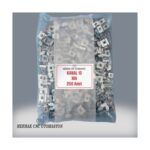
















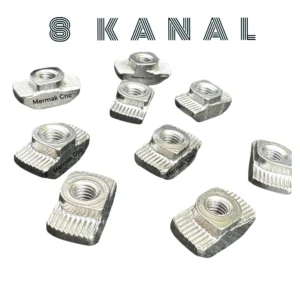
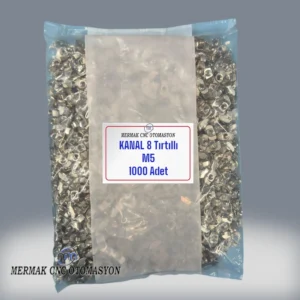
8 Channel M6 1000 pcs Serrated Nut
Detailed Product Review
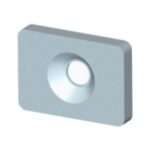
In industrial automation systems, ensuring structural integrity is directly related to the stability of fastening elements, even under dynamic loads. This 8 Channel M6 Serrated Nut is a critical component designed to establish high-strength, vibration-resistant, and long-lasting mechanical connections, particularly on aluminum profile systems. The “serrated” surface structure of the nut, when engaged with the profile channel, creates micro-level deformations, thereby increasing the coefficient of friction between the nut and the profile. This mechanism helps maintain the preload generated when the bolt is tightened, minimizing self-loosening in applications subjected to continuous vibration, impact, or dynamic stresses, thus maximizing operational reliability. This feature ensures the long-term structural stability and precision of machine frames, conveyor systems, or robotic cells being assembled.
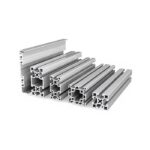
The product is manufactured from high-strength industrial steel in accordance with industrial standards. This material selection allows the nut to withstand high tensile and shear stresses, while also enhancing its resistance to wear and fatigue, ensuring its performance even under demanding working conditions. In terms of mechanical integration, these serrated nuts are dimensioned for full compatibility with 30×30 K8 sigma aluminum profiles, which have a European standard 8mm channel width. This profile series is widely used in a broad range of industrial applications such as robotic platforms, linear motion systems, modular assembly lines, and safety barriers. The M6 metric thread size allows for direct integration with standard M6 bolts, offering flexibility in system design and standardization advantages in parts procurement. Assembly flexibility is achieved by the ability to insert the nuts into the profile channel by sliding them in from the end or by dropping them in from the top at any point along the channel. This allows for quick modifications to existing systems or easy integration of additional components, optimizing time and labor costs in engineering processes.
Advantages of 8 Channel M6 1000 pcs Serrated Nut
Superior Vibration Resistance and Connection Security: The specially designed serrations on the nut physically engage with the inner surface of the profile channel, ensuring that the preload generated when the bolt is tightened is maintained even under dynamic conditions. This micro-locking effect increases the coefficient of friction between the nut and the profile, significantly reducing the tendency for loosening caused by continuous vibrations, impacts, and thermal expansion/contraction cycles inherent in industrial machinery. Consequently, the mechanical integrity of the connection is preserved throughout its operational life, enhancing system precision and reliability, extending maintenance intervals, and minimizing unplanned downtime.
High Assembly Flexibility and System Adaptation: These serrated nuts can be mounted by sliding them in from the end of the profile (end-feed) or by dropping them in from the top at any point along the channel (drop-in). The end-feed method is ideal for quick and sequential assembly in new designs or with open profile channels. The drop-in feature allows for easy addition of components or modifications to existing and partially assembled systems without requiring any disassembly. This flexibility offers greater freedom in engineering design processes while significantly saving time and labor costs in on-site adaptations and maintenance operations, thus supporting system modularity and future expandability.
Wide Compatibility and Industrial Standardization: The product exhibits excellent compatibility with 30×30 K8 sigma aluminum profiles, which are widely used in industrial automation and machine manufacturing. K8 series profiles, with their 8mm channel width, comply with European standards and are recognized within a broad ecosystem. Furthermore, the M6 metric thread size ensures direct integration with standard M6 bolts, which are globally available. This high compatibility and standardization simplify the spare parts supply chain, facilitate part interchangeability between different systems, and eliminate compatibility issues in engineering design processes. As a result, project development times are shortened, and total cost of ownership is reduced while system integration becomes more efficient. Mermak supplies these components to markets including the United Kingdom, United States, Canada, Australia, Ireland, and New Zealand, alongside similar countries and international markets.
Technical Specifications and Capacity
Feature
Value/Description
Product Type
Serrated Nut (Knurled Nut)
Thread Size
M6 (Metric 6)
Compatible Profile Series
30×30 K8 Sigma Profiles (8mm channel width)
Dimensions (Width x Length)
30mm x 30mm (Part fitting into profile channel)
Material Quality
High-Strength Industrial Steel
Mounting Method
End-Feed or Drop-in
Quantity
1000 pcs / Pack
Key Feature
Serrated Structure for Anti-Loosening Against Vibration
Barcode No
8692024020069
Technical Frequently Asked Questions (FAQ)
What is the primary mechanism that provides vibration resistance for serrated nuts, and how does it differ from standard nuts?
The primary mechanism providing vibration resistance in serrated nuts is the creation of a mechanical lock by the serrations on the nut’s surface deforming the profile material upon insertion. This lock increases the coefficient of friction between the nut and the profile, helping to maintain the preload applied when the bolt is tightened. Standard nuts, on the other hand, typically have a smoother contact surface with the profile, resulting in lower frictional force. Under dynamic loads, vibrations, or thermal cycles, standard nuts are more prone to preload loss and subsequent loosening. The serrated structure actively counteracts this tendency, significantly enhancing the long-term stability and operational reliability of the connection. This is a critical advantage in industrial applications subjected to continuous movement or impact loads.
The material quality for these serrated nuts is specified as high-strength industrial steel. How does this material choice affect the nut’s performance and lifespan?
The selection of high-strength industrial steel is a critical engineering decision that directly impacts the performance and lifespan of the 8 Channel M6 Serrated Nuts. This material offers high tensile strength and yield strength, allowing the nut to withstand high preloads without deforming under bolt tightening torque and operational loads. Furthermore, this type of steel enhances resistance to wear and fatigue, meaning the nut can maintain its structural integrity for extended periods in industrial environments exposed to continuous vibration, impact, or repetitive load cycles. The material’s hardness ensures that the serrations effectively penetrate the profile channel and do not deform over time. Additional surface treatments (e.g., galvanization) can be applied for corrosion resistance, adapting the nut to harsh environmental conditions. These combined properties increase the overall reliability of the nut and the long-term stability of the system.
What is the recommended maximum tightening torque for these nuts with M6 metric thread, and how is this value determined?
The recommended maximum tightening torque for these M6 serrated nuts varies depending on the strength class of the bolt used, the material properties of the nut and profile, friction coefficients, and the desired preload level. Generally, for high-strength steel bolts of M6 size (e.g., strength class 8.8 or 10.9), a suitable tightening torque range can be between 10 Nm and 15 Nm. This torque value is determined to create sufficient preload in the bolt to prevent loosening, without exceeding the yield limit of the bolt or nut. Overtightening can lead to plastic deformation or stripping of threads, while undertightening increases the risk of loosening. The precise torque value should be determined based on application specifications, bolt manufacturer data, and, if necessary, experimental testing. While the serrated structure contributes to preload retention through increased friction, basic torque calculations should be based on bolt strength.
How does the compatibility of these nuts with 30×30 K8 sigma profiles affect their use with aluminum profiles of different dimensions or channel geometries?
These 8 Channel M6 Serrated Nuts are specifically designed for perfect compatibility with 30×30 K8 sigma profiles, which have an 8mm channel width and a specific channel geometry. The dimensions and serrated structure of the nut are optimized to fit precisely within this 8mm channel and geometry, ensuring maximum contact surface area and locking effect. When used with aluminum profiles of different dimensions (e.g., 20×20, 40×40) or different channel geometries (e.g., various series of T-slot profiles), the optimal performance of the nut cannot be guaranteed. In a narrower channel, the nut may not physically fit or the serrations may not engage effectively. In a wider channel, the nut may be loose, significantly reducing vibration resistance and preload retention capacity. Therefore, using the product with profiles other than the specified 30×30 K8 sigma profiles is not recommended from an engineering standpoint due to the risk of incompatibility and performance loss. Using the correct profile series and nut combination is essential for the structural integrity of the system.

Reviews
There are no reviews yet.