
No products in the cart.
%51 Discount


DSP Control Panel 0501 3 Axis CNC Control Panel Set
Original price was: 550.80$.271.52$Current price is: 271.52$.
Best Quality, Best Price Guarantee
In stock
🔥 Special for Today Only %51 Discount Opportunity!📦 Category: CNC Control Panels
Mermak assuranceFrom factory to end user · importer / main dealer · strong stock
ImporterMain dealer / distributorStrong stockGood priceCorporate invoice
In stock / available to order · 14-day return for standard unused products; conditions may vary for custom size/cut products.
The DSP Control Panel 0501 is a high-performance control unit specifically designed for 3-axis CNC machines, featuring an embedded Digital Signal Processor (DSP) architecture. Unlike traditional PC-based control systems, this architecture ensures real-time processing of G-code interpretation, toolpath calculations, and servo/step motor commands with millisecond precision, independent of operating system delays. The DSP’s parallel processing capabilities and dedicated hardware accelerators execute complex interpolation algorithms (linear, circular, helical) at high frequencies, minimizing deviations of the tool tip from the target trajectory. This is critical for high-speed machining operations, precise surface finishing requiring micro-step control, and error-free production of complex 3D geometries. The control panel converts received G-codes into pulse trains for the axis motors via kinematic transformations, generating these pulse trains synchronously to ensure coordinated axis movement, thereby maximizing dynamic response time and positioning accuracy.
This control panel set boasts a robust construction designed to withstand the demanding conditions of industrial automation environments. Its housing is made from high-quality industrial-grade materials, providing resistance against electrical noise, vibration, and wide temperature ranges. Internal components are designed and shielded in compliance with Electromagnetic Compatibility (EMC) standards, minimizing operational errors caused by environmental interference. For system integration, the DSP Control Panel 0501 offers broad compatibility through USB, RS232, and various digital input/output (I/O) ports. The USB port facilitates program loading and parameter backup, while the RS232 port enables data exchange with devices compatible with industrial communication standards. Digital I/Os provide a flexible platform for direct integration with limit switches, emergency stop buttons, tool sensors, and other peripheral actuators. These integration capabilities make the panel suitable for a wide range of applications, from CNC routers and milling machines used in the woodworking and furniture industry to prototyping, small-batch production, and precision engraving in the metalworking and mold-making sectors. It exhibits high performance particularly in applications such as complex wood carving, detailed furniture component production, precise machining of light alloys, and finishing of mold surfaces.
Advantages of the DSP Control Panel 0501 3 Axis CNC Control Panel Set
Embedded DSP Architecture and Real-Time Processing Capacity: Unlike general-purpose microprocessors, the DSP Control Panel 0501 houses a high-performance Digital Signal Processor (DSP) optimized for signal processing and control applications. This specialized architecture offers the ability to perform critical tasks such as G-code interpretation, toolpath interpolation, and axis motor command transmission with nanometer-level precision and deterministic timing. Thanks to the DSP’s parallel processing and dedicated Arithmetic Logic Units (ALUs), look-ahead algorithms and dynamic acceleration/deceleration profiles minimize tool tip deviation from the target trajectory during machining. This significantly enhances final product quality and machining efficiency, especially in high-speed cutting operations, by optimizing speed at corner turns and reducing vibration and surface roughness. Its embedded nature eliminates reliance on an external computer, increasing system reliability and stability.
Precise 3-Axis Coordinated Motion Control: The DSP Control Panel 0501 is capable of managing the simultaneous and synchronized movement of the X, Y, and Z axes with high accuracy. This feature enables the error-free machining of complex 3D geometries, free-form surfaces, and detailed engravings. The controller generates pulse trains for each axis, individually yet coordinated, ensuring precise positioning of servo or stepper motors. Advanced interpolation algorithms dynamically calculate the speed and position of the axes at every point of the toolpath and compensate for potential kinematic errors. This minimizes toolpath deviations, corner rounding, and machining defects caused by vibration. Consequently, the dimensional accuracy of machined parts increases, surface quality improves, and tool life is extended through more balanced distribution of cutting forces. This coordination capability offers a critical advantage in applications requiring high precision, such as mold making and prototyping.
Industrial Interface Ergonomics and Error Management: The DSP Control Panel 0501 features an industrial interface with a physical keypad and an intuitive menu structure, designed for easy and safe machine control by operators. This interface, with its tactile feedback keys and clear display, allows for comfortable operation even with gloves in industrial environments. Advanced error detection and diagnostic mechanisms detect operational anomalies, sensor failures, or motor overloads in real-time and notify the operator with visual or audible alerts. Integrated safety protocols include direct integration of emergency stop (E-stop) circuits, continuous monitoring of limit switches, and enforcement of software-defined work area boundaries. These features prevent potential damage to the machine and maximize operator safety. Furthermore, internal memory ensures that machining programs and configuration parameters are protected against power outages, guaranteeing production continuity and eliminating the risk of data loss.
Technical Specifications and Capacity
Feature
Value/Description
Processor Type
High-Performance Embedded DSP (Digital Signal Processor). This specialized processor executes signal processing and control algorithms much faster and more deterministically than traditional microcontrollers, ensuring sub-millisecond response times and precise synchronization.
Number of Axes
3-Axis (X, Y, Z) Simultaneous Control. This capability allows the machine to move simultaneously in three-dimensional space and enables high-precision machining of complex 3D parts through linear, circular, or helical interpolations.
G-Code Support
Standard ISO G-Codes and M-Codes. Fully supports G-codes (geometric motion commands) and M-codes (machine function commands), the universal language of the CNC industry, ensuring smooth operation of programs generated by various CAM software.
Connectivity Interfaces
USB, RS232, Digital Inputs/Outputs. The USB port offers convenience for program and parameter transfer, while RS232 is crucial for industrial communication standards. Digital I/Os provide direct and reliable communication with limit switches, emergency stop buttons, and other sensors/actuators.
Power Requirement
DC 24V (±10%). This standard power supply, widely used in industrial automation systems, offers high resistance to electrical noise and guarantees stable system operation.
IP Protection Class
IP20 (for the rear of the panel). This classification indicates that the product is protected against solid objects larger than a finger. Due to its limited protection against liquid ingress, it is recommended to install the control panel inside an enclosure protected from dust and moisture.
Technical Frequently Asked Questions (FAQ)
What are the main advantages of DSP control panels compared to PC-based systems, and how do these advantages affect production processes?
DSP-based control panels offer key advantages over PC-based systems, including deterministic operation, low latency, and high real-time processing capacity. PC-based systems, due to the nature of general-purpose operating systems (Windows, Linux, etc.), can exhibit variability in task scheduling and interrupt handling times, leading to micro-delays in G-code interpretation and motor command transmission. The DSP architecture, however, with its specialized hardware and software designed for signal processing and control tasks, minimizes such delays and guarantees precise command timing. This deterministic nature allows for toolpath tracking with sub-millimeter precision, especially in high-speed and high-precision machining operations, thereby improving surface quality and reducing dimensional deviations. The direct positive impacts on production processes include the ability to achieve higher machining speeds, produce more complex geometries with fewer errors, extend tool life, and increase overall production efficiency. Furthermore, DSP systems generally require less maintenance and are more resistant to the harsh conditions of industrial environments.
How does the 3-axis synchronization capability of the 0501 model provide superiority in machining complex geometries based on engineering principles?
The 3-axis synchronization capability of the DSP Control Panel 0501 provides superiority in machining complex geometries through principles of kinematic control, look-ahead algorithms, and precise interpolation. The controller instantaneously calculates the required speed and position for the X, Y, and Z axes simultaneously for each toolpath segment derived from G-code. These calculations are performed using linear, circular, or helical interpolation algorithms, and the pulse trains sent to each axis motor are precisely synchronized. Look-ahead algorithms allow the controller to analyze future segments of the toolpath in advance, enabling dynamic adjustment of machine speed during sharp corners or sudden direction changes to minimize tool tip deviation from the trajectory and reduce vibration. This ensures that geometries such as free-form surfaces, complex carving patterns, or parts with polygonal cross-sections can be produced with high dimensional accuracy and superior surface quality, without synchronization errors between axes. These engineering principles directly impact production quality, especially in applications where precision is critical, such as mold and model making.
What technical features ensure the durability of this control panel against electrical noise and temperature fluctuations in industrial environments?
The durability of the DSP Control Panel 0501 against electrical noise and temperature fluctuations in industrial environments is ensured by a range of technical features and design principles. Protection against electrical noise is primarily achieved through a multi-layer PCB (Printed Circuit Board) structure designed in compliance with Electromagnetic Compatibility (EMC) standards, integrated filtering circuits, and high-quality shielded cabling interfaces. Digital and analog signal paths are isolated from each other, and noise-suppressing inductors and capacitors are used in the power supply lines. Furthermore, input/output ports are typically isolated via optocouplers or differential receivers, preventing external noise from reaching the controller’s sensitive electronic circuits. Resistance to temperature fluctuations is ensured by the use of industrial-grade components selected for a wide operating temperature range, typically from 0°C to 60°C. These components maintain their stable electrical characteristics across these wide temperature ranges. The enclosure design, optimized for passive cooling, and internal heat dissipation mechanisms prevent overheating, guaranteeing long-term and reliable operational performance. The IP20 protection class ensures the panel is protected against solid objects larger than a finger, while installation within an enclosure is recommended for more demanding environments.
How do the G-code interpretation and toolpath optimization algorithms of the DSP Control Panel 0501 maximize machining accuracy and surface quality?
The G-code interpretation and toolpath optimization algorithms of the DSP Control Panel 0501 maximize machining accuracy and surface quality through a series of advanced techniques. During the G-code interpretation phase, the controller analyzes each command at high speed to extract the geometric and kinematic properties of the toolpath. This interpretation process is performed using a direct hardware-based approach that eliminates the delays found in traditional systems. Toolpath optimization is primarily achieved through “look-ahead” algorithms. These algorithms analyze not only the current segment of the toolpath but also several future segments in advance. This allows the controller to dynamically adjust machine speed and acceleration when approaching sharp corners or making sudden direction changes. This adaptive speed control enables the tool to slow down at corners and accelerate again on straight segments, minimizing toolpath deviations (e.g., corner rounding) and vibration. Additionally, the DSP’s high-frequency pulse generation capability precisely manages the micro-step control of servo or stepper motors, ensuring smoother and more continuous axis movements. This integrated approach reduces undulations and roughness on machined surfaces, significantly enhancing the dimensional accuracy and aesthetic quality of the final part.
| Number of Axes | 3-Axis |
|---|
You must be logged in to post a review.
Taksit Tablosu
Related Products
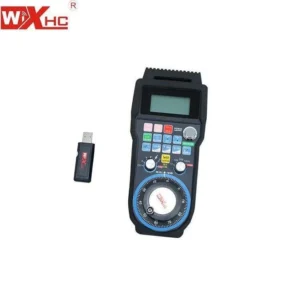 %49 DiscountMach3 Wireless Handwheel CNC Router Remote ControlOriginal price was: 256.97$.132.30$Current price is: 132.30$.View
 TC55H 4-Axis USB CNC Control Panel388.73$View
 %35 Discount5 Axis CNC Control Unit SMC5-5-N-NOriginal price was: 1,159.06$.750.20$Current price is: 750.20$.View
Reviews
There are no reviews yet.