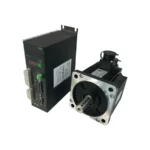
































































1.5 kW Servo Motor Set 130ST-M06025 T3A-L30F-RABF
Detailed Product Review
The 1.5 kW Servo Motor Set 130ST-M06025 T3A-L30F-RABF, offered by Mermak CNC Technology Market, is an integrated drive system designed for high-precision motion control in industrial automation and CNC machines. This set combines the 130ST-M06025 model servo motor with the T3A-L30F-RABF digital servo drive, operating on the principle of closed-loop control. The high-resolution incremental encoder integrated into the motor shaft feeds back the shaft’s instantaneous position and speed information to the drive within milliseconds. The drive compares this feedback data with reference commands, instantly detects any deviation (following error), and corrects the error by dynamically adjusting the current applied to the motor’s stator windings. This continuous, real-time correction mechanism completely eliminates the “step loss” problem observed in stepper motors, ensuring the system reaches the desired position with millimeter accuracy and provides stable, reliable operation by maintaining its nominal torque across the entire speed band.
The material structure of this servo motor set is designed to withstand the demanding conditions of industrial environments. The 130ST-M06025 motor, with its 130×130 mm flange size, features a robust cast aluminum body and IP65 protection class, offering high resistance to dust and liquid ingress, making it suitable for use in machining and humid environments. The T3A-L30F-RABF drive, with its advanced digital signal processor (DSP) based control architecture, offers flexible operation in position, speed, and torque control modes. In terms of integration, the set’s “Plug-and-Play” compatibility allows for quick commissioning without the need for complex parameter settings, as the motor and drive are pre-matched with factory settings. This set can be used as an axis drive solution in a wide range of applications, including CNC routers, plasma cutting machines, laser processing systems, industrial robotic arms, automatic assembly lines, and specialized automation systems requiring high dynamism and precision. The drive’s internal braking resistor and RS485 communication interface (indicated by RABF) support integration into more complex automation networks and remote monitoring/control capabilities.
Advantages of the 1.5 kW Servo Motor Set 130ST-M06025 T3A-L30F-RABF
Superior Torque Characteristics and Dynamic Load Management: The 130ST-M06025 servo motor provides continuous mechanical power transmission even under heavy processing conditions and constant load, with a nominal torque of 6 Nm. This nominal torque capacity is maintained across the motor’s entire operating speed range, allowing for stable performance in applications requiring high power, even at low speeds. Furthermore, its ability to increase torque up to 3 times, i.e., to a peak torque of 18 Nm, during instantaneous loads or sudden acceleration/deceleration allows the motor to withstand short-term overload conditions and perform dynamic movements without stalling or slowing down, even with the hardest materials. This feature is a critical engineering advantage that directly impacts processing efficiency and part quality.
Advanced Position Feedback and Closed-Loop Control Architecture: The high-resolution incremental encoder integrated into the motor shaft precisely measures the motor’s angular position and speed thousands of times per second, feeding it back to the T3A-L30F-RABF drive. This closed-loop control system allows the drive to continuously monitor the difference between reference commands and the motor’s actual position (following error) and dynamically adjust the motor current to minimize this error. As a result, even the slightest positional deviations caused by external load changes or mechanical resistances in the system are instantly corrected, guaranteeing that the 130ST-M06025 motor operates with zero error tolerance and offers high repeatability. This precision is indispensable, especially in critical applications such as mold making and precision part manufacturing.
High Speed Dynamics and Acceleration Capability: The 1.5 kW Servo Motor Set offers the capacity to reach high processing speeds with a nominal speed of 2500 RPM, contributing to shorter production cycle times and increased overall efficiency. The motor’s low inertia allows it to respond very quickly to sudden acceleration and deceleration commands. This dynamic response capability minimizes time losses in applications requiring complex contour machining, sharp corner turns, and detailed engraving that demand high acceleration and precise deceleration. Low inertia also allows control loops to be tuned with higher gains, enabling the system to operate more rigidly and with less vibration, thereby optimizing machining quality and surface roughness.
Technical Specifications and Capacity
Feature | Value/Description
Motor Model | 130ST-M06025
Drive Model | T3A-L30F-RABF
Nominal Power | 1.5 kW (1500 Watts) – Maximum mechanical power it can produce in continuous operation.
Nominal Torque | 6 Nm – The torque the motor can continuously produce.
Peak (Maximum) Torque | 18 Nm – The maximum torque the motor can briefly produce during instantaneous loads.
Nominal Speed | 2500 RPM – The optimal speed at which the motor can continuously operate.
Supply Voltage | 220V AC – Compatible with single-phase or three-phase 220VAC ±10-15% mains.
Encoder Type | Incremental Encoder – High-resolution feedback sensor with 2500 lines (10000 PPR).
Flange Size | 130×130 mm – The industrial standard for the motor’s mechanical mounting surface.
Shaft Diameter | 22 mm – The diameter of the shaft to which power transmission elements (couplings, pulleys, gearboxes) are connected.
Drive Control Modes | Position, Speed, Torque – Supports different control algorithms according to application requirements.
Communication | RS485 (Isolated) – Enables multi-drive communication and parameter access via Modbus RTU protocol.
Technical Frequently Asked Questions (FAQ)
How should PID gain parameters be optimized in the T3A-L30F-RABF drive to prevent oscillation or slow response, especially with high inertia loads?
To ensure stable and dynamic operation of the 1.5 kW Servo Motor Set (130ST-M06025) with high inertia loads, correct adjustment of the PID gain parameters in the T3A-L30F-RABF drive is critical. Initially, P-005 (Speed Loop Proportional Gain – Kv) and P-009 (Position Loop Proportional Gain – Kp) values should be gradually increased. In high inertia systems, increasing the Kv value is usually the first step to speed up the motor’s response, but this can lead to high-frequency vibrations in the system. In such cases, parameters P-007 (Torque Filter Time Constant) and P-019 (Speed Detection Filter Time Constant) should be gradually increased (typically in increments of 5 units) to suppress mechanical resonances and electrical noise. The correct entry of parameter P-017 (Load Inertia Ratio) forms the basis for the drive to correctly perceive the load and adjust the PID algorithms accordingly. Excessive gains will cause “hunting” (back-and-forth oscillation), while very low gains will lead to slow response and high following error. The optimization process can be initiated with the auto-tuning function while the motor is unloaded, followed by manual fine-tuning under actual load. The goal is to achieve the lowest following error and vibration-free operation with the highest possible gains.
How can the RS485 communication interface of the T3A-L30F-RABF drive be used for data exchange and synchronization in multi-axis CNC systems?
The T3A-L30F-RABF servo drive, via its integrated isolated RS485 communication interface, can be used for data exchange and synchronization in multi-axis systems with a master controller (PLC, HMI, or industrial PC) using the Modbus RTU protocol. This interface allows for reading and writing drive parameters (e.g., P-181 Drive ID, P-182 Baud Rate) via Modbus commands, and monitoring real-time status information such as motor speed (0x0000), torque (0x0009), and position (0x0001). In a multi-axis CNC system, each servo drive is assigned a unique Modbus ID (P-181). The master controller can query the status of each axis, send speed or torque commands, or read alarm statuses (0x001A) through these IDs. For synchronization, the master controller can send simultaneous commands to all axes or correct inter-axis relative position errors by reading the position feedback of each axis. The isolated RS485 structure provides high immunity to electrical noise in industrial environments, ensuring reliable data communication and stable operation even over long cable distances. This reduces cabling complexity and provides flexibility, especially in systems with complex motion profiles, a high number of axes, and requiring centralized control.
How does the resolution of the 2500-line incremental encoder of the 130ST-M06025 motor affect CNC machining precision and micro-movement capability?
The integrated 2500-line incremental encoder of the 130ST-M06025 servo motor provides a resolution of 10,000 pulses per revolution (PPR) when processed by the drive using quadrature technique. This high resolution has a direct and significant impact on CNC machining precision and micro-movement capability. Each pulse represents a very small angular movement of the motor shaft (360 degrees / 10,000 = 0.036 degrees). This allows the drive to perceive and control the motor’s position in extremely fine steps. In a mechanical system (e.g., with a 5 mm pitch ball screw), this can correspond to a linear movement of 0.0005 mm (0.5 microns) per pulse. Thanks to the high encoder resolution, even the smallest command pulses from the CNC controller are precisely perceived and executed by the motor, which improves surface quality, detail machining capability, and part dimensional accuracy. It also reduces motor jitter even during micro-movements, providing a smoother and more stable motion profile, which is a critical advantage, especially in precision mold making and 3D machining applications.
When controlling a high inertia load (e.g., a heavy Z-axis) with the T3A-L30F-RABF drive, how should an external braking resistor be selected and connected?
Although the T3A-L30F-RABF drive, as a 220V ‘L’ series model, has an internal braking resistor, using an external braking resistor may become necessary for regenerative energy management, especially in applications requiring frequent start/stop or rapid deceleration of high inertia loads (e.g., a heavy Z-axis). When the internal resistor’s capacity is insufficient, an “overvoltage” (Err 2) alarm occurs in the drive. The selection of an external braking resistor should be based on the continuous and peak regenerative power required by the application. For heavy-duty applications for the T3x-L30F (220V) series, a resistor configuration with a resistance of 47 Ohms and a power rating greater than 500W is generally recommended. The resistor’s ohm value must be compatible with the drive’s internal braking circuit and should not fall below the minimum resistance value specified in the drive manual. The connection should be made to the drive’s “BR+” and “BR-” terminals. Resistor cables should be routed separately from power cables, and using shielded cable is recommended to minimize electrical noise. Additionally, parameters P-060 (Acceleration Time) and P-061 (Deceleration Time) should be optimized so that regenerative energy is spread over a longer period, reducing the thermal load on the braking resistor. This engineering approach extends the drive’s lifespan and ensures stable system operation without overvoltage alarms.
Mermak has 16 years of experience in the industry, operating from its factory and warehouse in Ankara Uzay Sanayi. Our website displays up-to-date stock quantities and prices. Stocked products are dispatched directly from our warehouse, eliminating production waiting times. We ensure careful packaging, meticulous invoice and document follow-up, and collaborate with reliable logistics partners. The Mermak team closely monitors the shipment process. Upon request, we can arrange video viewings of our products or factory via WhatsApp or other contact channels. We proudly supply our products to numerous countries, including the United Kingdom, United States, Canada, Australia, Ireland, New Zealand, and South Africa, as well as similar countries and international markets worldwide.
Alan açıklamalarıDeğerler nereden bulunur?
Kullanım alanı
Neden girilir? Aynı güç, tork veya hız değeri CNC, konveyör, fan, pompa, pano veya genel otomasyon uygulamasında farklı emniyet payı ve farklı ürün sınıfı gerektirir.
Nereden bakılır? Makinenin gerçek kullanım amacından seçilir. Birden fazla kullanım varsa en ağır ve en sürekli çalışan senaryo esas alınır.
Sonuçta neyi etkiler? Sonuç yorumunda risk seviyesi, ürün sınıfı, emniyet payı ve destek notlarını yönlendirir.
Kontrol: Değer pozitif ve gerçek saha/katalog bilgisiyle uyumlu olmalıdır. Varsayılan cnc_router yalnızca örnek başlangıç değeridir.
Servo motorun kullanılabilir torku Nm
Neden girilir? Dönen sistemdeki mekanik momenttir. Güç, redüktör, fren, pinyon veya mil seçimini doğrudan etkiler.
Nereden bakılır? Motor kataloğundan, torkmetreden, sürücü izleme ekranından veya yük hesabından alınır.
Sonuçta neyi etkiler? kW hesabı, fren torku, kaplin, redüktör ve mekanik dayanım seçimlerinde kullanılır.
Kontrol: Beklenen giriş aralığı: en az 0.001 Nm. Varsayılan 3.18 Nm yalnızca örnek başlangıç değeridir.
Servo motor çalışma devri rpm
Neden girilir? Dönen takım, motor, spindle, kasnak veya fan hızını belirler. Kesme, tork, güç ve çevresel hız sonuçlarını doğrudan değiştirir.
Nereden bakılır? Spindle/inverter ekranı, motor etiketi, kontrol yazılımı, takometre veya üretici katalog değerinden alınır.
Sonuçta neyi etkiler? Kesme hızı, talaş yükü, tork, güç, rulman ömrü ve maksimum hız yorumlarında kullanılır.
Kontrol: Beklenen giriş aralığı: en az 1 rpm. Varsayılan 3000 rpm yalnızca örnek başlangıç değeridir.
Çalışma zorluğu
Neden girilir? Bu alan hesap sonucunu doğrudan etkileyen temel girdilerden biridir. Değer yanlış girilirse çıkan kapasite, hız, kuvvet veya maliyet yorumu da yanlış olur.
Nereden bakılır? Değer; ürün etiketi, katalog, kontrol yazılımı, sürücü/inverter ekranı, ölçüm cihazı, teknik çizim veya gerçek saha ölçümünden alınmalıdır.
Sonuçta neyi etkiler? Sonuç kartındaki ana değer, risk seviyesi, ürün sınıfı ve teknik öneri bu girdiye göre şekillenir.
Kontrol: Değer pozitif ve gerçek saha/katalog bilgisiyle uyumlu olmalıdır. Varsayılan normal yalnızca örnek başlangıç değeridir.
Bakım ve mekanik durum
Neden girilir? Akım değeri kablo, sigorta, güç kaynağı, pano ısısı ve cihaz güvenliği için temel veridir.
Nereden bakılır? Pens ampermetre, cihaz etiketi, sürücü/inverter ekranı veya katalog nominal akımından alınır.
Sonuçta neyi etkiler? Kablo, sigorta, gerilim düşümü, güç ve pano ısı yükü hesaplarında kullanılır.
Kontrol: Değer pozitif ve gerçek saha/katalog bilgisiyle uyumlu olmalıdır. Varsayılan normal yalnızca örnek başlangıç değeridir.
Pano / ortam sıcaklığı °C
Neden girilir? Bu alan hesap sonucunu doğrudan etkileyen temel girdilerden biridir. Değer yanlış girilirse çıkan kapasite, hız, kuvvet veya maliyet yorumu da yanlış olur.
Nereden bakılır? Değer; ürün etiketi, katalog, kontrol yazılımı, sürücü/inverter ekranı, ölçüm cihazı, teknik çizim veya gerçek saha ölçümünden alınmalıdır.
Sonuçta neyi etkiler? Sonuç kartındaki ana değer, risk seviyesi, ürün sınıfı ve teknik öneri bu girdiye göre şekillenir.
Kontrol: Beklenen giriş aralığı: en az -20 °C, en fazla 80 °C. Varsayılan 35 °C yalnızca örnek başlangıç değeridir.
Eş zamanlı yük oranı %
Neden girilir? Oran değeri kayıp, emniyet, eş zamanlı çalışma, verim veya fireyi hesaba katmak için kullanılır.
Nereden bakılır? Saha tecrübesi, üretici verisi, ölçülen fire/kayıp oranı veya kullanım senaryosundan alınır.
Sonuçta neyi etkiler? Gerçekçi kapasite, maliyet, risk ve ürün sınıfı önerisinde kullanılır.
Kontrol: Beklenen giriş aralığı: en az 1 %, en fazla 100 %. Varsayılan 70 % yalnızca örnek başlangıç değeridir.