











































































Misaligned CNC Router Racks and Rails: Consequences and Solutions

📑 Table of contents (Click to open)
Practical notes for CNC router, automation and industrial motion systems.
When the racks and rails on a CNC router chassis are misaligned, it leads to significant operational and costly issues, including loss of machining accuracy, deterioration of surface quality, reduced equipment lifespan, motor overload, and frequent breakdowns. This situation directly and negatively impacts production efficiency and product quality.
What Happens When CNC Router Racks and Rails Are Misaligned?
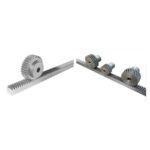
In CNC router systems, the accuracy and repeatability of motion axes are vital for machining quality. One of the primary mechanisms ensuring this accuracy, typically used on the X and Y axes, is the rack and pinion system. The rack is a straight toothed bar fixed to the chassis, while the pinion is a small gear attached to the shaft of a servo motor or step motor. The pinion rolls along the rack to provide linear motion. This system offers advantages in high speed and dynamic response. However, misalignment of the racks and rails on the chassis—meaning they are not parallel, not on the same plane, or outside assembly tolerances—causes a series of detrimental effects that fundamentally impact system performance. This misalignment is more than just an aesthetic flaw; it is a critical technical problem that directly weakens the machine’s mechanical integrity and machining capability. For instance, even a millimeter of deviation on one axis can result in geometric deviations far exceeding a millimeter on the workpiece.
Operating Principle and Technical Data
Rack and pinion systems are used in CNC routers to convert the motor’s rotational motion into precise linear motion. The rails (linear guide rails) ensure this linear motion occurs stably and the load is distributed evenly. In a perfect system, the pinion teeth should be in full contact with the rack teeth, with no excessive backlash or binding. The rails should support the weight of the moving gantry or axis, providing smooth and friction-free travel. Misalignment disrupts these fundamental principles.
When racks and rails are misaligned, the pinion teeth apply uneven pressure to the rack. This can lead to premature wear or even breakage of the teeth. The linear guides (blocks) on the rails, instead of distributing load evenly across the entire rail surface, experience excessive stress at specific points. This causes microscopic deformations, scratches, and eventual failure of the blocks and rails. As the machine moves, these irregular contacts generate vibrations. During cutting or machining, vibrations disrupt tool stability, reducing surface quality, compromising dimensional accuracy, and shortening tool life. Furthermore, friction between the pinion and rack increases, causing motors to draw more current than normal and overheat. In the long term, this can significantly reduce the lifespan of motor driver boards and the motors themselves. Increased friction and stress prevent the machine from reaching its maximum speed and negatively affect position repeatability, leading to inconsistent products in mass production. Such misalignments are unacceptable, especially in high-speed cutting or precision engraving applications.
| Parameter | Value/Description |
|---|---|
| Alignment Deviation Tolerance | Typically should be between 0.02 – 0.05 mm (20-50 microns) per axis. Exceeding this value leads to significant performance degradation. |
| Effect of Backlash | Misalignment can disrupt ideal backlash of 0.01 – 0.03 mm, increasing it beyond 0.1 mm, which amplifies positioning errors. |
| Friction Coefficient Increase | The friction coefficient, normally 0.05 – 0.1, can rise to 0.2 – 0.4 in cases of misalignment. |
| Motor Overload Rate | Misalignment can cause the motor to experience additional load exceeding 20-50% of its nominal torque, reducing motor life by 30-50%. |
| Position Repeatability Impact | Ideal repeatability of ±0.01 mm can drop to ±0.05 – ±0.1 mm with misalignment. |
| Surface Quality Degradation | While a smooth surface typically has a Ra (average roughness) of 0.8-1.6 µm, misalignment can increase this to 3.2 µm and above. |
| Rack/Rail Lifespan Reduction | Expected lifespan of 5-10 years can be reduced to 1-3 years due to misalignment. |
Field Considerations
- Periodic Checks and Visual Inspection: At the start of each shift or at regular intervals, check the rack and rail surfaces for signs of abnormal wear, burrs, discoloration, or lack of lubrication. Verify that the mounting bolts for racks and rails are tight. Pay attention to the consistency of the visual gap between the pinion and the rack.
- Assembly Precision and Calibration: When installing a new machine or during major overhauls, the assembly of racks and rails must be extremely precise. Using laser alignment devices, precision levels, and gauges, ensure the parallelism, flatness, and perpendicularity of all axes are adjusted to within hundredths of a millimeter. Post-assembly, perform “run-out” tests and positioning accuracy tests.
- Environmental Condition Management: Dust, chips, humidity, and temperature fluctuations in the operating environment directly affect the performance of rack and rail systems. Dust and chips degrade the lubrication film, accelerating wear. Humidity can cause corrosion. Temperature changes cause materials to expand and contract, disrupting alignment. Therefore, it is crucial for the machine’s environment to be clean, temperature-controlled, and free from humidity. Bellows and protective covers should be used.
- Proper Lubrication and Maintenance Schedules: Rack and rail systems must be regularly lubricated with the correct type of lubricant at the intervals specified by the manufacturer. Lubrication reduces friction, prevents wear, and provides protection against corrosion. Automatic lubrication systems offer significant convenience and consistency in this regard. Check that lubrication points are not clogged and that lubricant reaches all surfaces.
- Load Distribution and Mechanical Stresses: It is important that the load on the machine’s gantry or moving axes is evenly distributed. Heavy or unbalanced loads can cause localized stresses on the rails, leading to misalignment over time. Adhere to the maximum machining load limits appropriate for the machine design, and consider additional supports or different machining strategies for heavier workpieces.
Common Problems and Solutions
Rack and rail misalignment manifests in various ways in the field and can be resolved with accurate diagnosis:
- Problem: Decreased Machining Quality (Surface waviness, cutting marks, dimensional inconsistency): The machine fails to achieve the desired precision during cutting or machining, resulting in surface waviness, burrs on cut edges, or dimensional deviations.
Solution: First, perform an alignment check on all machine axes. Using laser alignment devices or precision gauges, inspect the parallelism of the racks to the rails and the contact surface of the pinions with the racks. If necessary, realign the racks or replace them if damaged. Also, inspect the rail blocks and rails for wear and replace them if needed. - Problem: Excessive Noise and Vibration During Operation: The machine produces loud noises or noticeable vibrations while moving or cutting.
Solution: This often indicates worn gears, insufficient lubrication, or significant misalignment. Check pinion and rack wear. Ensure proper lubrication is applied. Perform a full alignment check and adjust as necessary. Replace worn components. - Problem: Motor Overload and Overheating: Motors draw excessive current, leading to overheating and potential damage.
Solution: This is a direct consequence of increased friction due to misalignment or worn components. Check the alignment of the entire drive train. Ensure smooth movement of the axes without binding. Lubricate appropriately and replace any worn parts, such as the mechanical components, gears, or bearings. - Problem: Inconsistent Cutting Paths and Poor Part Fit: Machined parts do not fit together correctly, or the cutting path deviates from the programmed path.
Solution: This points to issues with positional accuracy, often caused by backlash or misalignment. Check and adjust the backlash on the pinion and rack. Perform a thorough alignment of the axes. Ensure the motion control system is functioning correctly and that encoder feedback is accurate.
Maintaining proper alignment of CNC router racks and rails is paramount for achieving high-quality results and ensuring the longevity of your industrial CNC router machine. Regular inspection, precise calibration, and diligent maintenance are key to preventing costly downtime and production errors. Investing in proper alignment and maintenance directly translates to improved efficiency and profitability.
If you are experiencing issues with your CNC router’s performance or suspect alignment problems, it’s crucial to address them promptly. Contact us for expert advice and solutions to keep your machinery operating at peak performance.
Ready to ensure your CNC router operates with maximum precision? Request a quote on WhatsApp today!
Related product categories: Sigma Profiles