
No products in the cart.
What Problems Does Stepper Motor Driver Current Ripple Cause in CNC Machines?

Contents
- Introduction and Technical Analysis In industrial automation systems, especially in applications requiring precise positioning and motion control, stepper motors play an indispensable role. One of the most critical factors directly affecting the performance of these motors is the quality of the current supplied by the motor driver. A significant phenomenon that degrades current quality and negatively impacts system performance is current ripple. Current ripple refers to the periodic rise and fall of the DC current applied to the stepper motor windings, deviating from ideal smoothness. These ripples typically originate from the PWM (Pulse Width Modulation) technique, which is the operating principle of the driver electronics, and can lead to a series of undesirable mechanical and electrical problems by affecting the motor’s magnetic field. In industrial automation environments, the effects of these ripples are critical in applications such as CNC machines, robotic arms, 3D printers, labeling machines, and optical alignment systems, where millimeter precision or micron-level repeatability is expected. This technical article and field guide will delve into the problems caused by stepper motor driver current ripple in machines, offering engineering approaches and practical solutions to provide a comprehensive roadmap for industrial automation professionals. Our goal is to identify this hidden yet impactful adversary, understand its effects, and enable proactive steps in system design and troubleshooting. Operating Principle and Technical Data
- Field Considerations
- Common Problems and Solutions
- Expert Advice
- FAQ
Introduction and Technical Analysis
In industrial automation systems, especially in applications requiring precise positioning and motion control, stepper motors play an indispensable role. One of the most critical factors directly affecting the performance of these motors is the quality of the current supplied by the motor driver. A significant phenomenon that degrades current quality and negatively impacts system performance is current ripple. Current ripple refers to the periodic rise and fall of the DC current applied to the stepper motor windings, deviating from ideal smoothness. These ripples typically originate from the PWM (Pulse Width Modulation) technique, which is the operating principle of the driver electronics, and can lead to a series of undesirable mechanical and electrical problems by affecting the motor’s magnetic field. In industrial automation environments, the effects of these ripples are critical in applications such as CNC machines, robotic arms, 3D printers, labeling machines, and optical alignment systems, where millimeter precision or micron-level repeatability is expected. This technical article and field guide will delve into the problems caused by stepper motor driver current ripple in machines, offering engineering approaches and practical solutions to provide a comprehensive roadmap for industrial automation professionals. Our goal is to identify this hidden yet impactful adversary, understand its effects, and enable proactive steps in system design and troubleshooting.
Operating Principle and Technical Data
Stepper motor drivers are electronic devices that control the current in motor windings to enable the motor to move step by step. The vast majority of modern stepper motor drivers use PWM (Pulse Width Modulation) based current chopper circuits to regulate the current applied to the motor windings. In this technique, a DC supply voltage is applied to the motor windings with high-frequency switching, and when the winding current reaches a certain reference value, the switching elements (typically MOSFETs) are turned off, allowing the current to drop. When the current falls to a certain lower limit, the switches are turned on again, and the current rises. This continuous on-off cycle creates an average current value in the motor windings, while also generating current ripple at a specific frequency and amplitude. This ripple depends on factors such as the inductance of the motor windings, the driver’s switching frequency, the supply voltage, and the target current value.
High inductance motors exhibit lower current ripple at the same switching frequency because they resist current change more. However, high inductance can also negatively affect the motor’s dynamic performance, especially its torque at high speeds. On the other hand, the higher the driver’s switching frequency, the shorter the period of the current ripple, and generally, the lower its amplitude. However, very high switching frequencies can increase power loss and thermal load in the driver. Microstepping technology adds intermediate steps between each full step by approximating the winding currents to sinusoidal or cosinusoidal waveforms, enabling smoother and more precise movement of stepper motors. However, the quality of these sinusoidal current waveforms, i.e., the deviation from the ideal sine curve, is directly affected by current ripple. High ripple can severely impact microstepping accuracy, thereby affecting the motor’s positioning accuracy and repeatability.
The effects of current ripple in a machine manifest in various ways. One of the most prominent effects is mechanical vibration and noise. The fluctuating current causes continuous changes in the motor’s magnetic field, leading to rotor vibration and an audible hum or buzzing sound. These vibrations can become more pronounced, especially at low speeds or speeds close to the motor’s resonant frequencies. In the long term, these vibrations can lead to wear and fatigue in machine components, loosening of bolts, and generally shorten the machine’s lifespan. Another significant problem is loss of positioning accuracy. In a stepper motor operating in microstepping mode, the size of each microstep deviates from the ideal due to the fluctuating current. This leads to cumulative positioning errors, especially over long travel distances or in applications requiring precise alignment. For example, the surface quality of a part machined on a CNC router machine or the accuracy in an optical alignment system can be directly affected. Furthermore, high current ripple causes additional heat generation in the motor windings. This extra heat reduces motor efficiency and can cause the motor to exceed its nominal operating temperature. Excessive heating can damage motor insulation, lead to demagnetization of magnets, and shorten the motor’s lifespan. Finally, ripple can also disrupt the motor’s torque stability and smooth motion. Fluctuating current causes instantaneous drops or increases in the torque produced by the motor, leading to jerky or rough movement, especially at low speeds or in applications requiring precise speed control. This can reduce product quality in applications where continuous and smooth motion is critical, such as printing machines, film winding machines, or material feeding systems.
| Parameter | Value/Description |
|---|---|
| Switching Frequency (PWM) | 20 kHz – 100 kHz (Higher frequency, lower ripple but increased driver loss) |
| Current Ripple Ratio (Peak-to-Peak) | 5% – 20% of nominal current (Ideally, below 5% is targeted) |
| Motor Winding Inductance | 1 mH – 50 mH (Higher inductance, lower ripple) |
| Driver Supply Voltage | 12 VDC – 80 VDC (Higher voltage, faster current rise, requires faster switching for constant ripple amplitude) |
| Microstep Resolution | 1/2 – 1/256 step (Higher resolution requires lower ripple tolerance) |
| Motor Operating Current | 0.5 A – 10 A (Ripple amplitude tends to increase with current) |
| Ambient Temperature | 0°C – 50°C (High temperatures exacerbate overheating problems caused by ripple) |
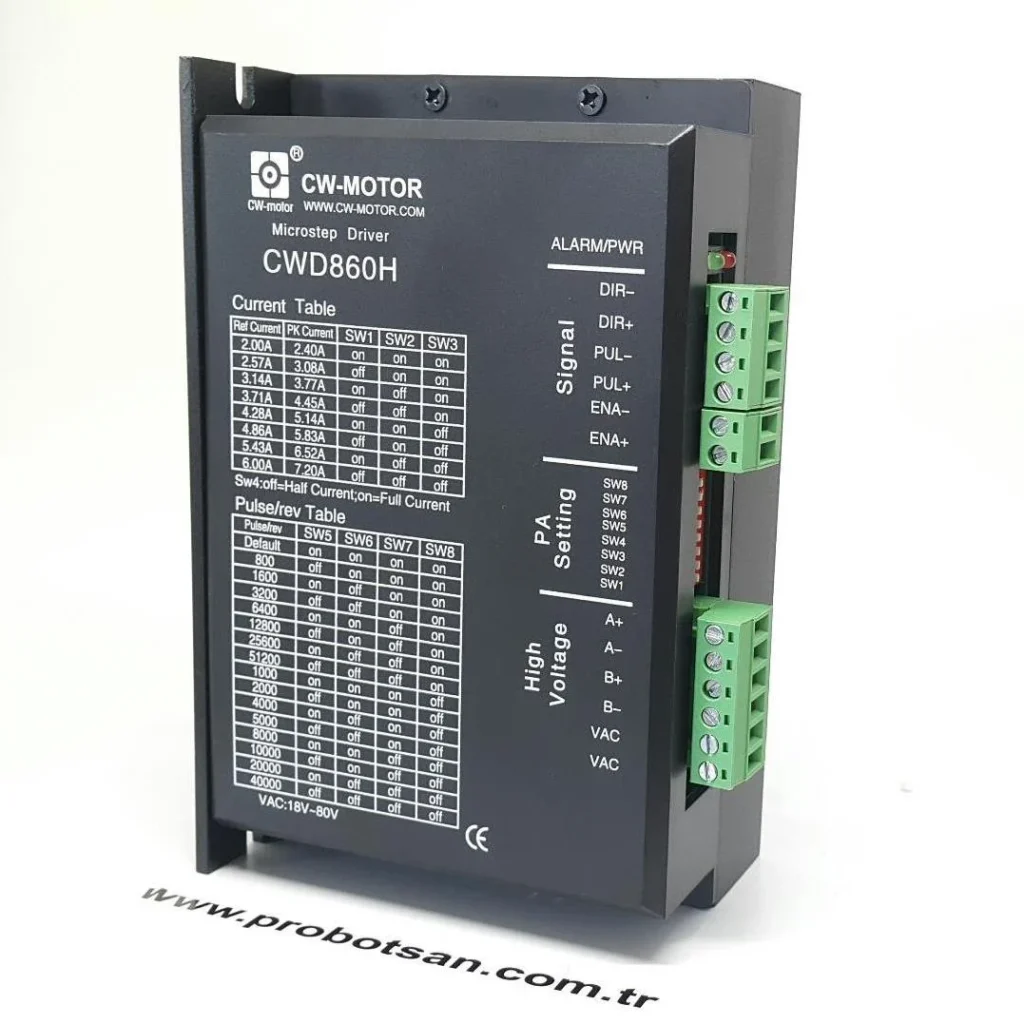
Field Considerations
- Driver and Motor Compatibility: Each stepper motor and driver combination must be compatible with specific electrical parameters for optimal performance. The driver’s switching frequency should be selected in direct proportion to the motor’s inductance and resistance. Lower switching frequencies may be tolerated for high-inductance motors, while low-inductance motors may require higher-frequency drivers. Meticulously checking manufacturer-recommended pairings is the first step to preventing unnecessary ripple.
- Power Supply Quality: The output voltage and current capacity of the power supply feeding the driver must meet the nominal values of the driver and motor. Low-quality or insufficient capacity power supplies can hinder stable driver operation and increase ripple. The power supply itself should have a low ripple factor at its output, which is vital for overall system stability. If necessary, additional filtering capacitors can be added to the power supply output.
- Cabling and Grounding: The quality of cabling between the motor and driver directly affects the impact of current ripple on the machine. Long, thin, or poorly shielded cables can increase inductive and capacitive interactions, disrupting signal integrity and causing electromagnetic interference (EMI). This can lead to distortions in control signals and, consequently, undesirable ripples in the motor current. Using thick, short, twisted-pair, and properly shielded cables, preventing ground loops, and ensuring proper grounding of the entire system are critically important.
- Driver Settings and Microstepping: Most modern stepper motor drivers allow adjustment of parameters such as current limits, microstepping resolution, and sometimes chopper frequency. Selecting the correct current limit according to application requirements ensures sufficient torque while preventing motor overheating. Choosing a very high microstepping resolution can increase positioning errors, especially in low-quality drivers or high-ripple systems. For the smoothest motion, the microstepping setting where the motor and driver perform best together should be determined experimentally.
- Resonance and Vibration Analysis: Stepper motors tend to resonate at certain speeds or step frequencies. Current ripple can trigger or exacerbate these resonance conditions. Identifying the system’s mechanical resonant frequencies and utilizing the driver’s “anti-resonance” or “vibration damping” features can minimize this problem. If necessary, resonant points can be shifted with mechanical dampers or inertia masses mounted on the motor.
- Thermal Management: The additional heat caused by current ripple makes thermal management of the motor and driver even more crucial. Providing adequate cooling (fans, heat sinks) extends the life of both the driver and the motor and maintains their performance. Appropriate cooling solutions should be designed considering ambient temperature and duty cycle.

Common Problems and Solutions
Problems caused by current ripple often manifest with similar symptoms, but the root cause can vary. Here are common problems and solution approaches:
- Problem: Motor overheating and efficiency loss.
Explanation: Fluctuating current in motor windings increases I²R losses, generating unnecessary heat. This can cause the motor to exceed its nominal temperature limits and reduce its performance. In the long term, it damages winding insulation and shortens motor life.
Solution: First, check if the driver current settings are appropriate for the motor’s nominal current value. If necessary, slightly reduce the current limit (but enough to meet torque requirements). If a lower inductance motor is used, consider switching to a driver with a higher switching frequency. Ensure adequate cooling (heat sinks, fans) is provided for the motor and driver. Reduce overall system ripple by using additional filtering capacitors at the power supply output.
- Problem: Audible noise and vibration in the machine.
Explanation: Fluctuating current leads to rapid changes in the motor’s magnetic field, causing the rotor to constantly move back and forth. This manifests as mechanical vibration and an annoying hum or buzzing sound, especially at low speeds or speeds close to the motor’s resonant frequencies.
Solution: Test and identify the motor’s resonant frequencies and avoid operating at these frequencies or change the speed profile. Improve motion smoothness by increasing the driver’s microstepping resolution (though this does not completely eliminate ripple). Enable anti-resonance or vibration damping features found in some drivers. Check mechanical connections for looseness and tighten if necessary. Consider using vibration-absorbing mounting elements (e.g., rubber isolators).
- Problem: Positioning errors and repeatability issues.
Explanation: Especially in microstepping mode, current ripple distorts the ideal sinusoidal current waveform, causing each microstep to be unequal. This leads to cumulative positioning errors over long movements or deviations in applications requiring precise positioning.
Solution: Evaluate using higher-quality, low-ripple drivers. Try to reduce ripple amplitude by increasing the driver’s switching frequency. Reduce the microstepping resolution to the minimum accuracy required by the application to lessen the driver’s workload. Minimize cable length between the motor and driver and use shielded cables to reduce the effect of external interference. In feedback systems (e.g., encoder-equipped stepper motors), adjust the control loop to compensate for the effects of current ripple.
- Problem: “Stuttering” or rough motion at low speeds.
Explanation: Current ripple causes instantaneous drops and rises in the torque produced by the motor, disrupting the smoothness of motor movement, especially at low speeds. This can reduce product quality in critical applications such as print quality or material feeding accuracy.
Solution: Optimize the driver’s microstepping setting. Higher microstepping resolutions generally provide smoother motion, but as mentioned above, they can increase the ripple effect. Consider using drivers with advanced control algorithms (e.g., adaptive chopper algorithms) that provide more stable current control at low speeds. Check the cabling between the motor and driver, repair or replace loose connections or faulty cables.
Expert Advice
Stepper motor driver current ripple is a critical factor in industrial automation systems that is often overlooked but has profound and varied negative effects on machine performance. These ripples can lead to a wide spectrum of problems, from simple mechanical noise to precise positioning errors, from shortening motor life to decreasing energy efficiency. Therefore, adopting a proactive approach to current ripple in the design and operation of an automation system is essential. From an expert perspective, the root of these problems often lies in not treating the system as a whole. It is not enough to simply select the best-performing motor and driver components separately; their interaction with each other and with the power supply, cabling quality, mechanical mounting, and environmental factors are just as important as component selection. Our field experience has shown that many “unsolvable” positioning errors or overheating problems stem from a lack of current ripple management, which is the weakest link in the system. Therefore, engineers and technicians need to pay special attention to this issue not only when a fault occurs but also from the design stage. Selecting high-quality drivers with advanced algorithms, preferring drivers suitable for motor inductance, being meticulous in power supply selection, implementing correct and shielded cabling techniques, and performing regular thermal analyses are key to minimizing the effects of ripple. It should be remembered that in industrial automation, every millisecond and every micron matters. Controlling current ripple not only solves problems but also extends machine life, reduces maintenance costs, increases energy efficiency, and most importantly, enhances the quality of the manufactured product and the overall reliability of the system. This comprehensive approach is an indispensable strategy for sustainable success in a competitive industrial environment.
FAQ
What is current ripple in stepper motor drivers?
Current ripple in stepper motor drivers is the periodic fluctuation of the DC current supplied to the motor windings, deviating from a smooth, ideal waveform. It is typically caused by the Pulse Width Modulation (PWM) technique used in most modern drivers to regulate current.
What are the main problems caused by current ripple in CNC machines?
Current ripple can lead to several issues, including increased mechanical vibration and noise, loss of positioning accuracy and repeatability, excessive motor overheating and reduced efficiency, and rough or jerky motion, especially at low speeds. These problems can degrade product quality and shorten machine lifespan.
What technical factors influence the severity of current ripple?
Key factors include the motor's winding inductance, the driver's switching frequency, the supply voltage, and the target current value. Higher inductance generally leads to lower ripple, while higher switching frequencies typically result in shorter ripple periods and lower amplitudes.
How can current ripple be minimized in industrial CNC applications?
To mitigate current ripple, ensure proper driver-motor compatibility, use a high-quality power supply with low ripple, implement robust and shielded cabling, optimize driver settings (e.g., microstepping resolution), address mechanical resonance, and provide adequate thermal management for both the motor and driver.
My stepper motor is overheating. Could current ripple be the cause, and what should I do?
If your stepper motor is overheating, check if the driver current settings match the motor's nominal current. Consider reducing the current limit if possible, or use a driver with a higher switching frequency for lower inductance motors. Ensure sufficient cooling with heat sinks and fans, and add filtering capacitors to the power supply if needed.