
No products in the cart.
Why Do Cheap Stepper Motor Drivers Miss Steps?

Contents
- Introduction and Technical Analysis As indispensable components of industrial automation, stepper motors play a pivotal role in numerous applications requiring precise positioning, speed control, and repeatability. Used across a wide spectrum from CNC machines and robotic systems to 3D printers and medical devices, the performance of these motors largely depends on the quality and capabilities of their associated driver boards. However, the increasing availability of cheap stepper motor driver solutions in the market, while offering attractive initial cost advantages, often brings significant operational problems, particularly the issue of step loss. Step loss means the motor fails to reach its target position or deviates from its expected path during movement. This can lead to a decline in production quality, material waste, system downtime, and substantial financial losses in the long run. This technical article and field guide will meticulously analyze why cheap stepper motor drivers miss steps, explain the fundamental technical reasons, and offer practical solutions for industrial automation professionals. Our objective is to highlight the potential risks of cost-driven choices and emphasize the importance of selecting the right driver for system reliability and performance. Operating Principle and Technical Data
- Field Considerations
- Common Problems and Solutions
- Expert Advice
- FAQ
Introduction and Technical Analysis
As indispensable components of industrial automation, stepper motors play a pivotal role in numerous applications requiring precise positioning, speed control, and repeatability. Used across a wide spectrum from CNC machines and robotic systems to 3D printers and medical devices, the performance of these motors largely depends on the quality and capabilities of their associated driver boards. However, the increasing availability of cheap stepper motor driver solutions in the market, while offering attractive initial cost advantages, often brings significant operational problems, particularly the issue of step loss. Step loss means the motor fails to reach its target position or deviates from its expected path during movement. This can lead to a decline in production quality, material waste, system downtime, and substantial financial losses in the long run. This technical article and field guide will meticulously analyze why cheap stepper motor drivers miss steps, explain the fundamental technical reasons, and offer practical solutions for industrial automation professionals. Our objective is to highlight the potential risks of cost-driven choices and emphasize the importance of selecting the right driver for system reliability and performance.
Operating Principle and Technical Data
Stepper motors are brushless DC motors that rotate in discrete angular steps when pulsed current signals are applied to their coils. Each step of a stepper motor is achieved by sequentially changing the magnetic field in the stator coils. This sequential change locks the motor’s rotor into a specific angular position. The motor’s precision is determined by the number of steps per revolution (typically 200 steps/revolution or 1.8 degrees/step). However, maintaining this precision and ensuring the motor accurately executes each commanded step largely depends on the driver’s capability. The stepper motor driver acts as an electronic bridge, receiving step (STEP) and direction (DIR) signals from a controller (e.g., PLC, microcontroller) and sending the appropriate current pulses to the motor coils. The driver’s main tasks include applying current to the motor phases in the correct sequence, precisely regulating the current in the motor coils (constant current control), and providing smoother, more accurate motion through microstepping capability.
The underlying technical limitations and deficiencies that cause cheap stepper motor drivers to miss steps can generally be examined under the following main headings:
1. Insufficient Current Regulation and Ripple: The torque of stepper motors is directly proportional to the magnitude of the current flowing through their coils. High-performance drivers regulate the current in the motor coils with extreme precision (typically using PWM-based constant current control). In cheap drivers, however, current sensing circuits and feedback loops are often simpler and slower. This leads to high current ripple. Current ripple causes instability in the magnetic field within the motor coils, preventing the motor from generating sufficient torque at each step. Especially when the motor operates at high speeds or under heavy loads, these instabilities force the motor to attempt the next step before completing the current one, resulting in step loss.
2. Low Switching Frequency and Latency: Constant current control requires switching transistors (typically MOSFETs) to turn on and off at high frequencies to maintain the current sent to the motor coils at a specific level. In cheap drivers, due to lower quality components or cost constraints, the switching frequency may be kept low. A low switching frequency results in slower and less precise current regulation. Furthermore, signal processing and switching delays (propagation delays) in these drivers can lead to synchronization issues between the step signals from the controller and the current pulses applied to the motor coils. These delays become critical, especially at high step frequencies, preventing the formation of a sufficient magnetic field for the motor to advance to the next step, thus causing step loss.
3. Faulty Microstepping Implementation: Microstepping is a technique that divides the motor’s full steps into smaller increments, providing smoother motion and higher resolution. This is achieved by applying a sinusoidal current distribution to the two phase coils. In cheap drivers, this sinusoidal current distribution is often implemented with less accuracy or a simplified approach. Incorrect ratios between phase currents or inadequate current regulation prevent the motor from producing equal torque at each microstep. This leads to vibrations, positioning errors, and “virtual” step losses (meaning the motor does not physically skip a step but deviates from the target position). Such deviations are unacceptable in precision applications.
4. Inadequate Thermal Management and Cooling: Stepper motor drivers generate heat in their power switching elements (MOSFETs) while supplying current to the motor coils. Cheap drivers often use insufficient cooling solutions (small heatsinks, poor PCB design) or less efficient power components. Excessive heating degrades the performance of the driver chip; internal thermal protection mechanisms typically slow down or completely shut down the circuit. This causes the motor current to drop, leading to torque loss and consequently step loss or complete driver shutdown. Prolonged overheating also significantly shortens the driver’s lifespan.
5. Noise Immunity and EMI/RFI Sensitivity: Industrial environments are filled with significant electromagnetic interference (EMI) and radio frequency interference (RFI) from motors, power supplies, and other electronic devices. Quality drivers offer high immunity to such noise through internal filtering, proper PCB layout, and shielding. In cheap drivers, these protection mechanisms are often absent or inadequate. Noise can corrupt the driver’s control signals (STEP/DIR), affect internal logic circuits, or lead to incorrect current sensing. These situations can cause the motor to make unexpected movements, experience random step losses, or completely freeze.
6. Lack of Protection Mechanisms: Industrial-grade drivers typically feature comprehensive protection mechanisms for conditions such as overcurrent, overvoltage, undervoltage, overtemperature, and short circuits. These protections safeguard the driver and the connected motor from potential failures while ensuring safe and stable system operation. In cheap drivers, these protection circuits are either missing or very basic. The lack of protection can easily lead to driver failure, motor damage, or unpredictable system behavior, increasing the likelihood of problems like step loss.
The combination of these technical limitations prevents cheap stepper motor drivers from delivering reliable performance, especially in dynamic, high-speed, or loaded applications. The initial cost advantage can, over time, translate into a much higher total cost of ownership (TCO) due to increased maintenance, repairs, production losses, and system downtime.
| Parameter | Value/Description |
|---|---|
| Current Regulation Accuracy | ±5% – ±15% (Cheap Drivers), ±1% – ±3% (Industrial Drivers). High accuracy ensures stable torque. |
| Microstepping Precision | Typically 1/16 or 1/32. Effective precision decreases in cheap drivers due to distorted current distribution. Industrial drivers offer precise and linear current distribution up to 1/256. |
| Switching Frequency | 15 kHz – 30 kHz (Cheap Drivers). 40 kHz – 200 kHz (Industrial Drivers). Higher frequency means smoother current and less noise. |
| Thermal Management | Small or inadequate heatsink, simple PCB heat dissipation (Cheap Drivers). Large integrated heatsink, multi-layer PCB, thermal shutdown protection (Industrial Drivers). |
| Noise Immunity (EMI/RFI) | Low, may require external filtering. High risk of interference on signal lines (Cheap Drivers). High, reinforced structure with internal filtering and shielding (Industrial Drivers). |
| Protection Features | Usually only basic overcurrent or none (Cheap Drivers). Overcurrent, overvoltage, undervoltage, overtemperature, short circuit protections (Industrial Drivers). |
| Supported Motor Inductance | Must be checked according to manufacturer datasheet. Cheap drivers generally perform optimally within a narrower inductance range. |

Field Considerations
- Motor and Driver Matching: Every stepper motor has specific nominal current, voltage, and inductance values. The driver selection must be fully compatible with these electrical characteristics of the motor. Ideally, the maximum current the driver can supply should be equal to or slightly above the motor’s nominal current. Otherwise, the motor cannot produce sufficient torque and will miss steps. The driver’s voltage range must also match the power supply voltage.
- Power Supply Quality and Capacity: The power supply unit (PSU) used for the stepper motor driver is critically important; it must be capable of providing sufficient current, be stable, and have a low ripple output. An inadequate power supply prevents the driver from delivering the necessary current to the motor coils, leading to torque loss and step loss. The power supply must have the capacity to handle instantaneous current draws and prevent voltage drops.
- Cabling and Grounding Standards: The quality, length, and shielding of power and signal cables between the motor and driver make a significant difference in terms of electromagnetic interference (EMI) and radio frequency interference (RFI). Using shielded cables and properly grounding the shield prevents external noise from affecting sensitive signal lines. Routing signal and power cables through separate channels also helps minimize interference. Incorrect or low-quality cabling can degrade signal integrity, causing step loss.
- Mechanical Load and Speed Profile Optimization: The mechanical load on the stepper motor must not exceed the torque produced by the motor. Acceleration and deceleration ramps required by the application should be set considering the motor’s torque curve. Sudden accelerations or overloading can prevent the motor from overcoming its inertia, leading to step loss. Selecting the correct motor size for the application and using appropriate mechanical reduction systems can mitigate this problem.
- Thermal Management and Cooling Solutions: Excessive heating of the driver and motor leads to performance degradation and failures. Especially during high-current or prolonged operations, ensure that the driver and motor are adequately cooled with sufficient airflow. If necessary, additional heatsinks or fans should be used. Reaching the driver’s thermal protection thresholds will result in current reduction and step loss.
- Resonance Control and Damping: Stepper motors tend to vibrate at certain speeds (resonance frequencies). These resonances can reduce motor torque, causing step loss. While quality drivers include resonance damping algorithms, these features are often absent in cheap drivers. In practice, the speed profile can be adjusted to avoid resonance points, or mechanical damping elements can be used.
- Noise Filtering and Signal Integrity: To reduce electrical noise in industrial environments, ferrite beads or RC filters can be added to control signal lines. Ensure that the driver’s input signals (STEP, DIR, ENABLE) are clean and stable. Using opto-isolators in communication between the control board and the driver can significantly reduce noise-related issues.
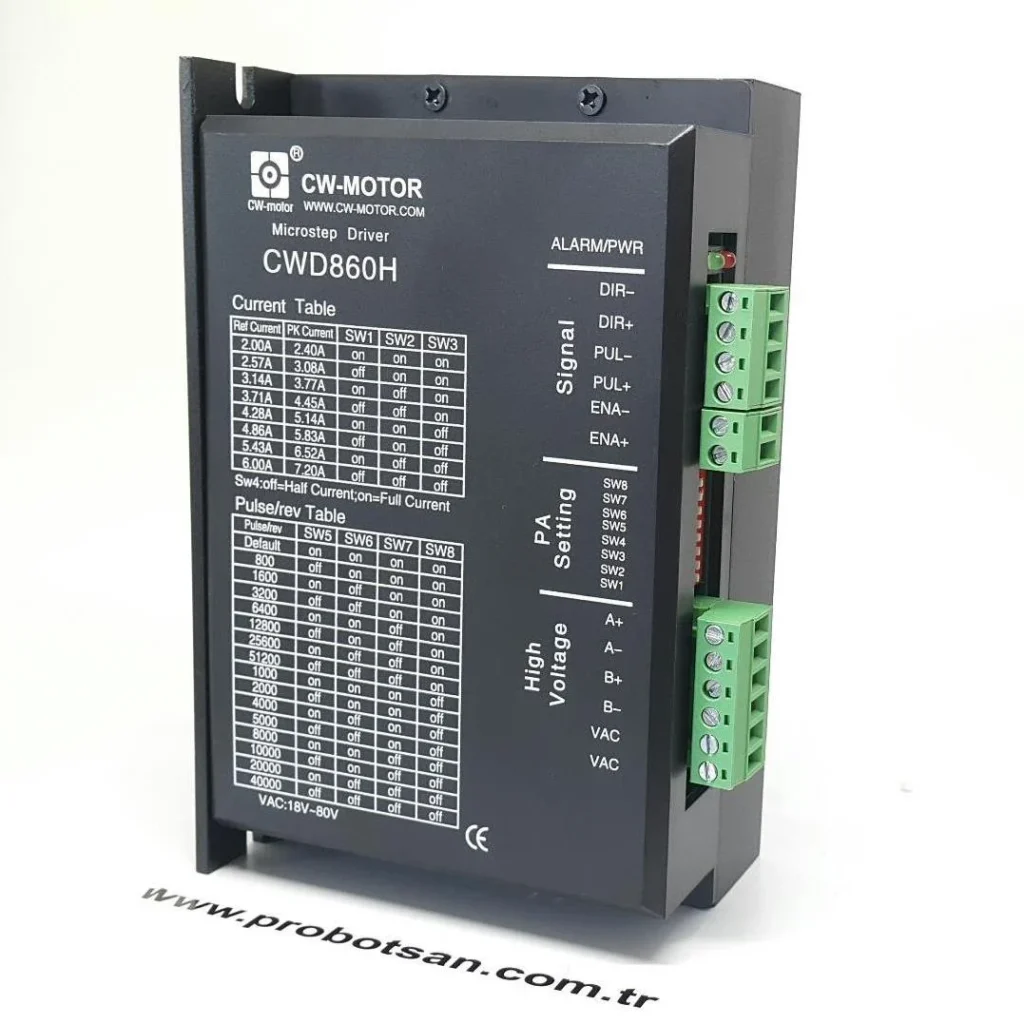
Common Problems and Solutions
Step Loss:
- Problem: The motor fails to reach the target position, cannot cover a specific distance, or loses its position during movement. This typically occurs during rapid movements, under heavy loads, or during sudden accelerations.
- Solution:
- Check Current Setting: Ensure the driver’s current setting is appropriate and sufficient for the motor’s nominal current. If necessary, slightly increase the current (within the thermal limits of the motor and driver).
- Verify Power Supply: Check that the power supply’s voltage is stable and has sufficient current capacity. Inadequate or fluctuating power supply leads to current problems.
- Reduce Mechanical Load: If possible, reduce the mechanical load on the motor or consider upgrading to a larger, higher-torque motor/driver combination.
- Slow Down Acceleration/Deceleration Ramps: Increase the acceleration and deceleration times in the controller to allow the motor to move more smoothly. This gives the motor more time to overcome its inertia.
- Review Microstepping Settings: Very high microstepping values (e.g., 1/256) can be inefficient in some cheap drivers. Experiment with lower microstepping (e.g., 1/8 or 1/16) to achieve more stable motion.
- Evaluate Driver Quality: If the above steps do not resolve the issue, it is highly likely that the driver itself has insufficient performance. It may be necessary to switch to a higher-quality, industrial-grade driver.
Vibration and Noise:
- Problem: The motor vibrates excessively, makes loud noises, or moves roughly during operation.
- Solution:
- Check Microstepping Settings: Insufficient microstepping or faulty current distribution can cause vibration. Try a higher microstepping setting or check the driver’s microstepping accuracy.
- Avoid Resonance Points: Prevent the motor from operating at its resonance speeds. Adjust speed profiles or use the driver’s resonance damping features to avoid these speeds.
- Review Mechanical Mounting: Ensure the motor and driver are mounted on a solid surface and that mechanical connections are not loose. Loose connections increase vibration.
- Driver Replacement: Quality drivers provide smoother and quieter operation thanks to resonance damping and more precise current control.
Overheating:
- Problem: The driver or motor overheats more than usual, becoming too hot to touch. This can lead to performance degradation and failure.
- Solution:
- Reduce Current Setting: If the motor provides sufficient torque, try slightly reducing the driver’s output current. This will reduce heat generation. However, reducing it too much can cause step loss.
- Increase Cooling: Ensure adequate airflow for the driver and motor. If necessary, install an additional fan or a larger heatsink. Open ventilation holes in systems operating within an enclosed box.
- Check Driver Capacity: Ensure the driver has adequate capacity for the motor’s nominal current. Overheating is inevitable if the driver is constantly forced to operate above its maximum capacity.
- Lower Ambient Temperature: Check the operating environment’s temperature. High ambient temperatures reduce the cooling efficiency of the driver and motor.
Random Errors/Stalls:
- Problem: The system unexpectedly stops, makes incorrect movements, or reports errors at intervals.
- Solution:
- Investigate EMI/RFI Sources: Identify potential sources of electromagnetic interference such as nearby power supplies, inverters, relays, or other motors. Keep these sources away from the driver and signal cables.
- Check and Improve Cabling: Ensure all cables are robust, shielded, and properly grounded. Separate signal and power cables. Identify and fix broken or loose cables.
- Strengthen Grounding: Ensure the entire system (controller, driver, motor, power supply) is properly and reliably grounded. Poor grounding exacerbates noise problems.
- Examine Driver Protection Features: Lack of protection in cheap drivers can cause the driver to fail during a small voltage fluctuation or current spike. Consider using a driver with more advanced protection features.
- Add Filters to Signal Lines: Reduce noise by adding ferrite beads or RC filters to control signal lines (STEP, DIR).
Expert Advice
In industrial automation applications, the selection of a stepper motor driver should not be viewed merely as a cost item but rather as a critical investment for the system’s overall performance, reliability, and longevity. The initial low cost of cheap stepper motor drivers often comes with technical limitations such as insufficient current regulation, faulty microstepping, low switching frequency, poor thermal management, inadequate noise immunity, and missing protection mechanisms. These limitations inevitably lead to serious operational problems like step loss, vibration, overheating, and random system errors, especially in high-speed, heavy-load, or precision positioning applications.
Our field experience shows that step loss problems caused by cheap drivers increase scrap rates in production, extend machine downtime, raise maintenance costs, and ultimately negatively impact businesses’ efficiency and profitability. Short-term cost savings often turn into much higher total costs of ownership (TCO) in the long run. Therefore, when selecting a stepper motor driver, it is essential to consider the performance, precision, reliability, and environmental conditions required by the application, rather than just focusing on the price tag.
As expert advice, you should always choose an industrial-grade driver that perfectly matches your motor’s nominal current and voltage values, and ideally has a slightly higher capacity. Carefully examine the driver’s technical datasheet to evaluate critical parameters such as current regulation accuracy, microstepping precision, switching frequency, thermal management features, and internal protection mechanisms. Especially when operating in noisy industrial environments, investing in drivers with high noise immunity, good shielding, and isolation will prevent many future problems. The same care should be given to environmental factors such as the correct power supply, quality cabling, and effective thermal management. Remember that the reliable and precise operation of your stepper motors, which are the heart of your automation systems, begins with the right driver selection, and this choice is one of the most important factors directly affecting the success of your project.
FAQ
What is step loss in stepper motors?
Step loss occurs when a stepper motor fails to reach its commanded position or deviates from its intended path. This is often due to insufficient torque, excessive load, high speeds, or issues with the driver's current regulation or microstepping accuracy. It leads to positioning errors and reduced precision in industrial applications.
Why do cheap stepper motor drivers commonly miss steps?
Cheap stepper motor drivers often suffer from poor current regulation, low switching frequencies, inaccurate microstepping, inadequate thermal management, and weak noise immunity. These deficiencies prevent the motor from generating consistent torque, especially under dynamic loads or high speeds, leading to missed steps.
How can step loss be prevented in industrial stepper motor applications?
To prevent step loss, ensure proper motor-driver matching, use a stable and adequately sized power supply, employ high-quality shielded cabling, optimize mechanical load and speed profiles, and provide effective thermal management. For critical applications, invest in industrial-grade drivers with advanced features like resonance damping and robust protection mechanisms.
How do current regulation and switching frequency affect step loss?
Inadequate current regulation causes current ripple, leading to unstable magnetic fields and insufficient torque. Low switching frequencies result in slower and less precise current control, causing synchronization issues. Both factors directly contribute to the motor's inability to hold position or complete steps accurately, especially at higher speeds.
What role does microstepping play in step loss with inexpensive drivers?
Poor microstepping implementation in cheap drivers can lead to uneven torque distribution across microsteps, causing vibrations and positioning inaccuracies. While the motor might not physically skip a full step, it deviates from the intended microstep position, resulting in 'virtual' step loss and reduced overall precision.