
No products in the cart.
Step Motor vs. Servo Motor for CNC Routers: A Technical Analysis

Contents
- Introduction and Technical Analysis As indispensable components of industrial automation and the manufacturing sector, CNC router machine systems today are capable of processing a wide variety of materials such as wood, metal, plastic, and composites with high precision. One of the most critical components directly affecting the performance, precision, and final product quality of these machines is the motor technology that provides axis movements. For motion control in CNC router systems, two main motor types are primarily preferred: step motors (stepper motors) and servo motors (servomotors). This technical article and field guide aims to assist industrial automation professionals, engineers, and manufacturers in making the right choice by providing an in-depth analysis of these two motor technologies. Both motor types have their unique advantages, disadvantages, and ideal application scenarios. The correct motor selection will significantly impact not only the initial investment cost but also operating costs, production efficiency, machining quality, and the overall lifespan of the system. This guide aims to provide readers with comprehensive knowledge, covering everything from the operating principles of motors to their technical specifications, application details in the field, and common issues encountered. Operating Principles and Technical Data
- Step Motors
- Servo Motors
- Field Considerations
- Common Problems and Solutions
- For Step Motors
- For Servo Motors
- Expert Advice
- FAQ
Introduction and Technical Analysis
As indispensable components of industrial automation and the manufacturing sector, CNC router machine systems today are capable of processing a wide variety of materials such as wood, metal, plastic, and composites with high precision. One of the most critical components directly affecting the performance, precision, and final product quality of these machines is the motor technology that provides axis movements. For motion control in CNC router systems, two main motor types are primarily preferred: step motors (stepper motors) and servo motors (servomotors). This technical article and field guide aims to assist industrial automation professionals, engineers, and manufacturers in making the right choice by providing an in-depth analysis of these two motor technologies. Both motor types have their unique advantages, disadvantages, and ideal application scenarios. The correct motor selection will significantly impact not only the initial investment cost but also operating costs, production efficiency, machining quality, and the overall lifespan of the system. This guide aims to provide readers with comprehensive knowledge, covering everything from the operating principles of motors to their technical specifications, application details in the field, and common issues encountered.
Operating Principles and Technical Data
Precise motion control in CNC router systems is vital for machining quality and efficiency. In this context, step and servo motors operate on different principles, offering distinct advantages.

Step Motors
Step motors are brushless DC motors that convert electrical pulses into mechanical rotational motion. As the name suggests, these motors operate by dividing a full rotation into a specific number of “steps.” Each electrical pulse rotates the motor’s rotor by a precise angle (e.g., 1.8 degrees). This allows for precise control of the motor’s position using an open-loop control system, meaning without any feedback sensor like an encoder. The drive knows how much the motor should rotate based on the number of pulses sent and relies on this information to determine the position. Step motors are particularly effective at providing high holding torque at low speeds. This characteristic allows them to maintain their position against unexpected load changes during machining. Thanks to micro-stepping technology, each step can be divided into smaller sub-steps, achieving smoother motion and higher precision. Their installation and programming are relatively simpler, and they are generally more cost-effective. However, their torque tends to decrease at high speeds, and they carry the risk of lost steps under excessive load, which can negatively affect machining precision. Additionally, resonance and vibration issues can occur at certain speeds, and they tend to heat up more due to continuous high current draw.

Servo Motors
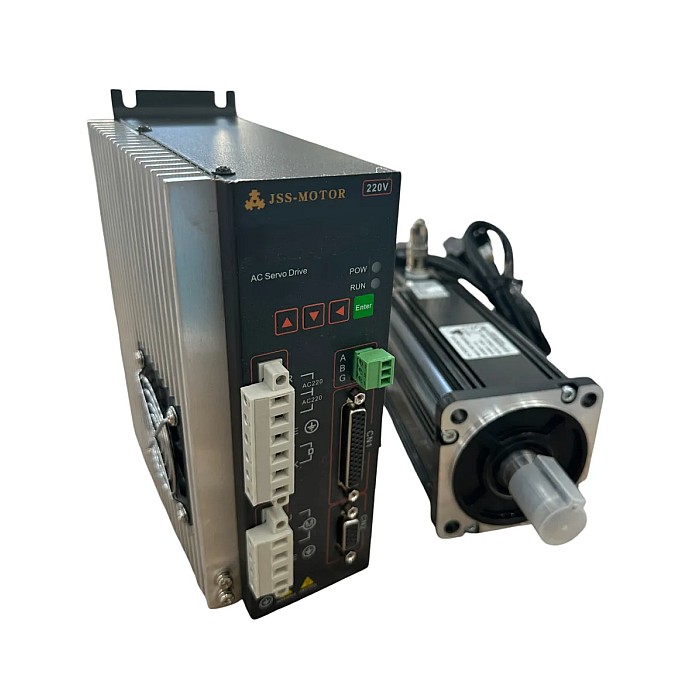
Servo motors are motors that operate on a closed-loop control principle, capable of being powered by DC or AC. A servo system consists of a motor, an encoder (feedback sensor), and a servo drive (controller). The encoder provides continuous feedback about the motor’s current position and speed. The servo drive compares this feedback with the reference signal (desired position/speed) and continuously adjusts the motor using a PID (Proportional-Integral-Derivative) control algorithm to minimize the difference (error signal). Thanks to this closed-loop control, servo motors offer very high precision, dynamic response, and repeatability. They can maintain their torque even at high speeds and have the ability to correct their position even under excessive load, eliminating the risk of lost steps. Acceleration and deceleration times are quite short, which reduces cycle times and increases production efficiency. Their energy efficiency is generally higher than step motors because they only draw current when needed. However, servo systems are more complex, have higher initial investment costs, and require precise tuning for optimal performance. If incorrectly tuned, issues such as overshoot or oscillation can occur. They are ideal for large, industrial-type CNC routers, robotic applications, and high-speed, high-precision automation systems.
Motor selection for a CNC router application depends on many factors, including the type of material to be processed, desired machining speed, precision expectations, budget, and the operator’s technical proficiency. For example, step motors may be sufficient for small CNC machines used for hobby purposes or processing light materials, while servo motors are indispensable for industrial routers that process materials like metal or hardwood with high speed and precision. The dynamic torque response of servo motors allows them to adapt better to sudden changes in cutting forces, while the holding torque of step motors is advantageous for maintaining position under static loads. The correct selection of both motor types will directly affect the overall performance of the CNC router and the return on investment.
| Parameter | Step Motors | Servo Motors |
|---|---|---|
| Control Type | Open-Loop | Closed-Loop |
| Feedback Sensor | Generally None | Encoder (Position and Speed) |
| Speed Range | Low-Medium (Typically below 1000 RPM) | Low-High (Typically above 5000 RPM) |
| Torque Characteristic | High at low speed, decreases at high speed. High holding torque. | Constant high torque over a wide speed range. High dynamic torque. |
| Precision and Repeatability | Good (Can be increased with micro-stepping), but risk of lost steps. | Very High (Error correction thanks to feedback). |
| Cost (Motor + Drive) | Low-Medium | Medium-High |
| Complexity and Installation | Simple | Complex, requires tuning. |
| Energy Efficiency | Lower (Tendency to draw continuous current) | Higher (Draws current only when needed) |
| Resonance/Vibration | Resonance issues can occur at certain speeds. | Generally smoother motion, lower risk of resonance. |
| Overload Capacity | Limited (Risk of lost steps) | High (Can meet load with instantaneous torque increase) |
| Maintenance Needs | Low | Low (But may require tuning and diagnostic knowledge) |

Field Considerations
- Application Requirements and Material Type: The hardness, density, and cutting force requirements of the material to be processed directly influence motor selection. For soft materials like wood, plastic, or foam, step motors are generally sufficient, while for metals like aluminum, brass, or hardwoods, servo motors offering high torque and dynamic response should be preferred. The expected surface quality of the material is also important; the precision of servo motors is more advantageous for smooth surfaces.
- Precision and Repeatability: The tolerances and repeatability expectations of the manufactured parts are critical factors. For applications requiring micron-level precision, such as mold making or precision part production, feedback-controlled servo systems are indispensable. For more general-purpose applications where tolerances can be in the range of tenths of a millimeter, step motors may be suitable.
- Speed and Efficiency: Production volume and cycle times play a significant role in motor selection. For high-volume production environments requiring high-speed cuts, fast traverse speeds, and short cycle times, the dynamic performance and high-speed torque of servo motors provide an advantage. For low-volume productions or situations where time is less critical, step motors can offer an economical solution.
- Cost and Budget: Initial investment cost is one of the most important factors determining the project budget. Step motor systems are generally 30% to 60% more cost-effective than servo systems. However, considering operating costs (energy consumption, maintenance, downtime) and production efficiency, there are situations where servo motors can be more economical in the long run. When evaluating the budget, it is necessary to consider not only the cost of the motor and drive but also installation, tuning, and potential troubleshooting costs.
- Ease of Installation and Maintenance: Step motor systems are easier to install and maintain due to fewer components and generally operating on a “plug-and-play” principle. Servo systems, on the other hand, may require encoder connections, PID tuning, and more complex diagnostics. The level of in-house technical knowledge and experience is an important determinant in this regard.
- Environmental Conditions: The levels of dust, humidity, temperature, and electrical noise in the environment where the CNC router will operate can affect motor and drive selection. Servo drives, in particular, can be more sensitive to electrical interference, while step motors may require good cooling due to their tendency to overheat.
- System Integration and Controller Compatibility: The existing or selected CNC control board (e.g., Mach3, LinuxCNC, GRBL-based boards, or industrial controllers) must be compatible with both step and servo motor drives. Some controllers support specific protocols (e.g., Pulse/Dir, EtherCAT, Modbus), and this compatibility should be considered in motor selection.

Common Problems and Solutions
Both motor types have their potential issues, and knowing them speeds up troubleshooting processes and ensures uninterrupted system operation.
For Step Motors
- Lost Steps: This is the most common problem with step motors. It occurs when the motor cannot handle the mechanical load, is attempted to be moved too fast, has insufficient current settings, or due to mechanical friction, the motor cannot follow the pulses sent. As a result, dimensional errors or shifts occur in the processed part.
- Solution: Correctly setting the motor current (usually according to manufacturer recommendations), using a higher torque motor, reducing acceleration/deceleration ramps, using micro-stepping, reducing mechanical friction, and optimizing machining parameters to prevent overloading. If necessary, consider switching to closed-loop stepper motors or servo motors.
- Resonance and Vibration: Step motors can enter resonance at certain speeds or frequencies, causing excessive vibration and noise. This can reduce motor torque and damage mechanical components.
- Solution: Using micro-stepping (reduces vibration), using vibration-damping couplings or mounting elements, adjusting speed profiles to avoid resonance frequencies, or trying the motor with a different drive.
- Overheating: Step motors can overheat, especially when operating at high current for extended periods or under inadequate cooling conditions. This shortens motor life and degrades performance.
- Solution: Optimizing the current setting in the drive (avoiding unnecessarily high current), adding heat sinks or fans to the motor, ensuring the motor operates within its nominal temperature range. Some drives have a feature to automatically reduce current when the motor is stopped.
For Servo Motors
- Overshoot and Oscillation: Servo motors can exhibit a tendency to overshoot the target position and return (overshoot) or continuously move back and forth around the target (oscillation) when reaching the desired position. This is caused by incorrect PID gain settings or insufficient rigidity of the mechanical system.
- Solution: Correctly tuning the PID (Proportional, Integral, Derivative) gains of the servo drive. Most modern servo drives have an auto-tuning feature, but sometimes manual fine-tuning may be required. Eliminating backlash in the mechanical system and increasing rigidity also helps reduce oscillation.
- Error Codes and Alarm States: Servo systems may display error codes or alarm states on the drive in situations such as wiring errors, encoder failures, overcurrent, overvoltage, or overload.
- Solution: Checking the error code table in the drive’s user manual to identify the source of the problem. Checking cable connections (power, encoder, control signals), ensuring the motor is not mechanically jammed. Testing that the encoder is working correctly. If necessary, seek support from a specialist technician.
- Noise: Although servo motors generally operate quietly, they can sometimes produce a high-frequency sound or mechanical noise. This can be caused by incorrect drive settings, mechanical incompatibilities, or a fault in the motor itself.
- Solution: Adjusting the switching frequency of the servo drive (if available), ensuring motor connections and mounting are secure, checking bearings or other mechanical components. If necessary, testing the motor or drive.
Expert Advice
The selection of a step motor or servo motor for CNC router systems is a highly critical and application-specific decision where a “one-size-fits-all” approach is definitely not applicable. As an experienced expert in the industrial automation sector, I would like to state that this choice is not limited to the motor itself but profoundly affects the performance, cost, operational efficiency, and future scalability of the entire system. For small-scale, hobbyist, or light material processing projects where the budget is limited and very high speed/precision expectations are not present, step motors still offer an attractive option due to their simple installation, affordable cost, and high holding torque at low speeds. However, even in such applications, care must be taken to ensure the rigidity of the mechanical system and the optimization of drive settings to minimize the potential risk of lost steps. On the other hand, in industrial-scale, high-volume production, processing challenging materials such as metal or hard composites, producing parts with thousandths of a millimeter precision, and requiring fast cycle times, servo motors demonstrate an undeniable superiority. The superior precision, dynamic response, constant torque over a wide speed range, and error correction capability they offer through closed-loop control accelerate the return on investment, providing a more efficient and reliable solution in the long term. Although high initial investment costs and complex tuning processes may seem like disadvantages, increased production quality, reduced scrap rates, and minimal downtime will offset these costs. When making the final decision, you should thoroughly analyze your project’s current and future needs, carefully evaluate the variety of materials to be processed, expected production speeds, required precision tolerances, and the Total Cost of Ownership (TCO). Furthermore, the technical knowledge and experience level of the team responsible for system installation and maintenance should not be overlooked. To make the most accurate decision, seeking consultation from experienced automation engineers and integrators in the field regarding different motor types will minimize potential risks and guarantee the success of your project. Remember, the correct motor selection is not just a part of your CNC router; it forms the foundation of your entire production capacity and machining quality.
FAQ
What is the fundamental difference between step motors and servo motors in CNC applications?
Step motors operate on an open-loop control system, moving in fixed steps based on electrical pulses without feedback. Servo motors use a closed-loop system with an encoder that provides continuous feedback on position and speed, allowing for real-time error correction and higher precision.
When should I choose a step motor over a servo motor for my industrial CNC router?
For hobbyist or light-duty CNC routers processing materials like wood or plastic, step motors are often sufficient and more cost-effective. For industrial CNC routers working with metals, hardwoods, or composites, requiring high speed, precision, and dynamic response, servo motors are the preferred choice.
What are the common issues associated with step motors and servo motors in CNC router applications?
Step motors are prone to 'lost steps' under heavy loads or high speeds, leading to positional inaccuracies. They can also experience resonance and overheating. Servo motors, if improperly tuned, can exhibit overshoot or oscillation, and require more complex setup and diagnostics.
Are servo motors more energy efficient than step motors for industrial CNC routers?
Servo motors generally offer higher energy efficiency because they only draw the necessary current to maintain position or achieve motion, unlike step motors which often draw continuous high current. This can lead to lower operating costs over time.
What is the cost difference between step motors and servo motors for CNC router systems?
The initial investment for step motor systems is typically 30% to 60% lower than for servo systems. However, servo motors can offer a better long-term return on investment through increased production quality, reduced scrap, higher efficiency, and minimal downtime.