
No products in the cart.
Is Cooling Necessary for Stepper Motor Drivers in Industrial CNC Applications?

Contents
- Introduction and Technical Analysis At the heart of industrial automation systems, stepper motors are indispensable for numerous applications requiring precise positioning and motion control. The accurate and efficient operation of these motors directly depends on the electronic drivers that power them. Stepper motor drivers control the motor’s steps by providing the necessary current and voltage to the motor windings. However, during this process, the power electronics components within the driver, especially MOSFETs and control integrated circuits, generate a significant amount of heat. If this heat is not managed effectively, it can degrade the driver’s performance, shorten its lifespan, and even lead to complete system failure. This technical article and field guide detail the critical importance of stepper motor driver cooling in industrial automation applications, thermal management strategies, and practical implementations. Our goal is to provide a comprehensive reference for engineers, technicians, and system integrators to enhance system reliability and sustainability. Operating Principle and Technical Data
- Field Considerations for Stepper Motor Driver Cooling
- FAQ
Introduction and Technical Analysis
At the heart of industrial automation systems, stepper motors are indispensable for numerous applications requiring precise positioning and motion control. The accurate and efficient operation of these motors directly depends on the electronic drivers that power them. Stepper motor drivers control the motor’s steps by providing the necessary current and voltage to the motor windings. However, during this process, the power electronics components within the driver, especially MOSFETs and control integrated circuits, generate a significant amount of heat. If this heat is not managed effectively, it can degrade the driver’s performance, shorten its lifespan, and even lead to complete system failure. This technical article and field guide detail the critical importance of stepper motor driver cooling in industrial automation applications, thermal management strategies, and practical implementations. Our goal is to provide a comprehensive reference for engineers, technicians, and system integrators to enhance system reliability and sustainability.
Operating Principle and Technical Data
Stepper motor drivers typically regulate the current in motor windings using PWM (Pulse Width Modulation)-based current control methods. This optimizes motor torque and precision while ensuring energy efficiency. The main power switching elements of the driver, such as MOSFETs or IGBTs, switch at high frequencies to transfer energy to the motor windings. During this switching operation and current conduction, two primary heat sources emerge: switching losses and conduction losses. Switching losses result from the energy dissipated during the transition of MOSFETs between on and off states, while conduction losses are the heat generated by the current (I²R) flowing through the MOSFET’s Rds(on) resistance in the on-state. High motor currents, high supply voltages, and high switching frequencies increase these losses, creating a greater heat load on the driver.
In industrial automation environments, drivers are expected to operate for extended periods at high currents and under challenging environmental conditions. This makes thermal management even more critical. Every electronic component, especially power components, has a maximum junction temperature (Tjmax) value. Exceeding this temperature significantly shortens the component’s lifespan and can cause permanent damage. Generally, the lifespan of semiconductor devices halves with every 10°C increase in operating temperature (Arrhenius Law). Therefore, keeping the driver’s junction temperature within safe limits is vital for the overall reliability and sustainability of the system. Thermal management strategies include various methods such as passive cooling (heat sinks), active cooling (fans), thermal pastes, and thermal pads. The selection of the correct cooling solution should consider the performance requirements of the application, cost, space constraints, and environmental conditions.
Drivers typically include over-temperature protection mechanisms. These mechanisms automatically reduce motor current or shut down the driver entirely when the junction temperature reaches a critical level. While this protection feature safeguards the driver from sudden failures, it can lead to performance degradation or system shutdowns. This is unacceptable, especially in industrial applications where continuous operation and high efficiency are expected. Therefore, cooling not only prevents failures but also ensures that the system can maintain its nominal performance without interruption.
| Parameter | Value/Description |
|---|---|
| Maximum Output Current | 0.5A – 10A (Varies by application, driver-specific) |
| Supply Voltage | 12V – 80V DC (Varies by driver model) |
| Switching Frequency | 16 kHz – 50 kHz (Typical values, depends on driver IC) |
| Thermal Resistance (RthJA) | Must be checked according to manufacturer datasheet. (e.g., 5-50 °C/W) |
| Maximum Operating Temperature (Tj) | 125°C – 150°C (Critical limit for semiconductor component) |
| Protection Mechanisms | Overcurrent, Overvoltage, Overtemperature, Short Circuit Protection |
| Recommended Cooling Method | Passive heatsink or active fan cooling depending on current and ambient temperature |
| Application Area | CNC Machines, Robotic Systems, 3D Printers, Packaging Machines, Automatic Assembly Lines |
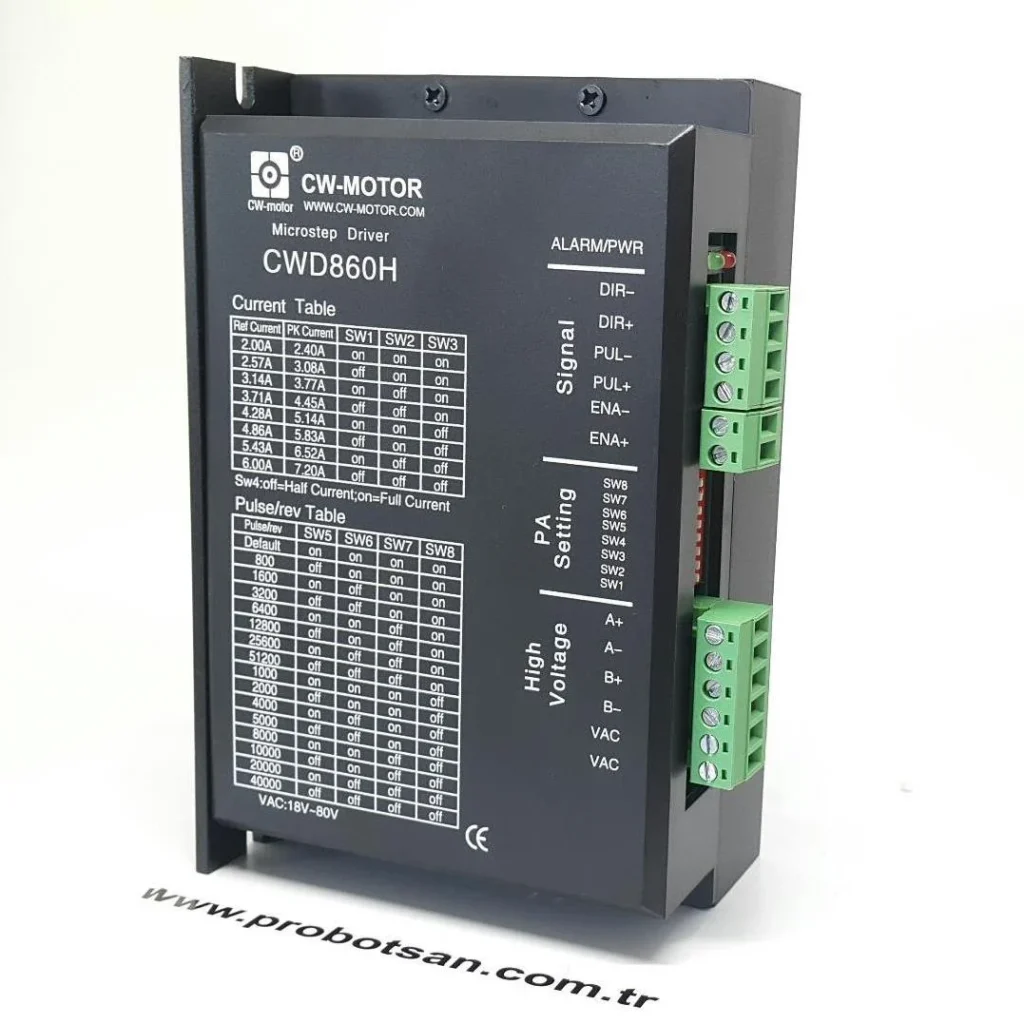
Field Considerations for Stepper Motor Driver Cooling
- Ambient Temperature and Enclosure Design: The ambient temperature in which the driver operates directly impacts cooling requirements. A driver operating inside a closed electrical cabinet alongside other heat-generating components will require more cooling than one operating in open air. The ventilation of the cabinet, air inlet/outlet points, and internal airflow designs have a critical impact on the thermal performance of the drivers. Proper fan placement and air direction are vital to prevent hot air pockets from forming inside the cabinet.
- Mounting Orientation and Airflow: The mounting orientation of drivers can affect heat transfer through natural convection. Generally, positioning heatsink fins vertically facilitates the natural rise of hot air upwards, ensuring better cooling. If active cooling is used, ensure that the fan’s airflow is directed straight onto the driver’s heatsink or the components requiring cooling. There should be no cables or other components obstructing the airflow.
- Driver Selection and Current Setting: It is crucial to select a driver with a capacity appropriate for, or slightly higher than, the motor current required by the application. Continuous operation at or very close to the driver’s nominal current rating can lead to overheating. If possible, setting the minimum current value truly needed by the motor helps reduce the heat load on the driver. Additionally, activating the
FAQ
Why is cooling necessary for stepper motor drivers in industrial CNC machines?
Cooling is essential for stepper motor drivers in industrial applications to prevent overheating, which can lead to performance degradation, shortened lifespan, and system failures. High operating temperatures accelerate the wear of semiconductor components and can trigger thermal protection mechanisms, causing unexpected shutdowns or reduced motor torque.
What factors influence the cooling requirements for a stepper motor driver?
Key factors include the motor's current draw, supply voltage, switching frequency of the driver, ambient temperature of the operating environment, and the enclosure design. Higher currents, voltages, and switching frequencies generate more heat, necessitating more robust cooling solutions.
What are the common cooling methods for stepper motor drivers?
Common cooling methods include passive heat sinks, active fan cooling, and the use of thermal interface materials like thermal paste or pads to improve heat transfer. For demanding applications or enclosed environments, active fan cooling is often required, sometimes combined with cabinet ventilation systems.
What are the risks of insufficient cooling for stepper motor drivers?
Inadequate cooling can cause the driver to enter thermal protection mode (reducing current or shutting down), leading to motor step loss, reduced torque, and premature driver failure. Over time, continuous high temperatures significantly shorten the lifespan of electronic components.
How can I optimize the cooling of my stepper motor drivers in an industrial setup?
Ensure proper driver selection with adequate thermal headroom, optimize motor current settings, provide sufficient airflow within the enclosure, use high-quality thermal interface materials, and perform regular maintenance such as cleaning fans and heat sinks. Mounting orientation can also impact natural convection.