
No products in the cart.
What is a 5-Phase Stepper Motor? Advantages Over 2-Phase Motors

Contents
- What is a 5-Phase Stepper Motor? Advantages Over 2-Phase Motors: Introduction and Technical Analysis At the heart of industrial automation, motion control systems are critically important for the efficiency and precision of modern manufacturing processes. As a fundamental component of these systems, stepper motors convert digital pulses into mechanical motion at specific angles, providing high-precision positioning and speed control. Widely used 2-phase stepper motors offer economical and general-purpose solutions but have certain characteristics that may be insufficient for specific applications. This is where 5-phase stepper motors come into play for engineers and system integrators seeking higher performance, lower vibration, and superior precision. Thanks to their structural and electrical differences, these motors have become an indispensable solution, especially in critical applications requiring high-resolution positioning, smooth motion, and minimal resonance. This detailed field guide and technical article aims to provide comprehensive knowledge from an expert perspective, delving into the fundamental principles of 5-phase stepper motors, their advantages over 2-phase motors, and their application areas in the industrial automation sector. What is a 5-Phase Stepper Motor? Advantages Over 2-Phase Motors: Operating Principle and Technical Data
- What is a 5-Phase Stepper Motor? Advantages Over 2-Phase Motors: Field Considerations
- What is a 5-Phase Stepper Motor? Advantages Over 2-Phase Motors: Common Problems and Solutions
- What is a 5-Phase Stepper Motor? Advantages Over 2-Phase Motors: Conclusion and Expert Advice
- FAQ
What is a 5-Phase Stepper Motor? Advantages Over 2-Phase Motors: Introduction and Technical Analysis
At the heart of industrial automation, motion control systems are critically important for the efficiency and precision of modern manufacturing processes. As a fundamental component of these systems, stepper motors convert digital pulses into mechanical motion at specific angles, providing high-precision positioning and speed control. Widely used 2-phase stepper motors offer economical and general-purpose solutions but have certain characteristics that may be insufficient for specific applications. This is where 5-phase stepper motors come into play for engineers and system integrators seeking higher performance, lower vibration, and superior precision. Thanks to their structural and electrical differences, these motors have become an indispensable solution, especially in critical applications requiring high-resolution positioning, smooth motion, and minimal resonance. This detailed field guide and technical article aims to provide comprehensive knowledge from an expert perspective, delving into the fundamental principles of 5-phase stepper motors, their advantages over 2-phase motors, and their application areas in the industrial automation sector.
What is a 5-Phase Stepper Motor? Advantages Over 2-Phase Motors: Operating Principle and Technical Data
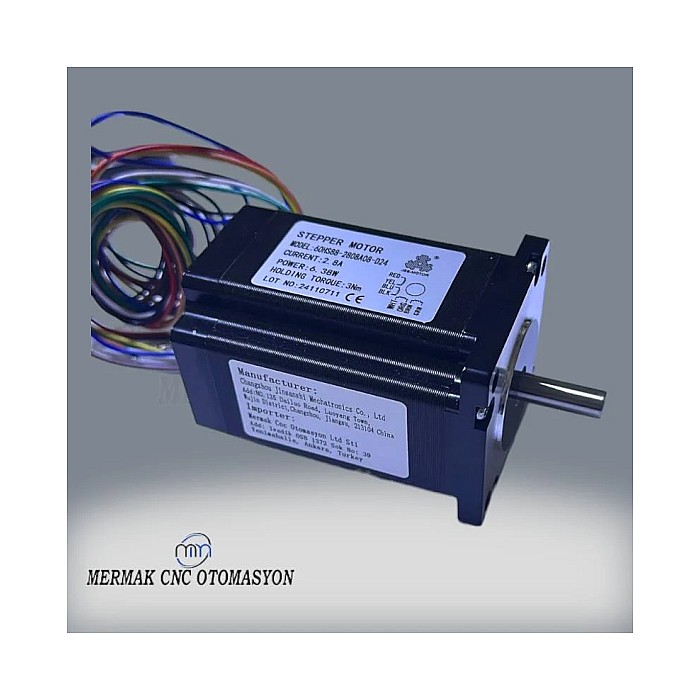
5-phase stepper motors, as the name suggests, are motors with five distinct winding groups. These windings are typically housed within the motor body to form a 10-pole stator structure. The rotor usually has a toothed structure composed of permanent magnets that interact with the stator poles. The operating principle is based on the sequential energization of these five windings by sequential current pulses controlled by a stepper driver. Each current pulse causes the rotor to rotate at a specific angle, known as the step angle. In 5-phase motors, with the energization of each phase, the rotor rotates with a much smaller step angle compared to 2-phase motors. While a typical 2-phase stepper motor has a full step angle of 1.8 degrees, 5-phase stepper motors generally have a standard full step angle of 0.72 degrees. This means a mechanically 2.5 times smaller natural step resolution, which directly increases the overall positioning accuracy in the system.
This fundamental difference provides 5-phase motors with a series of significant advantages. Firstly, thanks to the smaller natural step angle, more steps are taken for the same travel distance. This becomes particularly evident when operating in microstepping mode. Microstepping is a technique that allows the full step angle to be divided into much smaller sub-sections by sinusoidally varying the current applied to the motor windings. Because 5-phase motors have more phase windings, current transitions can be achieved more smoothly and gradually. This allows for much higher resolution microstep values (e.g., 1/250 or 1/500 steps) compared to 2-phase motors. This high resolution is critical in applications requiring sub-millimeter positioning accuracy, such as optical systems, semiconductor manufacturing equipment, precise medical devices, and CNC router machines.
The second major advantage is the significant reduction in torque ripple and vibration. 2-phase stepper motors can experience more pronounced torque ripples during phase transitions. These ripples can cause vibration and noise in the system, especially at low speeds or when approaching the motor’s resonance frequencies. 5-phase motors, however, minimize these ripples by distributing torque generation more homogeneously, thanks to the advantage of more phases and a smaller step angle. The result is smoother and more fluid motion. This feature enhances system performance and longevity in imaging systems, robotic arms, or any application where precise motion is desired.
Thirdly, 5-phase motors can generally provide more stable torque even at higher speeds. The increased number of phases allows the motor to utilize its magnetic field more effectively, which helps the motor exhibit a more consistent torque curve across its entire speed range. Furthermore, less pronounced or shifted resonance points to higher frequencies ensure the motor operates smoothly over a wider speed range. This is one of the main reasons they are preferred in high-speed and precise positioning automation systems, such as in test and measurement equipment or fast pick-and-place robots.
Finally, the low noise level of 5-phase stepper motors is also a significant advantage. Smoother phase transitions and reduced vibration decrease the acoustic noise produced by the motor during operation. This makes a big difference, especially in laboratory environments, hospitals, or other sensitive environments where quiet operating conditions are sought.
| Parameter | Value/Description |
|---|---|
| Number of Phases | 5 Phases |
| Standard Full Step Angle | 0.72° (Typically) |
| Precision (Natural) | High (2.5 Times Better Than 2-Phase) |
| Microstepping Capability | Very High (1/250, 1/500 and above) |
| Torque Ripple and Vibration | Very Low |
| Smooth Motion | Excellent, Even at Low Speeds |
| Noise Level | Low |
| Driver Complexity | More Complex (Requires Dedicated Driver) |
| Cost | Higher Compared to 2-Phase Motors |
What is a 5-Phase Stepper Motor? Advantages Over 2-Phase Motors: Field Considerations
- Appropriate Driver Selection and Configuration: 5-phase stepper motors require specially designed 5-phase stepper motor drivers due to their unique winding configurations. They are absolutely not compatible with 2-phase drivers. In driver selection, choosing a model that matches the motor’s nominal current, voltage, and torque requirements is critically important. Furthermore, parameters such as microstep settings, current limits, and pulse/direction signal configurations must be meticulously set to ensure optimal motor performance. Incorrect settings can lead to motor overheating, vibration, or failure to deliver expected precision.
- Cabling and EMI/RFI Protection: Electromagnetic interference (EMI) and radio frequency interference (RFI) are common problems in industrial environments. Signal lines and power cables from the driver to 5-phase stepper motors can be affected by such interference. It is important to use high-quality, shielded cables and route them away from power sources, high-frequency devices, or other noise sources. Cable lengths should be kept as short as possible, and grounding must be properly done. Incorrect wiring can lead to distortion in control signals, causing the motor to miss steps or operate unstably.
- Thermal Management and Environmental Conditions: Stepper motors generate heat, especially when operating at high currents or for extended periods. Since 5-phase motors contain more phases, thermal management can be even more critical. An appropriate cooling solution (e.g., heat sinks or forced air cooling) may be necessary to ensure the motor’s operating temperature remains within specified limits. Additionally, environmental conditions such as temperature, humidity, and dust in the motor and driver’s operating environment must be considered. Excessive temperature or humidity can shorten the motor’s lifespan and degrade its performance.
- Mechanical Mounting and Alignment: Proper mechanical mounting and alignment of the motor to the mechanical system are vital for precision and longevity. Correct selection and installation of couplings prevent shaft runout and axial misalignment. Loose connections or misalignment can increase vibration, impose excessive loads on bearings, and lead to missed steps. Ensure the motor’s mounting surface is flat and robust.
What is a 5-Phase Stepper Motor? Advantages Over 2-Phase Motors: Common Problems and Solutions
Here are some common problems that may be encountered when working with 5-phase stepper motors in the field and their solutions:
- Missed Steps: This occurs when the motor skips steps it should have moved. This is usually due to insufficient torque, excessive load, incorrect driver current setting, operating beyond the motor’s torque curve at high speeds, or mechanical friction. As a solution, check the motor’s torque capacity and reduce the load. Adjust the driver current according to the motor’s nominal values. Optimize acceleration and deceleration ramps. Check and eliminate friction or obstacles in the mechanical system. In some cases, considering a higher torque motor or a closed-loop (encoder-equipped) system may be necessary.
- Excessive Vibration and Noise: Although 5-phase motors are inherently low-vibration, these problems can arise with incorrect settings. Possible causes include incorrect microstep settings, operating the motor at a speed close to its resonance frequency, current fluctuations in the driver, or mechanical resonance. The solution is to optimize microstep settings, utilize the driver’s resonance damping features, move the operating speed away from resonance points, or tighten loose parts in the mechanical system.
- Motor Overheating: Continuous operation at high current, insufficient cooling, or consistently overloading the motor beyond its nominal torque leads to overheating. Motor overheating can damage winding insulation and shorten its lifespan. The solution is to optimize the driver current (especially reducing current during standby), add an appropriate cooling solution, or control the motor’s load. Activating the motor’s thermal protection features is also important.
- Motor Not Reaching Expected Position or Unstable Operation: This situation usually results from communication problems between the driver and controller, incorrect wiring, or a fault in the motor itself. As a solution, check all cable connections (power, signal, and motor windings). Examine the driver’s error codes. Ensure that the pulse and direction signals from the controller are correct and clean. Test the motor’s integrity by measuring the resistance and inductance of the motor windings.
- Driver Malfunction: Although the driver has protection mechanisms against conditions such as overcurrent, overvoltage, overheating, or short circuits, malfunctions can occur. Check the driver’s status LEDs, ensure the power supply is stable, and investigate for short circuits in the motor cables. A faulty driver usually requires replacement.
What is a 5-Phase Stepper Motor? Advantages Over 2-Phase Motors: Conclusion and Expert Advice
In the continuously evolving world of industrial automation, where precision becomes more critical every day, 5-phase stepper motors have carved out a solid niche for themselves with their distinct advantages over traditional 2-phase motors. Smaller natural step angles, superior microstepping capabilities, minimal torque ripple, low vibration, and smooth motion capability make these motors an ideal choice for applications requiring high-resolution positioning, precise speed control, and quiet operation. From wafer handling systems in the semiconductor industry to sample positioning units in medical imaging devices, from lens adjustments in optical systems to axis control in high-precision CNC router machines and robotic systems, 5-phase stepper motors exceed expectations in terms of performance and reliability across a wide range of applications.
As a system integrator or automation engineer, when evaluating a motion control solution, it is vital to take a holistic approach to factors such as the required precision, speed, vibration tolerance, and long-term operating costs, rather than focusing solely on the initial investment cost. Although 5-phase stepper motors initially require a higher cost and a more complex driver compared to their 2-phase counterparts, their superior performance and reliability can offer a much more economical and efficient solution in terms of Total Cost of Ownership (TCO), especially in critical applications. Reduced maintenance needs, longer system lifespan, and increased production quality ensure these motors quickly amortize their Return on Investment (ROI). Therefore, if your project requirements include high precision, low noise, and smooth motion, I strongly recommend placing 5-phase stepper motors at the top of your list. With the right motor and driver selection, meticulous installation, and careful adjustment, 5-phase stepper motors will add much more to your automation systems than you expect.
FAQ
What is a 5-phase stepper motor?
A 5-phase stepper motor is an electric motor with five distinct winding groups, typically forming a 10-pole stator. It offers superior precision, smoother motion, and reduced vibration compared to 2-phase motors due to its smaller step angle (0.72 degrees vs. 1.8 degrees) and enhanced microstepping capabilities.
What are the main advantages of 5-phase stepper motors over 2-phase motors?
5-phase stepper motors provide significantly higher precision, lower torque ripple, reduced vibration, smoother motion at low speeds, and quieter operation. They are ideal for applications demanding high-resolution positioning and stable torque across a wider speed range.
Where are 5-phase stepper motors commonly used in industrial settings?
5-phase stepper motors are widely used in high-precision industrial applications such as CNC router machines, semiconductor manufacturing equipment, medical imaging devices, optical systems, and robotics where fine positioning, smooth movement, and minimal noise are critical.
Do 5-phase stepper motors require special drivers?
Yes, 5-phase stepper motors require dedicated 5-phase stepper drivers. They are not compatible with 2-phase drivers due to their unique winding configuration. Proper driver selection and configuration are crucial for optimal performance.
What are common problems encountered with 5-phase stepper motors and how can they be solved?
Common issues include missed steps (due to insufficient torque or incorrect settings), excessive vibration/noise (often from incorrect microstep settings or resonance), motor overheating (from high current or poor cooling), and unstable operation (from wiring or communication problems). Solutions involve optimizing driver settings, ensuring proper cooling, checking wiring, and addressing mechanical issues.