
No products in the cart.
%34 Discount

SCE25 UU Linear Bearing
Original price was: 10.25$.6.72$Current price is: 6.72$.
High-performance linear bearing for industrial automation, offering precise and smooth motion.
In stock
🔥 Special for Today Only %34 Discount Opportunity!📦 Category: 25 mm Induction Shafts and Bearings
Mermak assuranceFrom factory to end user · importer / main dealer · strong stock
ImporterMain dealer / distributorStrong stockGood priceCorporate invoice
In stock / available to order · 14-day return for standard unused products; conditions may vary for custom size/cut products.
SCE25 UU Linear Bearing
INDUSTRIAL AUTOMATION PARTS | SUPERIOR PERFORMANCE SERIES
Detailed Product Review
The SCE 25 UU Linear Bearing, offered by Mermak CNC, is a component engineered to provide precise, stable, and high-performance linear motion in industrial automation systems. This bearing minimizes rolling friction through its precisely machined bearing raceways and optimized ball circulation mechanism, ensuring fluid and vibration-free movement along linear axes. The continuous cyclical movement of the balls from the load-carrying zone to the return path and back ensures even load distribution, enabling high repeatability and micron-level positioning accuracy. Particularly in dynamic applications requiring high acceleration and deceleration, the low friction coefficient provided by ball circulation enhances energy efficiency and supports the system’s thermal stability. This mechanical design maintains system rigidity even under heavy and variable loads, allowing for sustained machining quality and operational reliability.
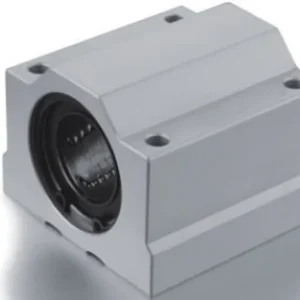
The SCE 25 UU series linear bearing is manufactured from high-carbon bearing steel and has undergone surface hardening. This combination of material selection and heat treatment maximizes the bearing’s wear resistance and fatigue life. The “UU” designation indicates the presence of double rubber seals integrated on both sides of the bearing. These seals form a physical barrier, protecting the bearing’s internal mechanism from dust, chips, moisture, and other industrial contaminants. This sealing feature extends maintenance intervals, especially in dirty or humid operating environments, and preserves the quality of the internal lubrication, which directly impacts bearing life. Its compact external dimensions allow for easy integration even in automation projects with limited installation space, and the flange-type mounting with 4 bolts ensures high stability and secure fastening. These linear bearings are utilized in a wide range of applications requiring high precision and durability, from the axial motion systems of CNC machining centers and linear modules of industrial robot arms to precision measuring instruments and positioning units in packaging machines.
SCE25 UU Linear Bearing Advantages
High Dynamic Load Capacity: The SCE 25 UU Linear Bearing features an optimized ball geometry and bearing raceway design, resulting in a dynamic load capacity (C) of 1.18 kN. This value technically represents the maximum radial load the bearing can withstand during continuous variable and high-speed movements within a specified expected life. High dynamic load capacity extends the bearing’s fatigue life and enhances system operational stability, particularly in applications like CNC machines and robotic systems that involve rapid acceleration and deceleration cycles, handling heavy workpieces, or experiencing high cutting forces. This minimizes unexpected downtime and maintenance needs.
Precise and Smooth Motion Characteristics: The precise machining of the raceways and the optimized circulation path allow the balls within the bearing to roll with virtually no friction, providing micron-level linear motion accuracy. The low friction coefficient minimizes heat generation during movement, reduces energy loss, and allows the drive system to operate more efficiently. This characteristic is critical for applications such as optical positioning systems, precision measuring instruments, and machining operations requiring high surface quality, where it plays a vital role in the repeatability and accuracy of tool or workpiece positioning, directly impacting final product quality.
Double-Sided Sealing (UU) Mechanism: The integrated double rubber seals (UU) effectively protect the bearing’s internal mechanism from solid particles (dust, chips) and liquid contaminants (cutting fluids, coolants) from the external environment. This sealing feature extends the life of the pre-lubrication within the bearing and prevents corrosion or wear of internal components, thereby increasing operational reliability. The protection provided by the seals contributes to extended maintenance intervals and reduced unplanned downtime, especially in harsh industrial environments, representing a significant technical advantage that lowers overall operating costs.
Technical Specifications and Capacity
Feature | Value/Description
Model | SCE 25 UU
Shaft Diameter (Nominal) | 25 mm
Outer Diameter (Nominal) | 40 mm
Length | 59 mm
Dynamic Load Capacity (C) | 1.18 kN
Static Load Capacity (Co) | 1.96 kN
Maximum Linear Speed | 60 strokes/minute (may vary based on system design)
Sealing Type | Double Rubber Seal (UU – Double Sealed)
Operating Temperature Range | -20°C to +80°C
Material | High-Carbon Bearing Steel, Hardened
Technical Frequently Asked Questions (FAQ)
How does the “UU” sealing mechanism of the SCE 25 UU linear bearing technically contribute to the bearing’s lifespan and performance?
The “UU” designation refers to the double rubber seals integrated on both sides of the bearing. These seals create a physical barrier, protecting the bearing’s internal mechanism from solid particles (dust, chips, metal debris) and liquid contaminants (water, coolants, cutting oils) from the external environment. Technically, this sealing preserves the quality and quantity of the pre-lubrication within the bearing, which reduces friction and prevents wear. Contaminant ingress into the bearing can cause abrasive effects on the ball and raceway surfaces, leading to premature fatigue and failure. UU seals prevent such particle entry, extending the bearing’s nominal lifespan, reducing maintenance intervals, and significantly enhancing operational reliability, especially in dirty or humid industrial environments. They also prevent lubricant leakage, avoiding environmental contamination.
What engineering approaches are used to calculate the expected service life of the SCE 25 UU linear bearing under variable load and speed conditions?
The expected service life (L) of linear bearings is typically calculated using the dynamic load capacity (C) and the equivalent dynamic load (P), according to ISO 14728 standard. The basic life equation is expressed as L = (C/P)^3 * 10^5 meters or revolutions. The value C (1.18 kN for this bearing) represents the theoretical load the bearing can withstand for a specific life expectancy (e.g., 100 km with 90% reliability). P is the equivalent dynamic load the bearing is subjected to under actual operating conditions, including radial, axial loads, and moments. Under variable load and speed conditions, the load and speed values for each operating cycle are evaluated separately to calculate an average or weighted average equivalent load (P_average). These calculations consider the load spectrum the bearing is exposed to and the duration at each load level to estimate the bearing’s total fatigue life. Additionally, factors such as operating temperature, lubrication conditions, and mounting accuracy are used as correction factors in life calculations.
Can the SCE 25 UU linear bearing be used in applications requiring vertical movement, and what are the special considerations for such installations?
Yes, SCE 25 UU linear bearings can be used in applications requiring vertical movement. However, some special engineering considerations must be taken into account for vertical installations compared to horizontal applications. The most important factor is the effect of gravity on the bearing. In a vertically moving system, the weight of the moving element continuously acts on the bearing, creating an additional load component that must be considered when calculating the bearing’s dynamic load capacity. Furthermore, to minimize backlash and ensure system rigidity in the vertical axis, applying a preload is generally recommended. Preload continuously maintains contact between the bearing balls and raceway surfaces, reducing vibration and increasing positioning accuracy. Regarding lubrication, it should be considered that lubricant may tend to flow downwards due to gravity in vertical installations, and therefore, more viscous or specialized greases may be preferred. The effectiveness of the seals is also critical in such applications, as the risk of particles from above entering the bearing may increase.
What is the significance of the “Standard (P0)” accuracy class specified for this linear bearing in engineering applications?
The “Standard (P0)” accuracy class is an industry standard that defines the manufacturing tolerances and geometric accuracy level of linear bearings. The P0 class represents a basic level of accuracy sufficient for general industrial automation applications. This classification indicates that the bearing meets specific tolerance ranges for critical dimensions such as shaft diameter, outer diameter, length, ball diameter, and the parallelism/straightness of raceway surfaces. From an engineering perspective, the P0 class offers cost-effectiveness and a wide range of applications. While higher accuracy classes (e.g., P5, P4) may be required for applications demanding high precision, such as optical alignment systems or ultra-precise measuring instruments, the P0 class is sufficient for general axial movements of CNC machines, robotic transport systems, or packaging machines to meet specified positioning repeatability and motion smoothness requirements. This class also optimizes the bearing’s ease of installation and compatibility with standard shafts while providing cost advantages where extreme precision is not necessary.
| Dimensions |
|---|
You must be logged in to post a review.
Taksit Tablosu
Related Products
 Staf Bgcx25bn 25 mm Narrow Linear Carriage22.25$View
 %49 DiscountSCE 30 UU Linear BearingOriginal price was: 14.11$.7.22$Current price is: 7.22$.View
 %40 DiscountSCE 40 UU Linear BearingOriginal price was: 25.27$.15.26$Current price is: 15.26$.View
Reviews
There are no reviews yet.