
No products in the cart.
%57 Discount


Step Motor Driver DM556
Original price was: 36.47$.15.64$Current price is: 15.64$.
High-performance electronic control unit for precise angular positioning and speed control in industrial automation systems.
In stock
🔥 Special for Today Only %57 Discount Opportunity!📦 Category: Stepper Motor Drivers🏷️ Supply Voltage: 20 - 50V DC🏷️ Output Current: 1.0 - 5.6A
Mermak assuranceFrom factory to end user · importer / main dealer · strong stock
ImporterMain dealer / distributorStrong stockGood priceCorporate invoice
In stock / available to order · 14-day return for standard unused products; conditions may vary for custom size/cut products.
Step Motor Driver DM556
INDUSTRIAL AUTOMATION PARTS | SUPERIOR PERFORMANCE SERIES
Detailed Product Review
The DM556 Step Motor Driver is a high-performance electronic control unit designed for applications requiring precise angular positioning and speed control in industrial automation systems. This driver is optimized to work seamlessly with 2-phase hybrid stepper motors, particularly those in the NEMA 23, NEMA 24, and certain NEMA 34 series. Its fundamental operating principle involves sequentially and controllably switching the current supplied to the motor windings, thereby altering the magnetic field direction and causing the rotor to rotate in discrete steps. Integrated microstepping technology allows the driver to divide a motor’s full step into a variable number of microsteps, ranging from 200 to 25600, significantly enhancing motion resolution. This results in smoother motor operation, minimized vibration even at low speeds, and positioning accuracy down to sub-millimeter levels. These capabilities are critical in applications demanding high precision, such as CNC machining centers, optical alignment systems, and robotic manipulators.
The DM556 driver features a robust construction designed to withstand demanding industrial environmental conditions. Internally, it incorporates an advanced Anti-Resonance algorithm that actively suppresses unwanted mechanical vibrations and acoustic noise generated at the motor’s natural resonance frequencies. This algorithm prevents torque reduction in the mid-speed range, ensuring more efficient and quieter system operation. Its design exhibits high immunity to electrical noise and supply voltage fluctuations, enhancing system stability. Furthermore, integrated safety mechanisms such as Over-Voltage Protection (OVP), Under-Voltage Protection (UVP), Over-Current Protection (OCP), and Phase Error Protection safeguard the driver and the connected stepper motor against potential electrical faults, extending system lifespan and maximizing operational safety. Its compact dimensions (approximately 118 x 75.5 x 34 mm) and standard PUL/DIR control interface allow for quick and seamless integration into existing automation infrastructure. These features make the DM556 a technically suitable solution for a wide range of applications, including CNC routers, laser cutting machines, plasma cutters, 3D printers, automated assembly lines, and industrial robotic applications.
Advantages of the Step Motor Driver DM556
High-Resolution Microstepping Capability: The DM556 offers adjustable microstepping resolution from 200 to 25600 steps/revolution, enabling the stepper motor’s full step to be divided into numerous smaller microsteps. This technical feature ensures extremely smooth and vibration-free motor movement, even at low speeds. In applications like CNC machining, optical alignment, and precision measurement systems, this high resolution allows for superior surface finish quality, sharper details, and repeatable positioning accuracy. By effectively reducing the motor’s step angle, it mitigates the impact of mechanical backlash, thereby increasing overall system precision.
Integrated Anti-Resonance Algorithm: The built-in Anti-Resonance algorithm actively detects and suppresses unwanted mechanical vibrations and acoustic noise that occur at the stepper motor’s natural resonance frequencies. This feature prevents torque drops and step losses, particularly in the mid-speed range (typically 100-500 RPM). Effective resonance management ensures the motor operates more stably, quietly, and efficiently. This extends the motor’s lifespan, reduces stress on the mechanical system, and enhances overall system durability and operational reliability, providing consistent performance even during prolonged high-speed operations.
Comprehensive Electrical Protection Mechanisms: The DM556 driver is equipped with comprehensive protection circuits to guard against electrical anomalies encountered in industrial environments. These mechanisms include Over-Voltage Protection (OVP), Under-Voltage Protection (UVP), Over-Current Protection (OCP), and Phase Error Protection. OVP and UVP protect the system if the driver’s input voltage deviates from the specified 20-50 VDC range. OCP monitors the peak current flowing through the motor windings, preventing damage to the driver and motor during short-circuit or overload conditions. Phase Error Protection safeguards the system if one of the motor windings becomes disconnected or faulty. These integrated safety measures enhance the driver’s and connected stepper motor’s resilience against damage from electrical faults, maximizing system uptime and overall safety.
Technical Specifications and Capacity
Feature|Value/Description
Model Designation|DM556
Input Voltage Range|20-50 VDC (Optimal Operating Voltage: 36VDC)
Output Current Capacity|1.0 – 5.6 A (Peak Value, adjustable in increments via DIP switches)
Microstep Resolution|200 to 25600 steps/revolution (Selectable via DIP switches)
Maximum Pulse Input Frequency|200 kHz
Compatible Motor Types|NEMA 23, NEMA 24, and certain 2-phase (4, 6, 8 wire) NEMA 34 stepper motors (57mm, 60mm, 86mm outer diameter)
Integrated Protection Functions|Over-Voltage (OVP), Under-Voltage (UVP), Over-Current (OCP), Phase Error Protection
Physical Dimensions (LxWxH)|Approx. 118 x 75.5 x 34 mm (Compact industrial design)
Technical Frequently Asked Questions (FAQ)
How does the DM556 driver’s Anti-Resonance algorithm technically improve stepper motor performance?
Stepper motors tend to produce vibrations and noise at specific speed ranges, particularly mid-speeds, that coincide with the motor’s natural resonance frequencies. This resonance can lead to torque loss, step loss, and excessive stress on the mechanical system. The DM556’s integrated Anti-Resonance algorithm dynamically detects these resonance frequencies by continuously monitoring the motor’s back electromotive force (BEMF) or analyzing the motor current waveform. When resonance is detected, the driver actively suppresses it by instantaneously modifying the current waveform or switching frequency applied to the motor windings. This technical intervention ensures stable torque production, significantly reduces vibration and acoustic noise, even in resonance regions. Consequently, the motor operates more smoothly and efficiently, extending the system’s overall lifespan and maintaining positioning accuracy even in high-speed applications.
How does the DM556’s 200 to 25600 steps/revolution microstepping resolution affect motion precision and smoothness in a control system, and what factors influence the selection of an appropriate microstep setting?
The DM556’s wide microstepping resolution range increases the granularity of the stepper motor’s angular movement by dividing each full step (typically 1.8 degrees or 200 steps/revolution) into much smaller microsteps. For instance, a 25600 steps/revolution setting divides each full step into 128 microsteps (25600/200 = 128). This results in smoother, more continuous motor motion, minimizing the “cogging” effect at low speeds and reducing mechanical vibrations. Enhanced motion smoothness improves machining quality and can achieve positioning accuracy at the micron level. Selecting the appropriate microstep setting depends on various factors, including the required application precision, the mechanical rigidity of the system, the motor’s torque characteristics, and the control system’s pulse frequency capability. Higher microstep settings offer greater precision but require the driver to operate at higher pulse frequencies and may slightly reduce the motor’s effective torque. Generally, high microstep settings are preferred for high-precision applications, while lower microstep settings or full-step modes may be more suitable for high-speed, high-torque applications.
Can the DM556 effectively operate with both 4-wire and 8-wire stepper motors, and what are the technical implications of these wiring configurations on motor performance?
Yes, the DM556 driver is compatible with both 4-wire (bipolar) and 8-wire (unipolar/bipolar) configurations of 2-phase hybrid stepper motors. 4-wire stepper motors have a pair of windings per phase and are typically driven in bipolar mode, utilizing the full current for each winding, which generally provides higher torque and better high-speed performance. 8-wire stepper motors have two separate windings per phase, which can be connected in series, parallel, or unipolar mode. When using an 8-wire motor with the DM556, the windings are usually connected in series or parallel. Parallel connection reduces the motor’s inductance, offering better torque performance at higher speeds, while series connection provides higher torque at lower speeds due to higher inductance and requires lower current. The driver adapts to the motor’s wiring configuration and selected current settings, ensuring the motor is driven according to its nominal current ratings. This flexibility allows engineers to work with different motor types and optimize motor performance according to application requirements.
What are the specific electrical protection mechanisms integrated into the DM556, and how do they protect the driver and connected stepper motor from potential damage?
The DM556 driver offers a comprehensive protection suite against electrical anomalies common in industrial settings: Over-Voltage Protection (OVP), Under-Voltage Protection (UVP), Over-Current Protection (OCP), and Phase Error Protection. OVP activates when the driver’s input voltage exceeds 50 VDC, preventing damage to internal electronic components from high voltage. UVP shuts down the driver when the input voltage drops below 20 VDC, preventing unstable operation and incorrect motor stepping. OCP cuts off current when the motor winding current exceeds the peak value set by DIP switches (e.g., during motor jamming or short circuits), protecting both the driver’s power transistors and the motor windings from overheating and burnout. Phase Error Protection stops the system if one of the motor windings becomes disconnected or experiences an internal fault, preventing unstable motor operation or driver damage. These integrated protection circuits ensure the long-term, reliable operation of the driver and connected motor, reducing maintenance costs and minimizing system downtime. Mermak provides reliable automation solutions to customers in the United Kingdom, United States, Canada, Australia, Ireland, New Zealand, South Africa, and similar international markets.
| Supply Voltage | 20 - 50V DC |
|---|---|
| Output Current | 1.0 - 5.6A |
You must be logged in to post a review.
Taksit Tablosu
Related Products
 %40 DiscountStep Motor Driver JSS860HOriginal price was: 55.44$.33.04$Current price is: 33.04$.View
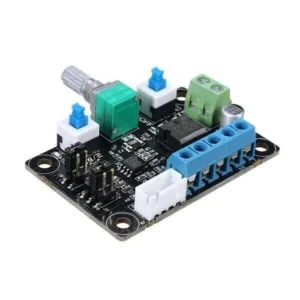 %53 Discount12-24V Step and Servo Motor Speed Controller MKS OSC PWM Pulse Signal GeneratorOriginal price was: 7.52$.3.58$Current price is: 3.58$.View
 %33 DiscountCwd556 Step Motor DriverOriginal price was: 64.80$.43.68$Current price is: 43.68$.View

Reviews
There are no reviews yet.