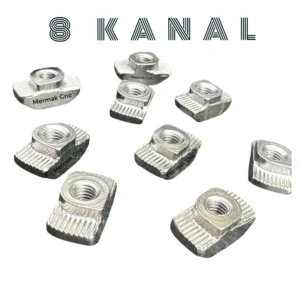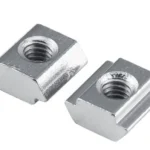
































































T-Slot Nut M6 20×20 K6
Detailed Product Review
The T-Slot Nut M6 20×20 K6 is a critical fastening component for modular aluminum profile systems used in industrial automation and machine building projects. This component is precisely designed to work in perfect harmony with the 6mm wide T-slot geometry of profile extrusions, specifically those with 20x20mm cross-sections. The nut’s wide gripping surface creates maximum contact area within the profile slot, providing high strength and structural stability to the mounted components. It is manufactured with fundamental engineering principles that ensure the reliability of the connection even under dynamic loads, vibrations, and static stresses, directly supporting the long-term and trouble-free operation of systems. The M6 metric thread ensures universal integration with ISO standard bolts and fasteners, while the K6 channel compatibility offers versatility across a wide range of profiles. This nut features an “end-feed” mounting method, inserted into the slot from the profile end. Unlike T-nuts with serrations or springs, this method offers superior locking performance, especially in applications requiring fixed and high-strength connections, minimizing the risk of loosening and enhancing the system’s structural integrity.
The material composition of the T-Slot Nut M6 20×20 K6 is high-quality carbon steel, offering optimal tensile strength, yield strength, and hardness. This material choice allows the nut to withstand high tightening torques and operational loads without deformation. The electrolytic zinc plating applied as a surface treatment significantly enhances the nut’s corrosion resistance, ensuring a long service life and aesthetic integrity even in demanding industrial environments that may be exposed to moisture, dust, or mild chemical vapors. The wide gripping surface of this nut ensures that the applied torque is evenly distributed across the internal geometry of the aluminum profile, reducing localized stress concentrations and preventing profile deformation. It offers an ideal solution for creating reliable, modular, and flexible connections in a wide range of applications, from CNC machines and conveyor systems to robotic cells, precision workstations, 3D printers, laser cutting machines, testing equipment, assembly tables, and industrial control panels. This integration capability provides designers and engineers with a broad selection of parts, offering flexibility and simplifying adaptation to existing systems.
Advantages of T-Slot Nut M6 20×20 K6
High Mechanical Strength and Optimized Load Distribution: With its wide and flat gripping surface, the T-Slot Nut M6 20×20 K6 establishes maximum contact area with the slot walls of aluminum profiles. This design ensures that the applied tightening torque and carried loads are uniformly distributed across the profile surface, minimizing point stress concentrations and thus the risk of profile deformation. This feature guarantees the integrity of the connection, especially in systems carrying heavy loads, subjected to high vibrations, or affected by dynamic forces, increasing the fastener’s resistance to pull-out or rotation within the profile and significantly improving the system’s long-term structural stability.
Precise and Secure “End-Feed” Mounting Mechanism: The ability of this nut to be inserted into the slot from the profile end (end-feed) ensures correct positioning and complete locking within the slot during assembly. This method guarantees that the nut fits perfectly into the slot’s internal geometry and achieves maximum thread engagement when the bolt is tightened. Compared to T-nuts with serrations or springs, this mounting type offers a much more secure grip by preventing the nut from sliding or rotating within the slot. This minimizes the risk of loosening after assembly, increases connection repeatability, and preserves the system’s structural integrity even under dynamic operating conditions, thereby reducing maintenance needs and enhancing operational reliability.
Universal Compatibility and Modular Design Flexibility: The M6 metric thread standard and 20×20 K6 aluminum profile compatibility guarantee seamless integration of the T-Slot Nut M6 20×20 K6 with a wide range of standard industrial bolts, brackets, and other fasteners available on the market. This universal compatibility offers designers and engineers a broad selection of parts, providing a high degree of flexibility in system design. Easy adaptation to existing systems supports rapid prototyping processes and simplifies future modifications, expansions, or repairs. This feature promotes the use of standard parts, simplifying inventory management and providing cost-effectiveness by reducing the need for custom-manufactured parts. Mermak serves clients in countries such as the United Kingdom, United States, Canada, Australia, Ireland, and New Zealand, alongside similar international markets.
Technical Specifications and Capacity
FeatureValue/Description
Product CodeT-Slot Nut M6 20×20 K6
Thread SizeM6 Metric (ISO compliant, 6mm nominal diameter, right-hand thread)
Channel CompatibilityK6 Channel (Ideal for aluminum profiles with a 6mm slot width)
Profile Compatibility20x20 Aluminum Profile Series (20mm x 20mm cross-section aluminum profiles)
MaterialHigh-Quality Carbon Steel (Optimal strength and durability), Electrolytic Zinc Plating (Corrosion resistance and surface hardness)
Mounting TypeEnd-feed into profile slot – High-strength and secure locking
Maximum Tightening TorqueAverage 8-12 Nm (depending on M6 bolt and profile material; manufacturer recommendations and bolt class should be considered to avoid profile deformation and exceeding bolt yield strength)
Technical Frequently Asked Questions (FAQ)
What engineering advantages does the “end-feed” mounting method of the T-Slot Nut M6 20×20 K6 offer compared to other T-slot nuts?
The “end-feed” mounting method allows the T-Slot Nut M6 20×20 K6 to be inserted into the aluminum profile slot only from the profile end. This ensures the nut is pre-positioned with the correct orientation and full seating within the slot. In contrast, “drop-in” or spring nuts can be dropped into the slot at any point along the profile, but this may not guarantee the nut’s full seating or proper alignment within the slot. The end-feed method ensures the nut is fully engaged with the slot’s internal geometry before the bolt is tightened, guaranteeing maximum thread engagement and thus higher tensile and shear strength. This significantly reduces the risk of loosening or slipping, especially in applications subjected to high dynamic loads or vibrations, and preserves the system’s structural integrity in the long term.
How does the material composition (High-Quality Carbon Steel and Electrolytic Zinc Plating) of the T-Slot Nut M6 20×20 K6 contribute to its operational lifespan and performance in industrial environments?
The primary material, high-quality carbon steel, provides the T-Slot Nut M6 20×20 K6 with superior tensile strength, yield strength, and hardness. These properties are critical for the nut to withstand high tightening torques and operational loads without plastic deformation. These mechanical characteristics of carbon steel directly impact the connection’s structural integrity and load-bearing capacity. The electrolytic zinc plating applied to the surface enhances the nut’s corrosion resistance, extending its operational lifespan. Zinc, being more reactive than steel, preferentially oxidizes when exposed to environmental factors (moisture, oxygen, mild chemicals), acting as a sacrificial anode to protect the steel. This protective layer increases the nut’s resistance to rust, even in harsh industrial environments, thereby reducing maintenance costs and improving the overall reliability of the equipment.
What are the critical engineering factors to consider when determining the maximum tightening torque for an M6 T-slot nut?
When determining the maximum tightening torque for an M6 T-slot nut, it is essential to consider not only the strength class of the nut and the bolt used but also the deformation limits of the aluminum profile itself. Selecting a torque value that does not exceed the bolt’s yield strength is fundamental. However, more critically, the slot walls of the aluminum profile must not be locally crushed or deformed under the tightening force. Aluminum has a lower yield strength compared to steel; therefore, applying excessive torque can lead to permanent deformation of the profile, causing the connection to loosen, reducing load-carrying capacity, and compromising the overall structural integrity of the system. Consequently, adhering to the profile manufacturer’s recommended maximum tightening torque values, using a torque wrench appropriate for the bolt class, and, if necessary, experimentally verifying torque values are vital for the reliability and longevity of the connection.
In which specific application scenarios does the wide gripping surface of the T-Slot Nut M6 20×20 K6 offer a significant engineering advantage compared to narrow designs?
The wide gripping surface of the T-Slot Nut M6 20×20 K6 distributes the clamping force over a larger area of the aluminum profile’s slot walls. This feature offers a critical engineering advantage, especially in applications involving high static or dynamic loads, continuous vibrations, or significant moment loads (e.g., long cantilever structures). Nuts with narrow gripping surfaces can create high stress concentrations by concentrating the clamping force into a smaller area, potentially leading to local crushing of the profile, fatigue crack initiation, or eventual loosening of the connection over time. The wide gripping surface reduces these stresses, prevents profile deformation, increases the connection’s tensile and shear resistance, and guarantees long-term operational stability. This is indispensable for industrial applications requiring high reliability, such as precision CNC machines, heavy-duty conveyor systems, or robotic platforms.