



































































































































DCRS-01J Digital Mode Switch
Detailed Product Review
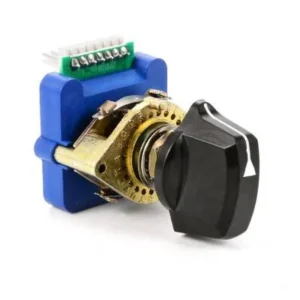
The DCRS-01J Digital Mode Switch serves as a critical component in the operator interface of modern CNC (Computer Numerical Control) machine tools. This unit operates on the principle of a rotary encoder switch, converting mechanical rotational movement into digital signals that are directly transmitted to the CNC control unit. Its primary function is to ensure precise and repeatable transitions between different machine operating modes, such as manual, automatic, semi-automatic, reference return, and MDI (Manual Data Input). Internally, the switch features a series of optical or mechanical contact elements that generate a unique digital code corresponding to each position. As the operator turns the switch, these elements open and close in a specific combination, producing binary or Gray code signals that the control unit can interpret. These signals inform the control unit which operating mode should be activated or which feed/rapid traverse rate should be applied. With 24 stable positions and a distinct 15° mechanical rotation angle between each position, the switch provides the operator with clear tactile feedback for every selection, minimizing the risk of accidental position skips or incorrect mode selection. This precision is a fundamental engineering feature that directly impacts production continuity, operator safety, and the consistency of machining quality.
The material construction of the DCRS-01J is designed with the principles of durability and longevity required for demanding industrial environments. The outer casing is typically made from high-strength engineering polymers or aluminum alloys that are resistant to impacts, abrasion, and chemicals. Internal mechanisms and electrical contacts are selected from materials such as nickel-plated brass or silver alloys to ensure high conductivity and corrosion resistance. The IP65 protection class signifies that the switch is completely sealed against dust ingress and is resistant to low-pressure water jets, achieved through the use of specially designed seals and sealing elements (e.g., EPDM or silicone O-rings). In terms of system integration, the DCRS-01J offers broad compatibility with industrial CNC control units like Fanuc and Mitsubishi. This compatibility is usually achieved through standard digital input/output (I/O) interfaces or specific communication protocols, facilitating adaptation to existing CNC systems and reducing engineering time for new installations. The primary application areas for the product include CNC machining centers such as milling, turning, grinding, and EDM machines. It also functions as a flexible and critical control point in complex production systems like robotic cells and automated assembly lines, where operators need to reliably change modes and speed settings for maintenance, tool changes, or different product series.
Advantages of the DCRS-01J Digital Mode Switch
Precise Mechanical and Digital Control Integration: The DCRS-01J is equipped with a rotary mechanism featuring 24 stable positions, with a precise 15° mechanical rotation angle between each position. This engineering design ensures the operator receives a distinct “click” feel and visual confirmation for every mode or speed selection, preventing accidental position skips or unintended mode activations. The mechanical detent mechanism guarantees the switch only stops at fully defined positions, while the internal encoder switch converts this mechanical position into a unique digital signal. This integration ensures high accuracy of the data transmitted to the CNC control unit, thereby minimizing machining errors, scrap production, and production downtime. Especially in critical operations like precise tool setting, manual feed adjustments, or initiating automatic cycles, this precise control directly enhances operational reliability and final product quality.
Broad Industrial Control Unit Compatibility: The DCRS-01J is designed for full compatibility with industry-leading CNC control units such as Fanuc and Mitsubishi. This compatibility is achieved by matching the switch’s electrical interface (typically 24V DC digital inputs) and signal protocols (e.g., BCD or a proprietary encoding scheme) with the standard requirements of these control systems. This broad integration capability allows users to seamlessly integrate the DCRS-01J into their existing machine fleets, eliminating the need for additional adapters, custom software development, or complex wiring requirements. Consequently, installation time is reduced, engineering costs are lowered, and spare parts management is simplified. Furthermore, by providing a standardized operator interface across different brands of CNC machines, it simplifies operator training and ensures consistency in human-machine interaction.
Superior Environmental Resistance and Durable Construction (IP65): The DCRS-01J boasts an IP65 protection rating according to the IEC 60529 standard. This classification indicates that the switch is ‘6’ rated for solid ingress protection, meaning it is completely dust-tight, and ‘5’ rated for liquid ingress protection, meaning it is protected against low-pressure water jets from any direction. This feature ensures the switch functions reliably in harsh operating environments where metal chips, oil mist, coolant fluids, and other industrial contaminants are prevalent. Isolating the internal mechanisms and electrical contacts from environmental factors significantly reduces the risk of short circuits, contact corrosion, and mechanical wear. This durable construction increases the switch’s Mean Time Between Failures (MTBF), eliminating the need for frequent repairs and replacements, thereby reducing maintenance costs and ensuring uninterrupted operation of the production line. Its long service life is a critical factor in optimizing the Total Cost of Ownership (TCO).
Technical Specifications and Capacity
FeatureValue/Description
Product TypeDigital Mode Switch / Rotary Encoder Switch (A multi-position switching device that converts mechanical rotation into digital signals.)
Number of Positions24 Stable Positions (Each position offers the operator a distinct, tactile, and repeatable selection point, eliminating the risk of incorrect mode or speed selection.)
Mechanical Rotation Angle15° (The 15-degree step between each position allows for precise indexing and a distinct “click” feel for the operator, preventing accidental position skips and increasing accuracy.)
Protection ClassIP65 (According to IEC 60529 standard, ‘6’ for complete protection against dust ingress; ‘5’ for protection against low-pressure water jets from all directions. Designed for uninterrupted and reliable operation in harsh industrial environments.)
Compatible Control UnitsFanuc, Mitsubishi, and similar industrial CNC control systems (Offers broad integration capability via standard digital I/O interfaces, allowing easy adaptation to existing infrastructure.)
Basic FunctionSwitching between CNC machine tool operating modes (Manual, Automatic, Semi-Automatic, Reference Return, MDI) and precisely setting feed/rapid traverse rates.
Operator FeedbackTactile and visual feedback (Provides certainty and reliability with each selection through mechanical detents and clear position markings, minimizing operator errors.)
Technical Frequently Asked Questions (FAQ)
How does the DCRS-01J’s encoding mechanism ensure signal integrity against electrical noise in industrial environments and prevent erroneous mode selections?
The DCRS-01J utilizes a highly reliable internal encoding mechanism, typically based on BCD (Binary-Coded Decimal) or Gray code principles. Gray code, in particular, minimizes instantaneous signal errors (glitches) caused by electrical noise or mechanical vibration because only a single bit changes between consecutive positions. This ensures the control unit always receives a clear and stable position signal. Furthermore, the switch’s 24 stable positions and 15° mechanical rotation angle are supported by a distinct detent mechanism at each position. These detents guarantee that the switch settles precisely into one position, preventing the operator from inadvertently leaving it between positions. This physical certainty enhances the stability of the digital signal, maximizing the reliability of the data transmitted to the control unit and preventing incorrect mode selections even in noisy industrial environments.
What are the specific electrical interface requirements for integrating the DCRS-01J with a Fanuc 0i-MF control unit, and what considerations are important during wiring?
Integrating the DCRS-01J with a Fanuc 0i-MF control unit typically involves 24V DC digital input/output (I/O) modules. The switch can provide a separate digital output for each position (e.g., NPN or PNP open collector type) or function as a BCD encoder, transmitting a coded signal via multiple bits. Fanuc 0i-MF systems generally expect a 24V DC supply voltage and a specific input impedance, which the DCRS-01J is designed to meet. During wiring, using shielded cables is crucial to protect against industrial noise. Grounding the shield at a single point on the control unit side minimizes electromagnetic interference (EMI) and radio frequency interference (RFI). Additionally, cable length should be kept as short as possible to prevent signal attenuation and noise induction, and cables should be routed separately from power cables. The conductor cross-section should be appropriately selected based on the switch’s nominal current draw and cable length to ensure sufficient thickness to prevent voltage drop. All connections must be robust and vibration-resistant for long-term reliable operation.
Beyond the IP65 protection class, what are the operational temperature and humidity ranges for the DCRS-01J, and how do these factors affect its long-term reliability?
The DCRS-01J Digital Mode Switch is typically designed to operate reliably within a wide temperature range of -10°C to +60°C. It can maintain its performance in relative humidity up to 95% (non-condensing). These temperature and humidity limits are the ranges within which the material properties of the internal electronic components, mechanical parts, and sealing elements (gaskets, O-rings) can maintain optimal performance. Extreme temperatures can cause material expansion and contraction cycles, accelerating mechanical wear or reducing the elasticity of sealing elements. Low temperatures can increase the brittleness of plastic components and affect the viscosity of internal lubricants. High humidity levels, especially during condensation, can lead to corrosion on electrical contacts and reduce insulation resistance. While the IP65 protection class is designed to prevent these external factors from reaching the switch’s sensitive internal mechanisms, operating outside the specified ranges can negatively impact the product’s lifespan and reliability. Therefore, using the product within its specified environmental conditions is critical for long-term performance and minimizing failure rates.
How does the DCRS-01J contribute to the overall Safety Integrity Level (SIL) of a CNC machine tool, and how does it prevent accidental mode changes during critical operations?
While the DCRS-01J is not a direct safety function (like an emergency stop button), it makes a significant indirect contribution to the overall Safety Integrity Level (SIL) of a CNC machine tool. This contribution stems from its ability to minimize the probability of human error during mode transitions. The switch’s 24 stable positions and the distinct 15° mechanical detent between each position provide the operator with definitive tactile feedback for every selection. This physical certainty prevents the operator from accidentally or intentionally shifting from one mode to another. For example, if the switch were to accidentally move to automatic mode during a tool setting operation in manual mode, it could lead to unexpected machine movements and potential hazards. The robust and precise construction of the DCRS-01J helps prevent such unintended mode changes, thereby assisting the operator in remaining within a safe operating environment. This can be considered a control measure that reduces the human error factor in risk assessments conducted under safety standards like EN ISO 13849 or IEC 62061. Reliable mode selection supports predictable machine control system behavior, thus enhancing overall system safety.
Reviews
There are no reviews yet.