

























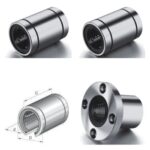



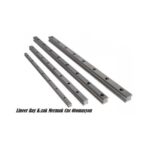


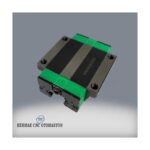









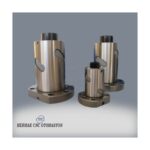




































FH RM20 FA 20 mm Linear Slide Guide
Detailed Product Review
The FH RM20 FA 20 mm Linear Slide Guide is a recirculating ball linear motion component designed to meet the high precision, rigidity, and repeatability requirements of linear motion in industrial automation systems. This system achieves load-bearing and motion transmission with minimal friction by ensuring the continuous circulation of precision balls housed within a moving carriage (block) on the rail. The balls move between specially designed return channels and load-bearing raceways within the carriage, rolling on hardened and precision-ground raceways on the rail’s surface. This structure optimizes the system’s dynamic and static load capacity by distributing loads equally and evenly in both radial and axial directions, while guaranteeing micron-level positioning accuracy and smooth motion. The flanged carriage design offers a larger contact area to the mounting surface, increasing system rigidity and improving vibration damping characteristics, which is critical in high-speed and high-acceleration applications. The optimized ball recirculation geometry minimizes resistance encountered by the balls during circulation, reducing the load on drive systems and maximizing energy efficiency.
The product’s material structure is formed by subjecting high-strength alloy steels to special heat treatment processes. The rail surfaces achieve a hardness of HRc 58-62 through induction hardening, increasing wear resistance and load-bearing capacity. This material selection and surface treatment technology ensure the long-term and reliable operation of the slide guide system. The FH RM20 FA linear slide guide has a modular structure that can be easily integrated into existing automation systems due to its mounting dimensions conforming to industrial standards. It can be used in a wide range of applications, including CNC machining centers, robotic arms, automatic assembly and packaging lines, precision measuring instruments, and laser cutting machines. The slide guide system is equipped with effective double-lip sealing elements. This sealing mechanism prevents dust, dirt, and other particles from the working environment from entering the ball recirculation system, protecting the internal mechanisms and maintaining lubrication efficiency. The grease nipple-supported lubrication system is compatible with periodic or automatic lubrication units, further reducing friction between the balls and rail surfaces, extending system performance and lifespan.
Advantages of the FH RM20 FA 20 mm Linear Slide Guide
High Load Capacity and Rigidity: The FH RM20 FA series, thanks to its optimized ball contact geometry and high-strength alloy steel rail and carriage material, is capable of carrying significant loads in both radial and axial directions. This minimizes system deformation, especially in CNC machines with heavy processing conditions or high-inertia robotic applications, thereby maintaining machining accuracy and positioning stability. The flanged carriage design provides a large contact area to the mounting surface, increasing the overall rigidity of the system and effectively damping vibrations that may occur under dynamic loads, which extends tool life and improves surface quality.
Superior Precision and Repeatability: Manufactured in the H (High Precision) accuracy class, this linear slide guide offers exceptional positioning accuracy and repeatability due to the micron-level grinding of the rail and carriage surfaces and the precise manufacturing tolerances of the ball recirculation system. This feature guarantees product quality consistency, especially in precision assembly, measurement, and machining applications, ensuring that each repeated movement returns to the same reference point. Low-clearance or pre-loaded mounting options reduce system response time and minimize backlash, allowing even complex motion profiles to be executed with high accuracy.
Minimal Friction and Energy Efficiency: The FH RM20 FA linear slide guide has an extremely low coefficient of friction (< 0.003) due to its optimized ball recirculation mechanism and precision surface finishing technology. This low friction significantly reduces the amount of heat generated during motion, which enhances the system's thermal stability and extends lubricant life. Furthermore, it increases energy efficiency by allowing drive systems (servo motors, stepper motors) to achieve the same or higher speed and acceleration values with less power consumption. Low friction also contributes to longer motor life by reducing the load on them and lowers operational costs.
Technical Specifications and Capacity
FeatureValue/Description
Model CodeFH RM20 FA
Nominal Rail Width20 mm
Rail Material and HardnessHigh Carbon Alloy Steel (Induction Hardened), HRc 58-62
Accuracy ClassH (High Precision)
Dynamic Load Capacity (C)25.5 kN (Per Axis)
Maximum Speed and Acceleration5 m/s, 300 m/s²
Sealing and LubricationDouble-Lip Effective Sealing, Grease Nipple Support
Technical Frequently Asked Questions (FAQ)
What is the fundamental difference between the dynamic and static load capacities of the FH RM20 FA linear slide guide, and how does it play a role in application selection?
The dynamic load capacity (C) is the maximum equivalent load that a linear slide guide can carry over a specified life (typically 50 km or 100 km of travel distance) without reaching an acceptable level of wear or fatigue. This value is critical, especially for systems that are in constant motion and operate under variable loads. The static load capacity (C₀), on the other hand, is the maximum load that the slide guide can withstand without permanent deformation or brinelling of the ball and raceway surfaces when it is not in motion. This value is important for situations where the system is stationary or subjected to sudden shock loads. In application selection, both capacities must be carefully evaluated considering the system’s operating mode (continuous movement, intermittent movement, dwell times), the maximum loads it will be subjected to, and the desired lifespan. While the dynamic load capacity is used in life calculations for moving systems, the static load capacity determines the safety factor against excessive loads that may occur during installation or when the system is at rest.
How does the operating temperature range of the FH RM20 FA linear slide guide (-20°C to +80°C) affect its performance and lifespan?
The specified operating temperature range of the FH RM20 FA linear slide guide defines the thermal limits within which the system can maintain optimal performance and lifespan. Operation outside this range can lead to various adverse effects. At low temperatures (below -20°C), the lubricant’s viscosity increases, which can raise friction and thus the torque required for motion, potentially reducing motion smoothness and placing additional load on motors. At high temperatures (above +80°C), the lubricant’s viscosity decreases, which can lead to thinning of the lubricating film and a reduction in its protective properties, potentially accelerating wear and shortening the slide guide’s life. Furthermore, extreme temperature variations can cause thermal expansion or contraction in the rail and carriage materials, affecting micron-level precision and preload settings. Therefore, ensuring that the application environment’s temperature conditions remain within this range, or supporting them with special lubricants and thermal management solutions, is critical for the system’s long-term reliability.
What advantages does the “H (High Precision)” accuracy class of this linear slide guide offer in industrial automation applications, and how is it achieved?
The “H (High Precision)” accuracy class indicates that the manufacturing tolerances and geometric deviations of the rail and carriage surfaces of the FH RM20 FA linear slide guide are within extremely narrow limits. This offers critical advantages in applications requiring micron-level positioning accuracy and repeatability, such as CNC machining centers, precision assembly robots, and measuring instruments. High precision improves machining quality, ensures product consistency, and reduces scrap rates. This accuracy class is achieved through specially designed high-precision grinding and honing processes, strict quality control procedures, and an optimized internal geometry of the ball recirculation system. The uniform distribution of ball contact points between the rail and carriage ensures even load distribution and minimizes deviations during motion. Furthermore, this precision allows for more effective preload adjustment of the system, offering high rigidity and response speed even under zero-clearance or minimal-clearance operating conditions.
What are the mounting surface requirements for the FH RM20 FA linear slide guide, and how does the mounting orientation affect performance?
To ensure optimal performance of the FH RM20 FA linear slide guide, the mounting surface must meet specific requirements. The mounting surface should have high flatness and parallelism tolerances; typically, these values are requested with tighter tolerances than the slide guide system’s own accuracy class. The surface roughness (Ra value) should also be kept below a certain level, as rough surfaces can prevent the rail from seating properly, leading to stress concentrations and premature fatigue. Additionally, the mounting surface must have sufficient rigidity to minimize deformations under dynamic loads. Although the FH RM20 FA is capable of mounting in “All Directions (Horizontal, Vertical, Lateral)”, different mounting orientations can affect load distribution and, consequently, the system’s lifespan and performance. For example, vertical mounting may alter the preload or load distribution on the balls due to gravity, while horizontal mounting generally offers the most balanced load distribution. Depending on the specific application, the appropriate mounting orientation should be selected considering the expected load directions and magnitudes, and system rigidity should be increased with additional support structures if necessary. Correct mounting is a fundamental step for the slide guide system to achieve its specified precision and lifespan values.


Reviews
There are no reviews yet.