



































































































































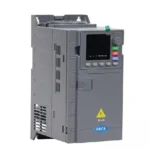
5.5 kW 220V to 380V Motor Drive Inverter
Detailed Product Review
The 5.5 kW 220V to 380V Motor Drive Inverter, developed by Mermak CNC, is a high-engineering power converter designed to overcome fundamental energy infrastructure limitations encountered in industrial motor drive systems. This device takes a standard 1-Phase 220V AC (single-phase) mains voltage and, through an integrated advanced “Step-Up” converter followed by a PWM (Pulse Width Modulation) controlled IGBT (Insulated Gate Bipolar Transistor) inverter stage, has the capacity to produce true 3-Phase 380V AC (three-phase) industrial voltage. This topology first converts the input voltage to a DC bus voltage via a rectifier; then, this DC voltage is boosted to a higher DC level required for the 380V three-phase output by a step-up converter. In the final stage, this elevated DC voltage is converted into a 3-phase AC output with adjustable frequency and voltage, approximating a sinusoidal waveform, to control the motor’s speed and torque. This enables industrial three-phase motors with a power rating of 5.5 kW (7.5 HP) to operate at their nominal power and torque values, even in locations with a single-phase power supply infrastructure.
The material structure of this inverter is designed for durability in harsh industrial environments. The internal components include industrial-grade semiconductors (IGBTs, fast diodes) with high current and voltage tolerance, and capacitors with low ESR (Equivalent Series Resistance). Thermal management is provided by an integrated dual-fan active cooling block, which prevents overheating of power electronic components, ensuring continuous and reliable operation. For system integration, this inverter can be directly connected to the existing single-phase 220V electrical network via terminal connections; however, adherence to the specified minimum cable cross-section and fuse ratings is absolutely essential. The product is optimized for industrial applications requiring high starting torque and continuous power, such as marble cutting machines, high-pressure compressors, hydraulic units, heavy-duty fans, and agricultural irrigation pumps. In these applications, it ensures stable motor operation even during sudden load changes, increasing process continuity and efficiency.
Advantages of the 5.5 kW 220V to 380V Motor Drive Inverter
True Three-Phase Output Voltage Generation: This inverter converts single-phase 220V AC input voltage to the industrial standard 3-phase 380V AC voltage using its internal step-up converter and PWM inverter technology. This capability allows 5.5 kW three-phase motors to operate at full capacity, especially in locations like construction sites, rural areas, or small workshops where industrial three-phase electricity infrastructure is unavailable or insufficient. This eliminates the need for costly and time-consuming three-phase electrical infrastructure installation or upgrades, significantly enhancing operational flexibility and geographical independence for businesses. We supply to markets including the United Kingdom, United States, Canada, Australia, Ireland, and New Zealand, among others.
Dynamic Torque Control and Stability Under Load: The device utilizes advanced vector control algorithms to ensure the connected motor maintains its nominal torque during startup and operation. It prevents motor stalling or speed drops in applications with high inertia or sudden load changes, such as marble cutting machines, high-pressure compressors, and hydraulic units. The inverter ensures the motor operates at optimal power factor and efficiency at all speeds, dynamically supplying the necessary current during sudden load increases to maintain stable motor operation. This feature improves the quality of processed materials, extends machine lifespan, and optimizes energy consumption.
Existing Single-Phase Network Integration and Infrastructure Optimization: The Mermak CNC 5.5 kW 220V to 380V Motor Drive Inverter can be easily adapted to existing single-phase 220V networks without the need for complex and costly three-phase infrastructure installations. This integration allows businesses to commission 5.5 kW three-phase machines without requiring a new industrial electricity subscription or making major modifications to existing electrical panels. However, for safe and efficient integration, it is mandatory to use a minimum 6mm² (recommended 10mm²) solid copper input cable and a 63 Amp (Type C – delayed) circuit breaker capable of handling the high input current (45-50 Amps) drawn by the device at full load. Direct terminal connection eliminates the risks of overheating and fire that can occur with plug-and-socket connections due to insufficient current carrying capacity.
Technical Specifications and Capacity
Feature
Value/Description
Input Voltage
1-Phase 220V AC (Single-Phase)
Output Voltage
3-Phase 380V AC (True Three-Phase)
Maximum Motor Power
5.5 kW / 7.5 HP
Input Current (Full Load)
45 – 50 Amps (Appropriate wiring mandatory due to high current draw)
Output Current
13 Amps ~ 14 Amps
Minimum Input Cable Cross-Section
Minimum 6mm² (Recommended 10mm²) solid copper cable, direct terminal connection
Fuse Selection
63 Amp (Type C – Delayed) circuit breaker
Motor Connection
380V Delta or suitable winding connection for 380V/660V rating
Cooling System
Dual-Fan Active Cooling Block
Technical Frequently Asked Questions (FAQ)
How does this inverter produce 3-phase 380V output from a single-phase 220V input internally?
The device’s fundamental operating principle relies on a series of power electronic conversion stages. Initially, the single-phase 220V AC input voltage is converted to DC voltage by a rectifier (typically a diode bridge). This DC voltage is stored and filtered in a DC bus capacitor bank. Subsequently, the critical “Step-Up” converter stage engages. This converter uses switched-mode power electronics (usually an IGBT or MOSFET and an inductor) to boost the DC bus voltage to approximately 540V DC, which is necessary for the 380V three-phase output. Finally, this elevated DC voltage is converted into a 3-phase AC output with adjustable frequency and voltage, approximating a sinusoidal waveform, by a PWM (Pulse Width Modulation) controlled IGBT inverter bridge to regulate the motor’s speed and torque. These complex control algorithms precisely adjust the output voltage’s amplitude and frequency, ensuring optimal motor performance.
What are the critical installation requirements for the safe and efficient operation of the inverter?
Proper wiring and motor connections are crucial for the safe and efficient operation of this inverter. Firstly, due to the high input current of 45-50 Amps drawn by the device at full load, the input supply line must be made with a minimum 6mm² (preferably 10mm²) solid copper cable. Standard 2.5mm² socket cables are completely inadequate and pose a risk of overheating and fire. A Type C (delayed) 63 Amp circuit breaker, capable of handling the high inrush current during motor startup, must be installed on the input line. The device should be connected directly via terminals, not through plug-and-socket connections. Furthermore, the winding connection of the connected motor at its terminal box must be configured for 380V Delta or be suitable for a 380V/660V rating; motors designed only for 220V Star connection cannot be used directly with this inverter, or their windings may need to be reconfigured for 380V Delta connection. All connections must comply with grounding standards and be inspected by a qualified electrician.
What types of motors and industrial applications is this inverter compatible with, and what are its limitations?
The Mermak CNC 5.5 kW 220V to 380V Motor Drive Inverter is compatible with standard three-phase asynchronous motors rated at 5.5 kW (7.5 HP). Application areas include machines requiring high starting torque and continuous operation, such as marble cutting saws, high-pressure air compressors, hydraulic power units, heavy-duty industrial fans, and agricultural irrigation pumps. The primary limitation is the winding connection type of the motor. Since the inverter provides a 380V three-phase output, the winding connection in the motor’s terminal box must be in the 380V Delta configuration, or the motor’s nameplate must indicate 380V/660V. If the motor is only suitable for 220V Star connection, it cannot be used directly with this inverter, or its windings may need to be adapted for 380V Delta connection. Additionally, this inverter is not suitable for special motor types (e.g., synchronous motors, DC motors, or servo motors); it is designed exclusively for standard asynchronous motors.
What are the technical effects of using this step-up inverter on motor efficiency and lifespan?
The use of this step-up inverter generally has positive effects on motor efficiency and lifespan, although certain technical aspects should be considered. By enabling the motor to operate at its nominal voltage and frequency, the inverter prevents torque loss and excessive current draw caused by low voltage, thereby improving motor efficiency. Advanced PWM control allows for precise adjustment of motor speed and torque, optimizing energy consumption and enhancing process control. Furthermore, the soft-start feature reduces mechanical stress on the motor during startup, extending the lifespan of motor windings and mechanical components. However, like all inverters, the output voltage is not a perfect sine wave (due to harmonic content from PWM switching), which can cause additional heating in motor windings. The Mermak CNC inverter employs advanced filtering and switching techniques to minimize this harmonic distortion, supporting long-term, efficient motor operation. The device’s active cooling system manages its own thermal stress while also preventing motor overheating, thereby extending the overall system lifespan.


Reviews
There are no reviews yet.