
No products in the cart.
%56 Discount


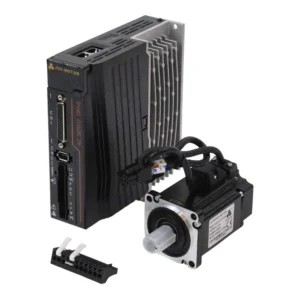
400W Servo Motor Set 60ST-M01330 T3A-L20F-RABF
Original price was: 551.83$.242.45$Current price is: 242.45$.
400 Watt Servo Motor Set 60ST-M01330 T3A-L20F-RABF. INDUSTRIAL AUTOMATION PARTS | Superior Performance Series. Detailed Product Review: The 400 Watt Servo Motor Set 60ST-M01330 T3A-L20F-RABF, offered by Mermak CNC, is designed for industrial automation projects requiring high precision.
In stock
🔥 Special for Today Only %56 Discount Opportunity!📦 Category: AC Servo Motors🏷️ Power: 0.4 kW🏷️ Operating Voltage: 220 V AC🏷️ Flange Size: 60 mm🏷️ Brake Configuration: Standard🏷️ Maximum Speed: 3000 RPM
Mermak assuranceFrom factory to end user · importer / main dealer · strong stock
ImporterMain dealer / distributorStrong stockGood priceCorporate invoice
In stock / available to order · 14-day return for standard unused products; conditions may vary for custom size/cut products.
400 Watt Servo Motor Set 60ST-M01330 T3A-L20F-RABF
INDUSTRIAL AUTOMATION PARTS | SUPERIOR PERFORMANCE SERIES
Detailed Product Review
The 400 Watt Servo Motor Set 60ST-M01330 T3A-L20F-RABF, offered by Mermak CNC, is an integrated drive solution designed to meet the precise motion control and high dynamic response requirements in industrial automation systems. This set combines a 60ST series AC servo motor with the T3A-L20F-RABF model intelligent servo drive, providing positioning accuracy at the thousandth of a millimeter level through its closed-loop control architecture. The motor’s shaft position is continuously monitored by an integrated 2500 PPR (10,000 Pulses/Revolution) incremental encoder, and this feedback is instantly transmitted to the drive. The drive compares this feedback data with reference command signals (Pulse/Direction) and utilizes advanced PID (Proportional-Integral-Derivative) control algorithms to dynamically adjust the motor’s torque from a nominal 1.27 Nm up to an instantaneous peak torque capacity of 3.8-3.9 Nm. This continuous feedback and correction mechanism ensures that the motor maintains its target position or speed without deviation, even under load variations, inertia effects, or external disturbances, thereby exceeding the performance limits of traditional open-loop stepper motor systems.
The 60ST-M01330 servo motor features a durable construction compliant with industrial standards. Its rotor and stator components are manufactured from optimized magnetic materials to ensure high efficiency and low heat generation. The motor’s bearings are industrial-grade, selected to provide long life and quiet operation even at high speeds. Thermal management operates on a natural air cooling principle, eliminating the need for additional cooling under nominal operating conditions. The T3A-L20F-RABF drive can be directly powered by a 1-Phase 220V AC mains voltage, allowing for easy integration with standard electrical infrastructure. Mechanically, the motor’s 60mm x 60mm flange size offers mounting compatibility similar to Nema 24 stepper motors, facilitating adaptation to existing systems. The 14 mm keyed shaft provides a secure and non-slip connection surface for high torque transmission. This set is an ideal solution for industrial automation applications where tolerance for error is low and millisecond response times are critical, such as medical device manufacturing, optical alignment systems, micro-machining CNC machines, high-speed labeling machines, and precision assembly robots.
Advantages of the 400 Watt Servo Motor Set 60ST-M01330 T3A-L20F-RABF
Stable Torque Performance at High Speeds and Overload Capacity: This 400W AC servo motor maintains a continuous torque of 1.27 Nm even at a nominal speed of 3000 RPM. Unlike conventional stepper motors, servo motors do not lose torque as speed increases; instead, thanks to the closed-loop control provided by the drive, the motor’s nominal torque is consistently maintained across the entire operating speed range. Furthermore, the system can instantaneously produce a peak torque of 3.8 to 3.9 Nm (approximately 3 times the nominal torque). This capability is crucial for dynamic applications requiring rapid acceleration/deceleration, for moving loads with high momentary inertia, or for overcoming unexpected mechanical binding. This minimizes the risk of motor stall or step loss, ensuring uninterrupted and efficient performance in production processes.
Closed-Loop Positioning Accuracy to the Thousandth of a Millimeter: The integrated high-resolution 2500 PPR (Pulse Per Revolution) incremental encoder converts each revolution of the motor shaft into digital signals with a precision of 10,000 pulses/revolution. The T3A-L20F-RABF servo drive uses these high-resolution feedback signals to monitor the motor’s actual position in milliseconds and instantly detect any deviation from the target position. The drive dynamically adjusts the current supplied to the motor windings to correct these deviations, achieving positioning accuracy at the thousandth of a millimeter level on the motor shaft. This closed-loop control mechanism offers indispensable performance in applications requiring zero error tolerance and high repeatability, such as optical alignment, semiconductor manufacturing, medical device assembly, or micro-machining.
Superior Power Density in a Compact Design and Easy Integration: While the 60ST series motor has physical dimensions similar to Nema 24 stepper motors with its 60mm x 60mm flange size, it exhibits superior power density by offering a nominal power of 0.4 kW (400 watts) and an instantaneous peak torque capacity of 3.8-3.9 Nm. This compact design saves space in automation panels and machine frames with limited area, while still meeting high-performance requirements. System integration is simplified by the standard 1-Phase 220V AC supply voltage and the pre-attached 3-meter power and encoder cables. This “plug-and-play” approach significantly reduces installation time and commissioning costs. Additionally, the Nema 24 compatible mounting holes allow for quick and effortless adaptation to existing mechanical designs or upgrade projects.
Technical Specifications and Capacity
FeatureValue/Description
Motor Power0.4 kW (400 Watts) – High dynamic power output despite compact dimensions.
Flange Size60mm x 60mm (60ST Series) – Mounting compatibility similar to Nema 24 stepper motors.
Nominal Torque1.27 Nm (Continuous) – Stable and reliable torque output up to 3000 RPM.
Maximum (Peak) Torque3.8 – 3.9 Nm (~3x Overload) – High resistance to momentary load changes and binding.
Nominal Speed3000 RPM (Revolutions per Minute) – Ideal performance for high-speed operations.
Shaft Diameter14 mm (Keyed Shaft) – Robust shaft connection according to industrial standards.
Drive Input Voltage1 Phase 220V AC – Easy power supply with standard household electricity.
Encoder Resolution2500 PPR (10,000 Pulses/Revolution) – Positional control with thousandth-of-a-millimeter precision.
Technical Frequently Asked Questions (FAQ)
What is the technical meaning of the T3A-L20F-RABF drive model, and how does it affect motor performance?
The T3A-L20F-RABF drive model code encodes the technical specifications and capacity of the product. “T3A” typically indicates the drive series or generation, while “L20” refers to the drive’s nominal current capacity or power class (in this case, a class suitable for a 0.4 kW motor). Additional letters like “F” and “RABF” usually denote specific drive functions, control interfaces (e.g., Pulse/Direction, analog inputs), safety features (e.g., braking resistor connection), or a software version optimized for a particular application. This drive operates in full compatibility with the 60ST-M01330 servo motor, processing feedback signals from the motor’s high-resolution encoder and sending precise current commands to the motor windings. This enables the motor to maintain its nominal torque up to 3000 RPM, produce peak torque up to 3.9 Nm, and achieve positioning accuracy at the thousandth of a millimeter level. The drive also integrates protection functions such as overcurrent, overvoltage, and encoder errors, ensuring safe and stable system operation.
What advantages does the motor’s 14 mm keyed shaft offer in terms of mechanical integration and power transmission?
The motor’s 14 mm diameter keyed shaft is an industrial standard for reliably transmitting high torques in power transmission systems. The key acts as a positive lock between the shaft and the rotating element mounted on it, such as a gear, pulley, or coupling. This locking mechanism completely eliminates independent rotation (slippage) between the shaft and the element, ensuring that the torque generated by the motor is transmitted to the load without loss. Especially in applications with high acceleration/deceleration cycles or frequent direction changes, a keyed shaft offers much superior mechanical integrity and durability compared to keyless connections. This structure increases the overall rigidity of the system, minimizes backlash, and guarantees precise and repeatable motion control even under prolonged, intensive operating conditions. It also simplifies assembly and disassembly processes and provides practicality during maintenance.
During the integration of this servo set into an industrial control panel, what technical considerations should be given to grounding and electromagnetic compatibility (EMC)?
Grounding and EMC are critical for system stability and safety during integration into an industrial control panel. The servo motor’s body and the drive’s chassis must be connected to the main grounding bar via a low-impedance path. This reduces the risk of electric shock and prevents electromagnetic noise (EMI/RFI) generated by the motor and drive, or coming from external sources, from propagating to other sensitive electronic components within the control panel. Shielded cables should be used for power and encoder cables, and these shields must be properly grounded on the drive side. Physical separation should be maintained between power cables and signal (encoder and control) cables; they should not be routed parallel to each other for long distances. If necessary, ferrite cores can be attached to the cables to suppress high-frequency noise. These measures protect the integrity of the encoder signal, ensuring the continuity of precise positioning performance and preventing the system from experiencing unexpected errors or malfunctions. Mermak CNC supplies products to the United Kingdom, United States, Canada, Australia, Ireland, New Zealand, and South Africa, as well as similar countries and international markets, ensuring compliance with global standards.
In which technical situations is the use of a planetary gearbox with a 400W servo motor necessary, and how should the gearbox be selected?
The use of a planetary gearbox with a 400W servo motor typically becomes a technical necessity when the torque required by the application is higher than what the motor can directly provide, or when the load inertia is significantly larger than the motor inertia. Gearboxes reduce the motor’s output speed and proportionally increase its torque, enabling heavier loads to be moved or higher accelerations to be achieved. When selecting a gearbox, the required reduction ratio (e.g., 1:5, 1:10) must first be determined; this ratio is calculated based on the desired output speed and torque requirements. Secondly, the gearbox’s backlash value is critical; low-backlash gearboxes should be preferred in applications requiring precise positioning, such as CNC applications. Thirdly, the gearbox’s input flange and shaft diameter must be mechanically compatible with the 60ST-M01330 motor’s 60mm flange and 14mm keyed shaft. Finally, the gearbox’s nominal torque and peak torque capacities must meet the application’s continuous and momentary torque demands. Correct gearbox selection ensures that the motor operates within its optimal efficiency and control range, enhancing the overall performance and lifespan of the system. Mermak CNC is a trusted supplier for customers in the United Kingdom, United States, Canada, Australia, Ireland, New Zealand, and South Africa, among other international markets.
| Power | 0.4 kW |
|---|---|
| Operating Voltage | 220 V AC |
| Flange Size | 60 mm |
| Brake Configuration | Standard |
| Maximum Speed | 3000 RPM |
| Torque | 1.27 Nm |
| Encoder Resolution | Incremental 2500 PPR |
You must be logged in to post a review.
Taksit Tablosu
Related Products
 %42 Discount1.8kW Servo Motor Set (110ST-M06030 + T3A-L30F-RABF)Original price was: 869.98$.503.68$Current price is: 503.68$.View
 %42 Discount750W Braked Servo Motor Set 80ST-M02430Z1 T3L-L20F-RABNOriginal price was: 757.28$.438.43$Current price is: 438.43$.View
 %42 Discount750W Servo Motor Set 80AST-A1C02430 with T3D-L20A-RABF DriverOriginal price was: 382.81$.221.63$Current price is: 221.63$.View
Reviews
There are no reviews yet.