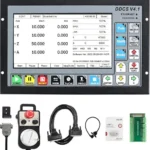
































































DDCS V4.1 CNC Control Unit 3 Axis + Handwheel
Detailed Product Review
The DDCS V4.1 CNC Control Unit is a hardware designed for industrial automation applications, capable of independently performing 3-axis motion control. This controller has the ability to read and process G-code files directly from a USB drive without dependency on an external personal computer (PC). The basic operating principle of the unit is based on the integrated architecture of the ARM9 main control chip and the FPGA (Field-Programmable Gate Array) core algorithm chip. The ARM9 processor is responsible for user interface management, G-code interpretation, file system operations, and general system coordination, while the FPGA core performs critical motion control algorithms, axis pulse generation, and real-time interpolation calculations with ultra-low latency and high deterministic performance. This discrete architecture maximizes the precision and stability of control signals, while providing up to 500 kHz pulse output for each axis, offering sub-millimeter positioning accuracy and dynamic speed control in step and servo motor systems. The system ensures that motors respond quickly and precisely with only a 4-millisecond control cycle for each positioning command.
The product’s material structure is designed to withstand harsh industrial environmental conditions; the compact and robust outer casing resists dust, vibration, and temperature fluctuations. In terms of system integration, the DDCS V4.1 offers standard industrial interfaces: 16 optically isolated digital inputs and 3 optically isolated digital outputs allow direct connection with various sensors, limit switches, and actuators. A 0-10V analog output (configurable as PWM) is available for spindle control. The integrated 4.3-inch TFT display (480×272 resolution) and 17 physical operation keys provide operators with a direct and intuitive human-machine interface. External MPG (Handwheel) support is a critical feature for precise manual movement of axes, homing operations, and fine adjustments. The unit can be used in precision machining operations such as CNC milling, router applications, metalworking, woodworking, mold making, and prototyping, as well as in automated assembly applications like electronic board placement, small part assembly, and Pick & Place systems requiring automated transport. Management of G-code files is facilitated by the built-in 1 GB memory and USB flash drive support (4GB included).
DDCS V4.1 CNC Control Unit 3 Axis + Handwheel Advantages
Independent (Offline) Operation Capability: The DDCS V4.1 control unit has the capacity to perform operations by reading G-code files directly from a USB drive, without being dependent on an external personal computer. This feature reduces system setup complexity, increases field reliability, and lowers overall system cost. Being free from PC operating system-related delays, security vulnerabilities, and sensitivity to environmental factors (dust, vibration) allows the controller to exhibit more stable and deterministic performance. This independence minimizes the risk of electromagnetic interference (EMI) in industrial environments and supports production line continuity, as situations like external computer failure or software conflicts do not interrupt the production process.
High-Precision Motion Control with Advanced ARM+FPGA Architecture: The unit’s architecture is built upon the strategic combination of an ARM9 main control chip and an FPGA core algorithm chip. While the ARM9 processor handles high-level tasks such as G-code interpretation, user interface management, and file system operations, the FPGA processes critical motion control algorithms, axis pulse generation, and real-time interpolation at the hardware level, in a parallel and deterministic manner. This separation ensures that critical motion control signals are generated at frequencies up to 500 kHz with a control cycle of only 4 milliseconds. This high pulse output frequency and low latency allow for very fast and millimeter-precise positioning of step and servo motors, thus ensuring stability…